
1950s Icons of Style & Cinema · No. 4
Jane Russell
A six-foot brunette from Bemidji, Minnesota — who weathered the most notorious wardrobe scandal in studio history, founded the first international adoption agency, and quietly proved that bombshells could think.
21 June 1921 — 28 February 2011
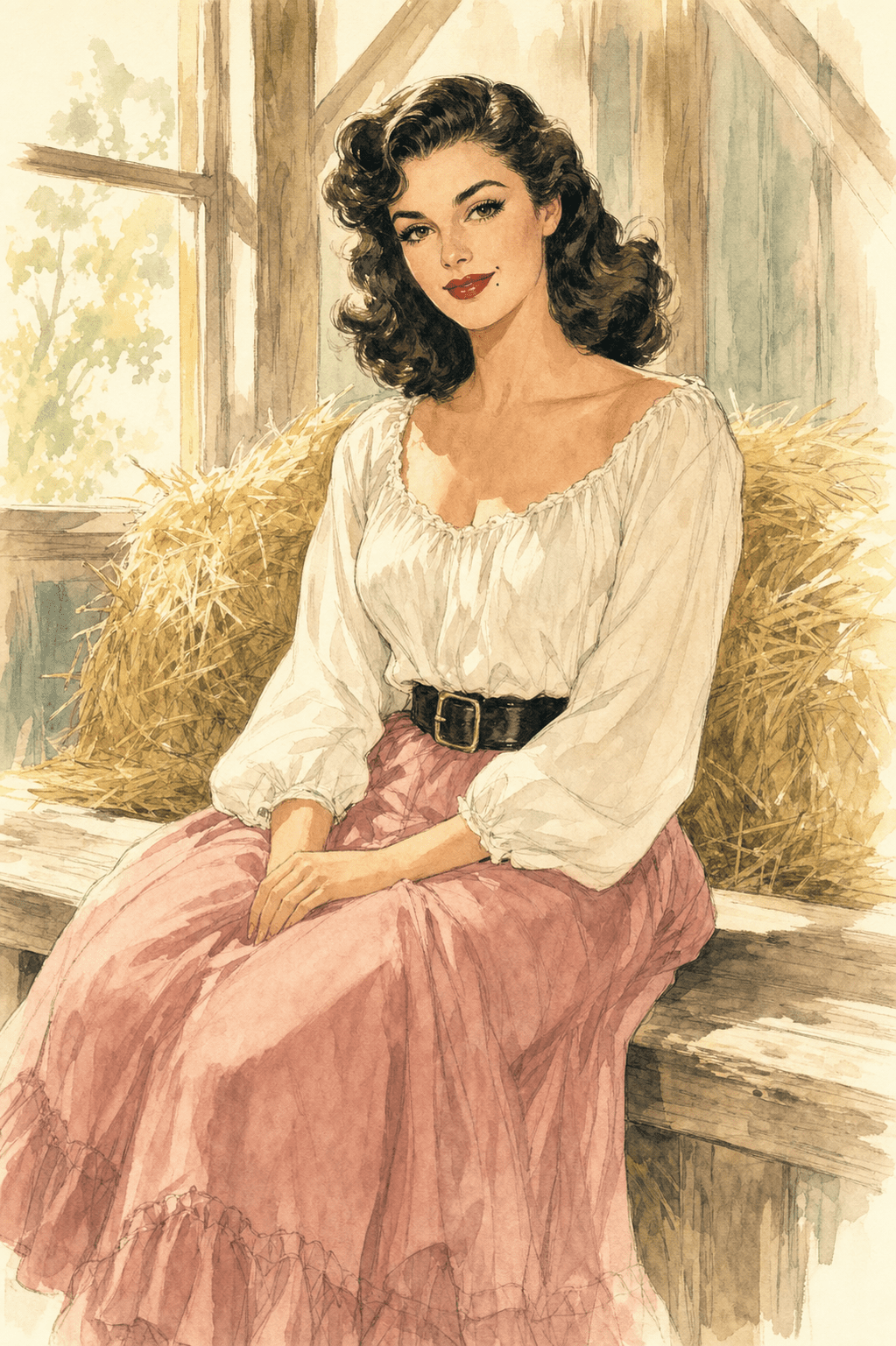
The Outlaw, 1943. Hughes spent six years and untold sums on a Western no one was allowed to watch — and on the brassiere he said it required. Russell wore neither the engineered bra nor the scandal he tried to wrap around her.
Part OneThe Receptionist Who Wouldn’t Be Built
She was working at Tom Kelley’s photography studio for ten dollars a week when Howard Hughes’s casting net dragged her in. Within a year she was the most photographed unknown in America.
rnestine Jane Geraldine Russell was born on 21 June 1921 in Bemidji, Minnesota — a logging town near the Canadian border so cold that her mother, Geraldine, decamped to California within months. The family settled in the San Fernando Valley before the Valley was anything but orange groves and dust. Geraldine was a former stage actress turned strict Methodist who taught her four sons and one daughter to read the Bible, ride horses, and never lie. The future studio bombshell grew up in jodhpurs and braids, the only girl in a household of brothers who treated her like a sixth boy.
At Van Nuys High she was tall — already touching six feet — and shy about it. She stooped. She slumped at her desk. After graduation she took a receptionist job at a chiropodist’s office, then drifted to a photographer’s studio, where the boss, Tom Kelley — the same Tom Kelley who would later shoot Marilyn Monroe’s red-velvet nude in 1949 — passed her test shot up the chain.
It landed on Howard Hughes’s desk. The aviator-tycoon-producer was casting his Western The Outlaw and had specified a single requirement: a brunette with a 38-inch bust. Russell, 19, was summoned. The screen test ran ten minutes. She got the part and a seven-year contract at $50 a week. Then, for six years, she sat. Hughes shot the film in 1941, recut it endlessly, fought the censors, and didn’t release it widely until 1946. During those six years he plastered her image across America — billboards of her reclining in a haystack with the tagline “Mean. Moody. Magnificent.” — without letting anyone actually see her in a movie. By the time The Outlaw opened, the country had been staring at Jane Russell longer than at any actress in history.
The image — and the legend that grew around it — concerned a brassiere. Hughes, an aeronautical engineer by training, decided Russell’s natural figure needed structural reinforcement under her loose peasant blouse. He spent days at the studio working with the wardrobe department on what was, by his account, an aerodynamically calculated cantilevered bra. He presented it to her. She tried it on. It was, she later wrote, “uncomfortable and ridiculous.” So she went into her dressing room, stuffed her old bra with tissues, tightened the straps, smoothed the seams, came out on set, and wore that for every shot. Hughes never noticed. The press, fed by Hughes’s own publicity machine, ran the brassiere story for decades.
“I never wore it in a thousand years,” Russell said flatly in 1987. “I just told him I did.”
It is the single most revealing fact about her: at nineteen, with no power and no profile, she found the most famous engineer in America had designed her underwear, and she lied to his face for six years rather than wear it. The bombshell was always quietly running the studio. Hughes just thought he was.
She could be photographed beautifully. She could not be photographed accurately.— Bosley Crowther, The New York Times, 1948
✦ ✦ ✦
Part TwoTwelve Things You Didn’t Know About Jane
A working-class Methodist who hosted a Hollywood Bible study, conducted in her own living room, that Marilyn Monroe occasionally attended.
She was 5′7″ — but everyone said 5′9″.
The studio padded her height for the bombshell mythology. She wore flat shoes through most of Gentlemen Prefer Blondes to keep from towering over Marilyn, who was 5′5½″.
Her first paying job was as a chiropodist’s receptionist.
She filed corn-removal records for $10 a week before Hughes’s people found her, and used the office’s telephone to call agents on her lunch break.
She founded the first international adoption agency in America.
After a 1942 botched abortion left her unable to bear children, she and her husband Bob Waterfield adopted three. In 1955 she founded WAIF (the World Adoption International Fund), which has since placed more than 51,000 children in homes.
She personally lobbied Congress.
She co-drafted the Federal Orphan Adoption Amendment of 1953 — the law that allowed foreign-born children of American servicemen to be brought home for adoption. She testified before House subcommittees seven times between 1953 and 1990.
She ran a Bible study group in her living room.
The “Hollywood Christian Group” met weekly through the 1950s. Regulars included Roy Rogers, Dale Evans, Connie Haines, and Beryl Davis. She invited Marilyn Monroe, who declined: “Jane tried to convert me, and I tried to introduce her to Freud.”
She married a quarterback.
Her high-school sweetheart Bob Waterfield played for the Cleveland Rams and L.A. Rams, won an NFL championship in 1945, was league MVP twice, and was inducted into the Pro Football Hall of Fame in 1965. Their marriage lasted twenty-five years.
She formed her own gospel quartet.
“The Four Girls” — Russell, Connie Haines, Beryl Davis and Della Russell (no relation) — performed Christian standards at the Cocoanut Grove and recorded an album for Capitol Records in 1954 that hit Billboard’s top 30.
Her shoe size was 8½.
She wore the same Ferragamo pumps she’d bought in 1948 to her 90th birthday party.
She turned down the lead in Niagara.
Fox offered it to her first; she said no because the script “had nothing for the woman to do except faint and look frightened.” It went to Marilyn instead and made her a star.
She was paid more than Marilyn.
For Gentlemen Prefer Blondes, Russell received $200,000 — five times Monroe’s $50,000 — because her RKO contract had a much steeper rate than Marilyn’s Fox deal. Marilyn never forgot, and never resented her for it.
Her hand and footprints sit beside Marilyn’s at Grauman’s.
They pressed them in wet cement together on 26 June 1953. Marilyn wanted to add a diamond from her ring to dot the “i”; Sid Grauman talked her out of it.
Her last performance was on a London stage at age 78.
She sang “I’m Always Chasing Rainbows” at the Garrick Theatre in 1999, accompanied by a five-piece band. She got two standing ovations and a marriage proposal from the audience.
✦ ✦ ✦
Part ThreeThe Three Looks That Built a Bombshell
Russell never sat for a fashion designer the way Audrey sat for Givenchy or Marilyn sat for Travilla. Three costumes did the work — one wholesome, one engineered, one outrageous.
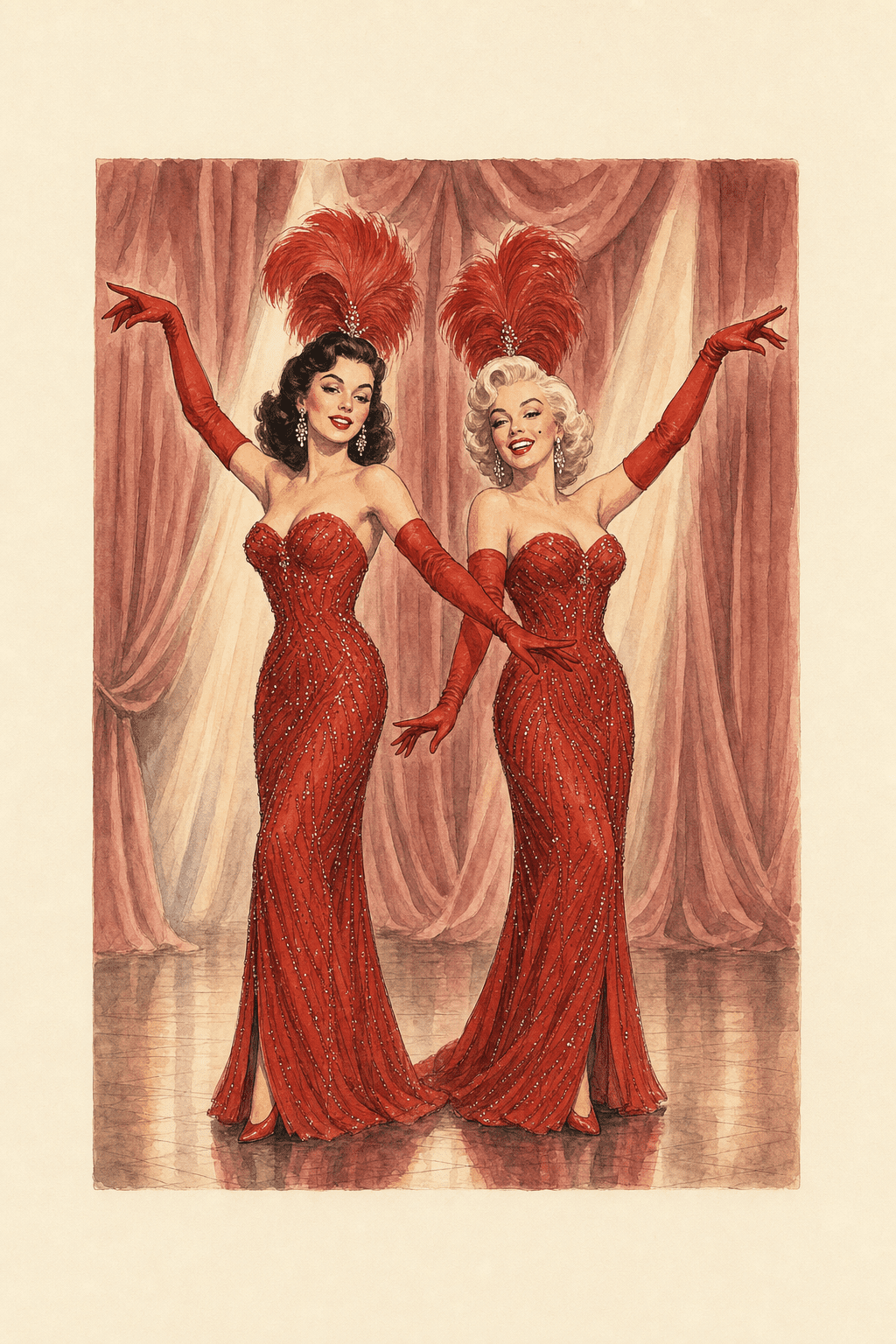
Two Little Girls from Little Rock, 1953. Travilla designed twin crimson-bugle-beaded sirens for Russell and Monroe — fitted to the millimetre and weighing roughly six pounds each. Russell’s version sold at auction in 2018 for $43,750; Marilyn’s identical one for $250,000. The market knew, even then, who the headliner was.
Costume designer William Travilla built the gowns for Gentlemen Prefer Blondes’s opening number from a single bolt of crimson silk faille, hand-embroidered with thousands of red bugle beads applied bead by bead by the Fox seamstresses over three weeks. The silhouette was identical for both women, but cut differently: Russell’s was tailored to a longer, narrower torso; Marilyn’s gathered the hip an inch higher to flatter her shorter frame. The matching feathered headdresses were made by the Hollywood specialist Reza, each plume hand-stripped and dyed.
Russell’s gown was the test piece. Travilla fitted her first and adjusted from there. When the cameras rolled on the opening shot — the curtain parting, the two girls stepping forward, the chorus blasting “We’re just two little girls from Little Rock” — what audiences saw was Russell and Monroe as visual equals. It was the only sustained moment in 1950s cinema where the brunette stood beside the blonde and was not subordinate to her. The shot is still studied in costume-design classes as a masterclass in how to dress two stars at once without making one of them disappear.
The Hay-Bale Peasant
The Outlaw · 1943 · Wardrobe Dept.
The off-the-shoulder peasant blouse, wide leather belt and long full skirt Russell wore in Hughes’s Western became the template for every “Wild West heroine” silhouette for the next thirty years — and the prototype, via Brigitte Bardot in And God Created Woman, for the entire 1950s gathered-blouse craze.
The Lookin’-for-Trouble Suit
The French Line · 1954 · Howard Greer
A one-piece sequinned bodysuit with strategic jewel cutouts at the waist, designed by Howard Greer to replace Hughes’s original — a flat-out bikini, which the Production Code would never have passed. The film was condemned by the Catholic Legion of Decency. It made $3 million anyway.
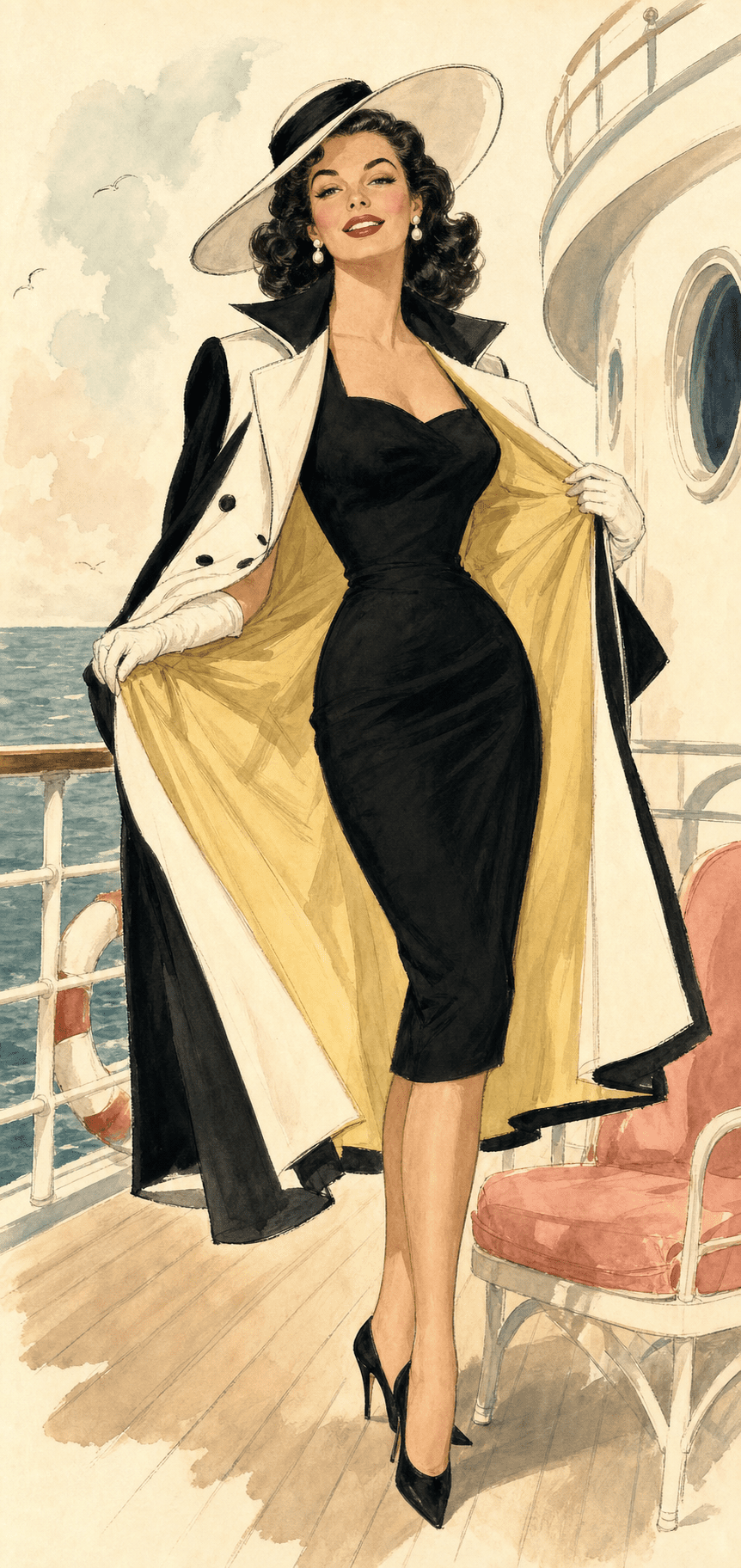
The Yellow-Lined Coat, 1953. A throwaway publicity-shot moment in Gentlemen Prefer Blondes that turned into the era’s most pirated silhouette: monochrome on the outside, butter-yellow on the inside, swung open like a magic trick. Inspired a decade of contrast-lined opera coats.
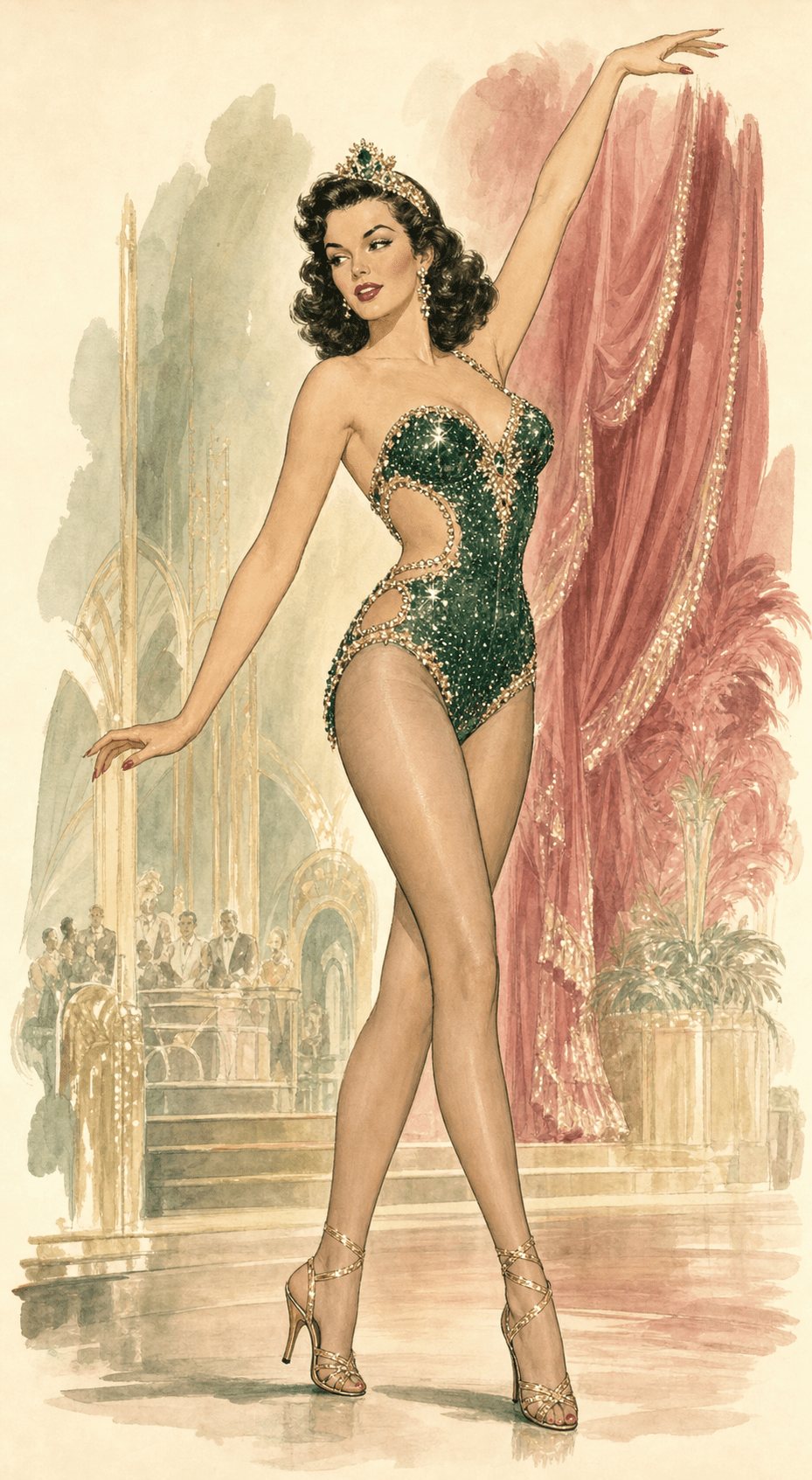
“Lookin’ for Trouble”, 1954. The bodysuit Howard Greer made when Russell refused Hughes’s original bikini. The Catholic Legion of Decency condemned the film “without reservation”; the public bought $3 million worth of tickets in six weeks. Russell shrugged.
✦ ✦ ✦
Part FourHow She Built the Jane Look
She didn’t have Marilyn’s voice. She had Marilyn’s exact opposite: a low, dry, mid-Atlantic alto with a Methodist sense of humour underneath.
The Hair
Worn shoulder-length, parted on the side, set in a heavy soft wave that she pinned herself at home. She refused the studio’s tight Veronica Lake-style finger waves and made the wardrobe department teach her how to roll her own pin curls. By 1953 she was doing her own hair on set, even in Gentlemen Prefer Blondes, while a full studio team did Marilyn’s.
The Face
Heavy dark brow, defined with a single pencil stroke rather than the plucked-then-redrawn arch other stars used. A red lip — Max Factor’s “Russell Red” was made for her in 1947 and stayed in the line until 1969. Almost no eye shadow. The beauty mark above her right lip was real. She kept it.
The Body
The studio measured her at 38-26-36 in 1941 and reprinted those numbers until 1965 — long after they were accurate. Russell’s actual response to the obsession with her measurements was to start jogging on the back lot before it had a name, lift weights with her quarterback husband, and at 79 publicly admit she’d been a recovering alcoholic for two years. She refused, throughout her life, to pretend her body was an accident.
The Voice
A clipped, dry, low alto — closer to a Bryn Mawr graduate than a Hollywood bombshell. She could deliver a punchline like Bacall and a hymn like Mahalia Jackson. The combination — sex-symbol body, deadpan voice, sincere Christian faith — was unprecedented in 1950s cinema, and audiences couldn’t quite categorise her. It is why her star never burned out the way Marilyn’s or Jayne Mansfield’s did. She wasn’t a category. She was a woman.
✦ ✦ ✦
Part FiveThe Jane Russell Timeline
✦ ✦ ✦
Part SixHow Jane Russell Changed the World
The bombshell who refused to be only a bombshell — and quietly rewrote what was possible for the women who came after her.
She gave the bombshell a brain.
Before Russell, the Hollywood sex symbol was Mae West, Harlow, Lana Turner — built for innuendo, written for one note. Russell played her sexuality straight and her irony drier than any of them. She showed that a woman could be looked at without becoming what she was looked at as.
She invented the modern adoption movement.
WAIF wasn’t just an agency — it was the legal and political vehicle that allowed Americans to adopt children from overseas at all. Every Korean, Vietnamese, Romanian and Russian adoption since 1953 traces back to legislation Russell helped draft and personally walked through Congress.
She normalised the full figure.
The Playtex commercials of the 1970s — “for full-figured gals like me” — were the first time mainstream American television featured an unapologetic plus-12 silhouette. Her ads ran for fifteen years and rewrote what bra advertising looked like for a generation.
She made the peasant blouse a fashion staple.
Russell’s costume in The Outlaw was lifted, almost line for line, by every Western and pin-up illustrator of the 1950s. By 1956 the off-the-shoulder peasant blouse was a Sears catalogue mainstay. It is still a fashion archetype.
She held her own beside Marilyn.
When Gentlemen Prefer Blondes was previewed in May 1953, Howard Hawks worried Marilyn would overshadow Russell. She didn’t. Russell got the better notices (“the picture’s anchor” — Variety) and the bigger paycheque. She made the room for Marilyn to be Marilyn without disappearing herself.
She broke the Production Code, twice.
The Outlaw and The French Line were two of only a handful of major studio releases of the 1940s and 50s to be released without a Production Code seal. Both made money. The Code never recovered.
She refused to hide her faith — or her doubts.
Russell hosted a Bible study attended by the biggest stars in Hollywood and was a public Christian, but she also said the things Hollywood Christians weren’t supposed to say: she’d had an abortion, she’d been an alcoholic, she’d married three men. She separated faith from sanctimony in a way American religious culture is still catching up to.
She gave women permission to grow old loudly.
At 79 she went to rehab and told a reporter about it. At 85 she gave an interview describing herself as “a teetotal, mean-spirited, right-wing, narrow-minded, conservative Christian bigot — but not a racist.” It was, characteristically, exactly half-joke. The bombshell at the end was still the same person who lied to Howard Hughes about a brassiere at nineteen.
✦ ✦ ✦
Coda
The Other Girl from Little Rock
On 26 June 1953, two women in matching white blouses knelt in wet cement in the forecourt of Grauman’s Chinese Theatre on Hollywood Boulevard. Sid Grauman handed them each a small wooden trowel. They pressed their hands and feet into the squares — Marilyn’s slightly smaller, Jane’s slightly larger — and signed their names beside them in spidery script.
When the ceremony was over the photographers asked Marilyn for a quote. She said something soft about being honoured. They asked Jane the same question. She looked at the wet cement, then at the photographers, then at Marilyn, and said:
“This is the only Hollywood thing I’ve ever done that I think will outlast me.”
She was wrong. WAIF has placed 51,000 children. The peasant blouse is still in the Sears catalogue. The Cross-Your-Heart bra is still sold at every Walmart in America. And every time a tall woman straightens up in a doorway and walks in without apologising for taking up the room, she is — whether she knows it or not — the other girl from Little Rock.
✦ ✦ ✦
1950s Icons of Style & Cinema · No. 4 · Jane Russell · Original watercolour illustrations in mid-century Hollywood portrait style · 2026




Leave a Comment