
1970s Men’s Fashion · A Complete Style Dossier
1970s Men’s Fashion:
The Six Tribes That Defined a Decade
The disco gods, the free spirits, the glam aliens, the punks, the leisure-suited and the impeccably tailored — plus the designers, the icons, and the golden age of the moustache.
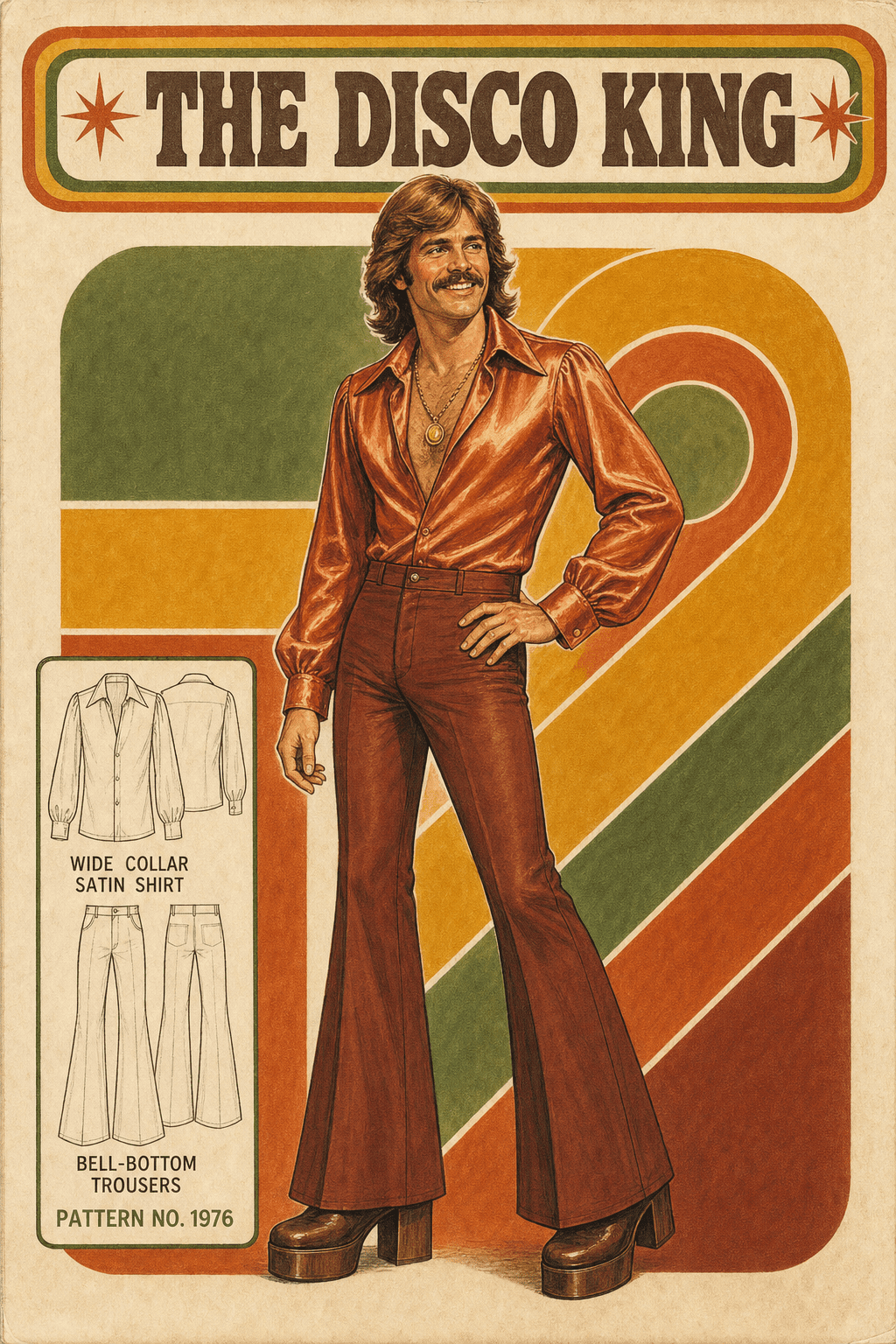
The Disco King — the face of 1970s men’s fashion. Pattern No. 1976: wide-collar satin shirt, bell-bottom trousers, platform shoes. The look that made Saturday night a sacred ritual.
Editor’s Note
Permission Granted
How 1970s men’s fashion gave an entire generation the right to be loud
If the 1960s cracked the door open, 1970s men’s fashion kicked it off the hinges. This was the decade men decided that clothes could be loud, hair could be long, chests could be bare — and absolutely nobody was going to apologise for any of it. It was the era of the “Peacock Revolution” in full bloom: the idea, radical at the time, that men were allowed to be as colourful and flamboyant as the birds.
What makes 1970s men’s fashion so endlessly fascinating is that it was never one look. It was a glorious, contradictory pile-up of them. You could be a disco god in satin, a denim-clad free spirit, a corporate man in baby-blue polyester, a glitter-covered rock alien, or a safety-pinned punk threatening the establishment — sometimes all on the same city block. Here are the six tribes of Seventies menswear, the legends who led them, and every wonderfully ridiculous detail in between.
✦ ✦ ✦
No. 01 · 1970s Men’s FashionThe Disco KingSatin, gold chains & the mirror-ball gospel
970s men’s fashion had many faces, but this is the one most people picture first. Born in the sweaty, mirror-balled clubs of New York — Studio 54 chief among them — and fired into the global imagination by John Travolta in Saturday Night Fever (1977), the disco look was pure peacock confidence made flesh.
The uniform of disco-era 1970s men’s fashion: a wide-collar satin shirt unbuttoned to the navel, a gold chain on a tanned chest, high-waisted bell-bottoms cut tight on the thigh and exploding at the ankle, and platform shoes for those extra commanding inches. Synthetic was the point — silky Qiana nylon caught the light beautifully on the floor in a way natural fibres simply couldn’t.
Travolta’s white three-piece gave rise to the legendary “medallion man” — droopy moustache, shirt open to the waist, flares so tight they were practically structural. It remains the single most-imitated look from the entire decade.
On a packed floor, an extra few inches of platform meant you could actually see — and be seen.
Did You Know
Those platforms weren’t just for height. With soles 2–4 inches thick, they kept those dramatic wide-leg flares from dragging on the dance floor — pure function dressed up as pure attitude.
✦ ✦ ✦
No. 02 · 1970s Men’s FashionThe Free SpiritHippie idealism, mellowed into earthy cool
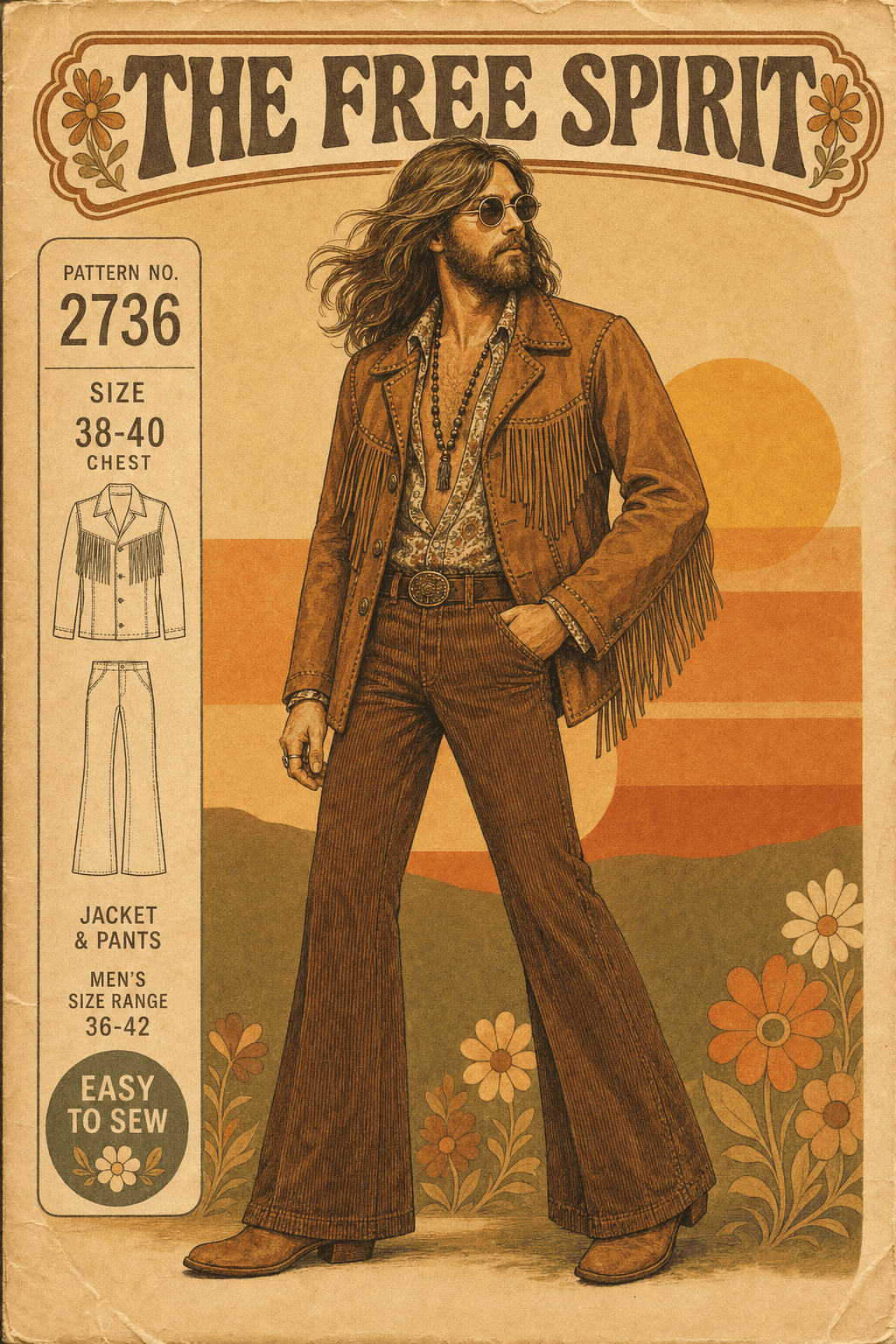
The Free Spirit — the bohemian face of 1970s men’s fashion. Pattern No. 2736: fringed suede jacket & corduroy flares. Easy to sew. Even easier to wear to a festival.
The hippie ideals of the late Sixties didn’t die when the calendar turned — they mellowed, grew a beard, and walked straight into the new decade to become one of 1970s men’s fashion’s most enduring tribes. The early-Seventies man embraced a soft, handmade, earthy aesthetic that looked like he’d wandered in from a festival, because he probably had.
Think fringed suede jackets, embroidery, patchwork, crochet vests, beaded necklaces, round wire-rimmed sunglasses, and flared corduroy in brown, tan, rust and olive. Designers leaned into the romance of the past — prairie influences, Victorian touches, anything handcrafted. In a decade of synthetic excess, the Free Spirit chose natural fibres and handwork as a deliberate counter-statement.
This was also where 1970s men’s fashion quietly blurred lines that had never been blurred before: tight tees, jeans, shirts and sweaters were now worn by men and women alike, sharing the same rails at the same shops. Fashion had reached a new level of gender equality, particularly in informal wear.
It looked like he’d wandered in from a festival — because he probably had.
✦ ✦ ✦
No. 03 · 1970s Men’s FashionThe Leisure SuitPolyester’s finest — and most photogenic — hour
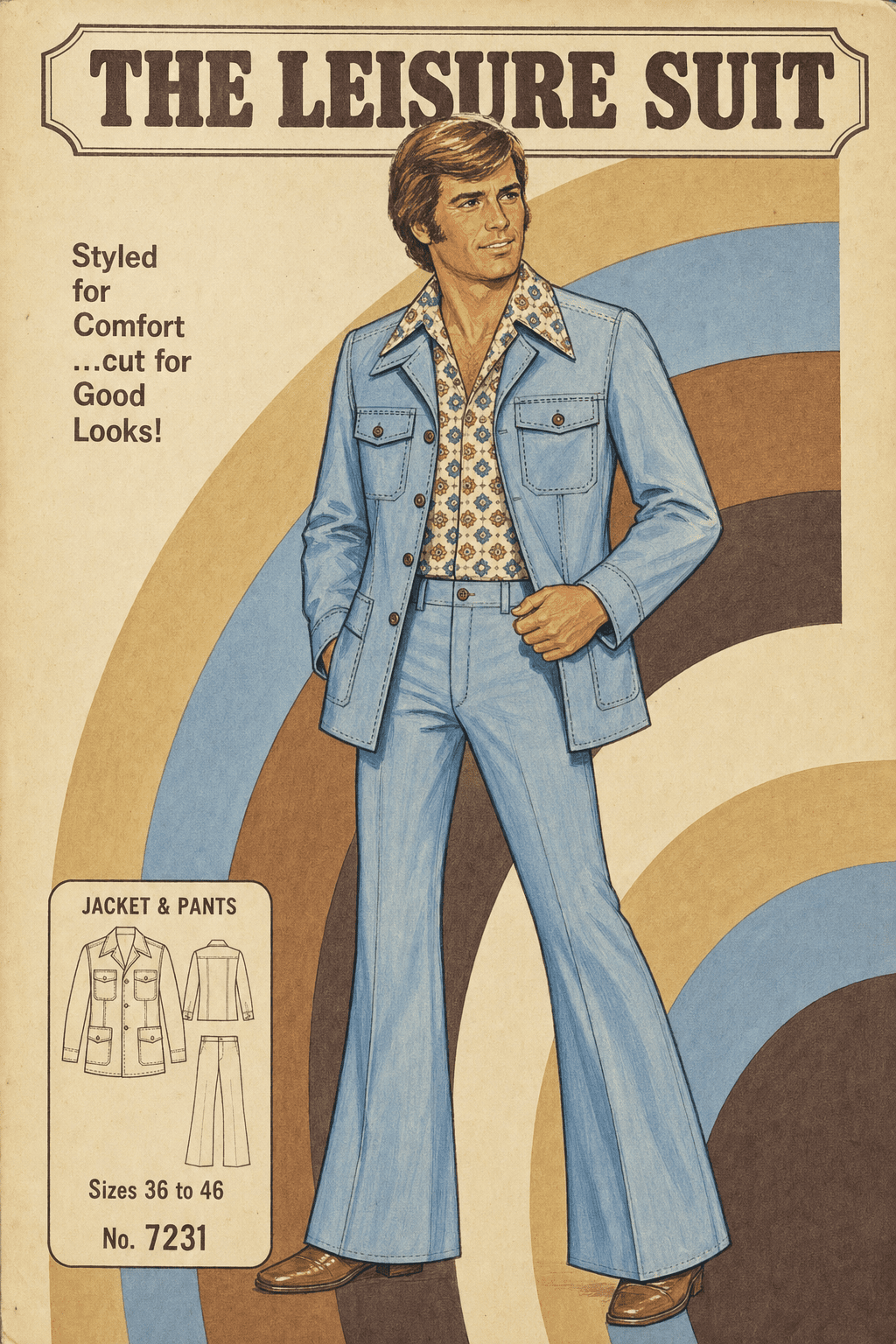
The Leisure Suit — the democratising force of 1970s men’s fashion. No. 7231: jacket & pants in matching polyester. Styled for comfort… cut for good looks!
No garment in the entire history of 1970s men’s fashion is more gloriously, hilariously of its moment than the polyester leisure suit. A matching shirt-style jacket and trousers — usually in pastel blue, tan, cream or unforgettable burnt orange — it answered a very Seventies question: what if a suit, but comfortable, washable, and impossible to wrinkle?
Its genius was social mobility: cheap enough for everyone, smart enough for the office, casual enough for the bar afterward. The leisure suit peaked mid-to-late decade and crashed spectacularly by the early Eighties — which is exactly why it’s now the universal shorthand for Seventies kitsch. No other single garment captures the optimistic, slightly naïve spirit of 1970s men’s fashion quite so completely.
Honourable mention: the Safari Suit. A close cousin — the belted, light-coloured safari suit with big patch pockets — was made effortlessly cool by Roger Moore’s James Bond, who wore his so often that fans crowned him “king of safari jackets.” Both the leisure suit and the safari suit represent a uniquely Seventies idea: that men could be comfortable and stylish at exactly the same time.
Kitsch Turned Cool
Wear a leisure suit ironically today and you’re a legend; wear one sincerely and you’re a time traveller. Either way, it is the most identifiable piece of 1970s men’s fashion on any vintage rail.
✦ ✦ ✦
No. 04 · 1970s Men’s FashionThe Glam RockerGlitter, androgyny & permission to be beautiful
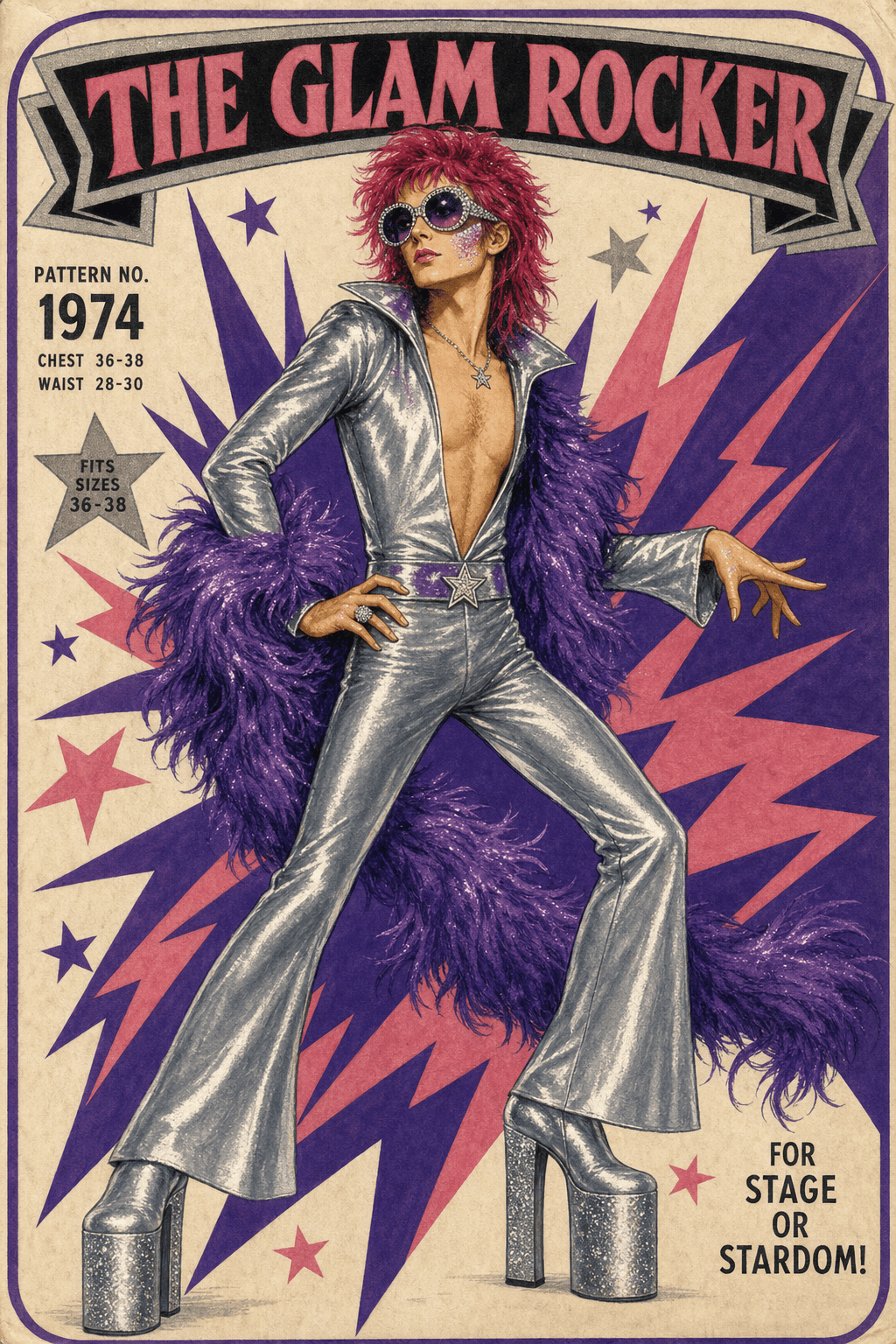
The Glam Rocker — the most theatrical tribe in 1970s men’s fashion. Pattern No. 1974: silver catsuit, purple feather boa, glitter platform boots. For stage or stardom!
If disco was the populist face of 1970s men’s fashion, glam rock was its avant-garde. Centred in the UK and built on unapologetic theatricality, this was the most fearless menswear the mainstream had ever seen — and its high priest was David Bowie.
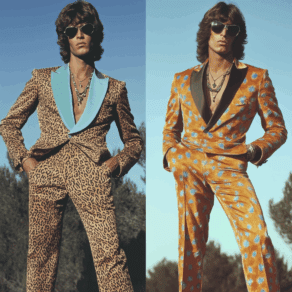
As his alter ego Ziggy Stardust, Bowie dressed like an alien rock messiah: skin-tight catsuits, fire-red hair, full makeup, glitter, metallics and animal print. Alongside him stood Marc Bolan of T. Rex and a young Freddie Mercury, each pushing 1970s men’s fashion further into territory previously considered impossible for mainstream male dressing.
The glam wardrobe: satin jumpsuits, velvet jackets, oversized collars, silk scarves, feather boas worn with no regard for matching, and towering platform boots. Even the manliest men started wearing eyeliner. Bowie’s later “Thin White Duke” phase swapped glitter for sharp tailoring — making him one of the few figures to lead two completely distinct trends within a single decade of men’s fashion.
He gave men permission to be beautiful.
✦ ✦ ✦
No. 05 · 1970s Men’s FashionThe PunkAnarchy in the UK — dressed to shock
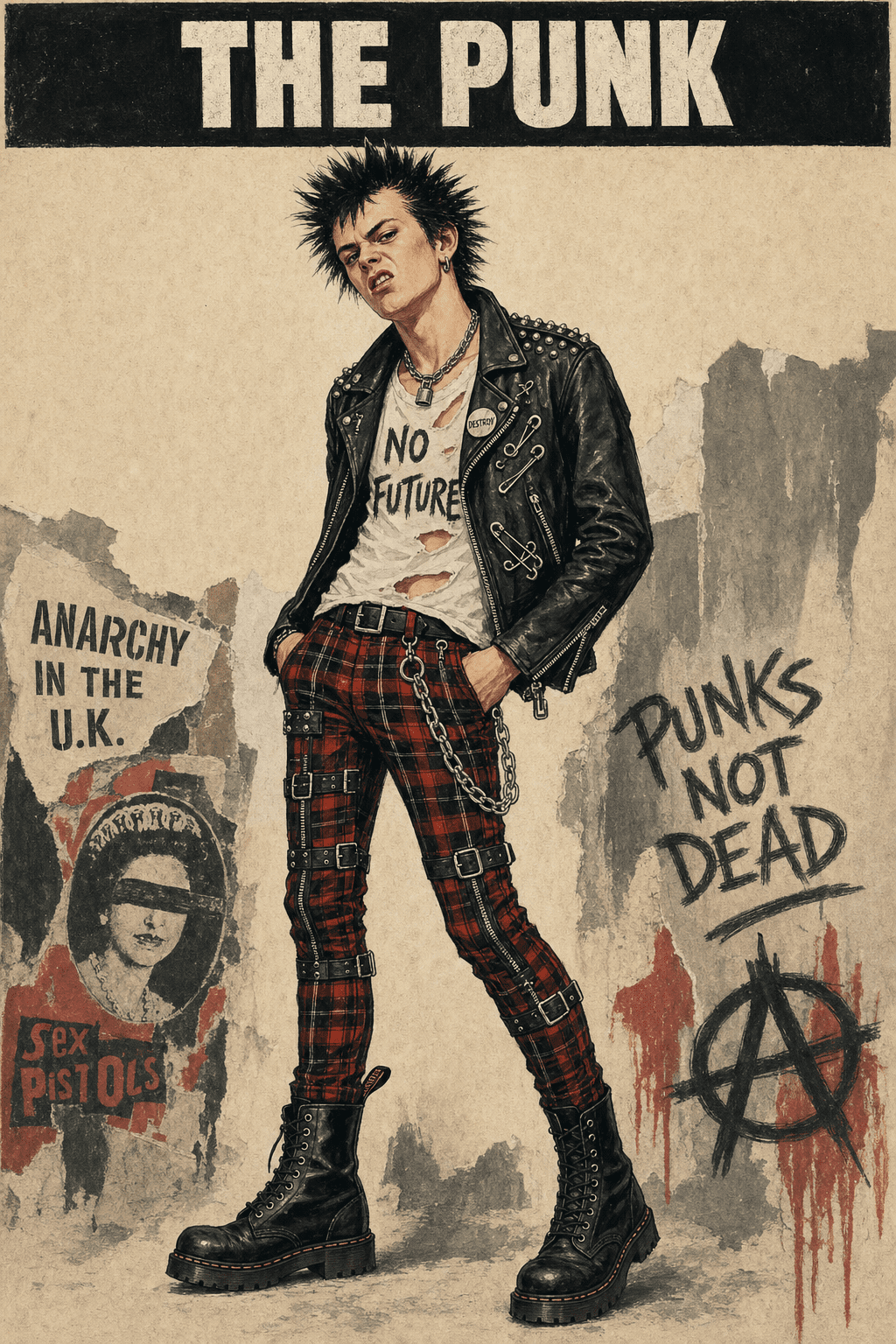
The Punk — the rebellious counter-tribe of 1970s men’s fashion. Studded leather, tartan bondage trousers, safety pins, Dr Martens. Not for sale — made at home, from rage and a pair of scissors.
By the late Seventies, a furious antidote to the disco glitz and hippie peace-and-love of early-decade men’s fashion erupted out of London. Punk rebelled against everything — high society and the hippies alike — and it dressed to shock. In doing so, it became the most politically charged men’s fashion movement the twentieth century had produced.
Designer Vivienne Westwood and partner Malcolm McLaren — who also managed The Sex Pistols — were punk’s style architects, dressing disaffected youth from their notorious London shop on the King’s Road. They turned 1970s men’s fashion into a weapon.
The look was deliberately destroyed: studded leather jackets, slogan tees, tight tartan bondage trousers, ripped clothing held with safety pins, and Dr Martens boots. Accessories were made from padlocks, chains, even razor blades. Fans didn’t buy the look — they made it, slashing thrift-shop clothes to match the band. It was, and remains, the only major style movement in men’s fashion that explicitly demanded you not spend money on it.
DIY Ethos
Punk was the first major men’s fashion style you were supposed to make yourself. Buying it ready-made rather missed the point.
✦ ✦ ✦
No. 06 · 1970s Men’s FashionThe Tailored GentWide lapels, kipper ties & quiet cool
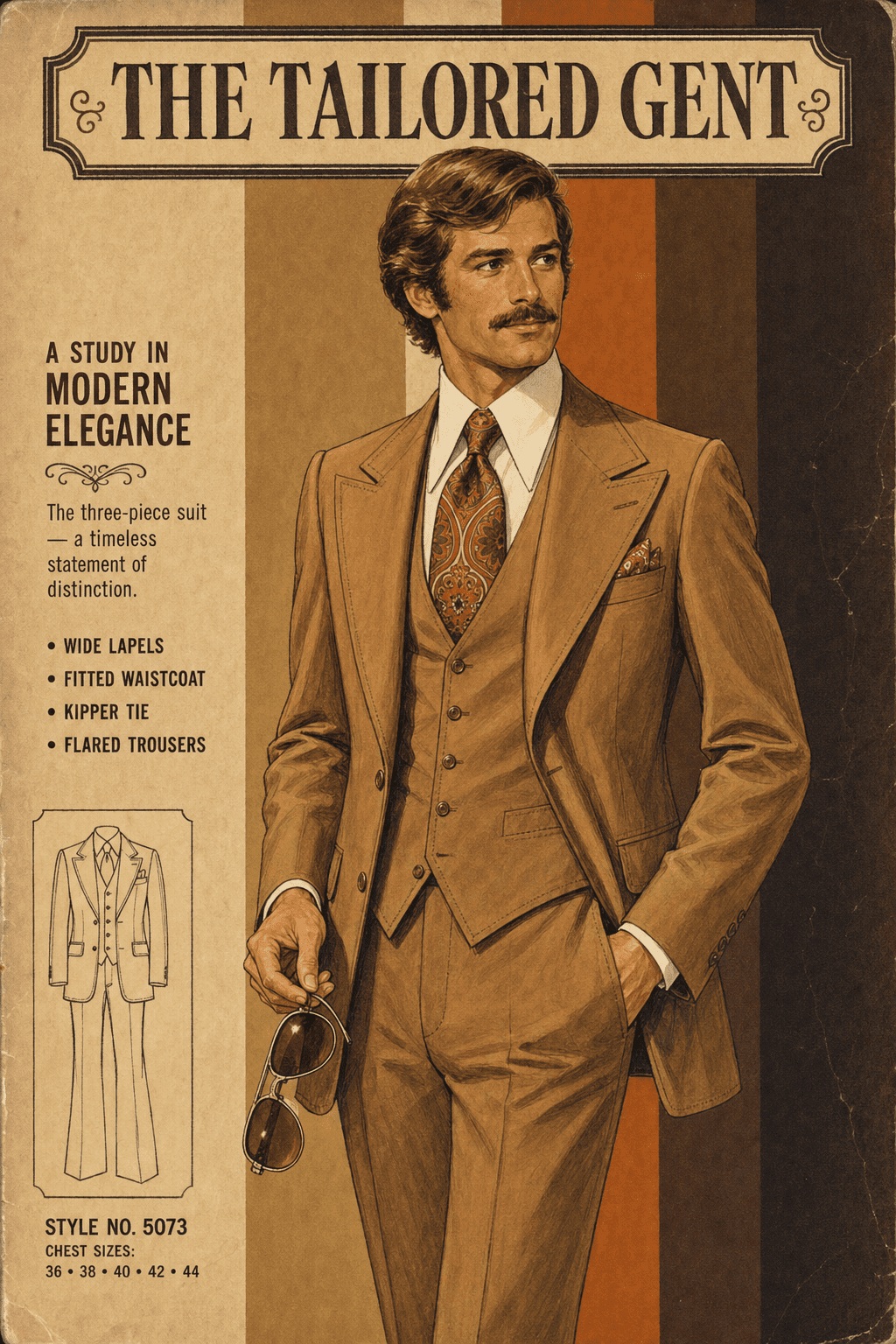
The Tailored Gent — the refined face of 1970s men’s fashion. Style No. 5073: wide lapels, fitted waistcoat, kipper tie, flared trousers. A study in modern elegance.
Not every Seventies man was on a dancefloor or a stage. For the sophisticated set, 1970s men’s fashion produced some of the most confident tailoring in the entire history of menswear. The silhouette aimed for tall and lean: nipped waists, lapels you could land a plane on, wide kipper ties, big-collar shirts and fitted three-piece suits cut to maximise the impression of height.
The icons were the embodiment of cool: Paul Newman, Steve McQueen, Robert Redford, and Italian industrialist Gianni Agnelli, the original sprezzatura master whose ability to wear expensive clothes as though he’d grabbed them off a chair defined the aspirational ceiling of 1970s men’s fashion. On the rock side, Mick Jagger played against the OTT crowd by going understated — fitted white tees, fedoras, velvet tuxedoes.
The era widened as it aged. By the late Seventies, double-breasted suits with broader shoulders crept in, setting the stage for the power-shouldered Eighties. The Tailored Gent of 1979 looks remarkably close to the Tailored Gent of 1985 — a reminder that great 1970s men’s fashion was always forward-looking, even when it seemed conservative.
Lapels you could land a plane on.
✦ ✦ ✦
Behind the Scenes
The Designers Who Built 1970s Men’s Fashion
1970s men’s fashion didn’t just change what men wore — it changed how fashion worked
Yves Saint Laurent
Launched YSL Rive Gauche, smashing the old made-to-measure model and pioneering “mix-and-match separates” — a younger, more democratic approach to men’s fashion that the entire industry would eventually follow.
Halston
The king of effortless American glamour and the face of the Studio 54 set. His minimalist approach proved that 1970s men’s fashion could be just as sophisticated as anything Paris had to offer.
Calvin Klein
Rose from a humble “coat and dress” manufacturer into a defining name of modern American sportswear — establishing a template for casual men’s fashion that endures to this day.
Westwood & McLaren
Weaponised clothing as political rebellion and invented the punk wardrobe wholesale. Their King’s Road shop was the most influential single retail space in the history of British men’s fashion.
The influence of 1970s men’s fashion never really left. Its sleek silhouettes have been revived again and again by Tom Ford and Hedi Slimane — proof that Seventies style was ahead of its time, not behind it.
The Finishing Touch1970s Men’s Fashion Grooming: The Hair Was the OutfitYou couldn’t pull off any of these looks with a short back and sides
The Shag
Layered, choppy, unstructured and effortlessly cool, the shag cut was the defining hairstyle of 1970s men’s fashion. David Cassidy made it a teen sensation on The Partridge Family; Roger Daltrey gave it rock grit; Paul McCartney wore it through his post-Beatles years. It complemented every tribe — soft enough for the Free Spirit, textured enough for the Glam Rocker, relaxed enough for the Tailored Gent.
Long & Flowing
Long hair on men went fully mainstream in the 1970s, normalised by Robert Plant, Mick Jagger and Björn Borg — a direct challenge to the old ideas of masculinity that had dominated men’s fashion since the Victorian era. The Afro was a bold, proud, sculptural statement worn by Black men and women as a political as much as an aesthetic choice. And for the first time, men and women visited the same unisex salons for the same shag cuts — another small revolution that 1970s men’s fashion quietly delivered.
Facial Hair: The Golden Age of the Moustache
If one grooming choice screams 1970s men’s fashion above all others, it’s the thick, lush moustache — the horseshoe, the full beard, the sideburns creeping down to the jaw. For a brief, glorious moment, the more facial hair you had, the more confident and masculine you appeared. A Burt Reynolds, a Tom Selleck, a Freddie Mercury — each wore facial hair as a signature as deliberate and constructed as any piece of clothing. It was a decade where a man’s moustache could enter a room before he did.
✦ ✦ ✦
Wear It NowHow to Wear 1970s Men’s Fashion TodaySix modern-friendly moves to channel the decade without wearing a costume
The best news about 1970s men’s fashion is that its most wearable elements have never really left the shops — they just cycle back under different names. Here’s how to channel each tribe without committing fully to fancy dress.
Flares & wide-leg trousers
The most direct nod to 1970s men’s fashion. Back in a big way — just keep the rise high and the break clean.
A wide-collar printed shirt
Open one more button than you normally would. That’s the whole trick.
Suede or corduroy in earth tones
The easiest, most wearable Seventies reference. Instant Free Spirit without the fringe.
A camel or chocolate three-piece
Slightly wider lapel than modern tailoring. Timeless, never costume-y.
Aviators + a chunky boot
The punctuation marks of 1970s men’s fashion, still working six decades later.
Grow the moustache
You know you want to. The golden age of the moustache is always available for revival.
✦ ✦ ✦
The defining lesson of 1970s men’s fashion is also its simplest: permission. Permission to be colourful, expressive, rebellious, romantic, or all of the above at once. Whatever tribe you’d have joined, and whatever decade you’re dressing in now, that lesson still holds. Wear it like you mean it.
✦ ✦ ✦
1970s Men’s Fashion · Issue No. 1970–1979 · Menswear · Grooming · Icons · Original illustrations in vintage sewing-pattern style · 2026
Leave a Comment