
1950s Icons of Style & Cinema · No. 3
Marilyn Monroe
A foster child from Hawthorne, California — who taught the twentieth century what it meant to be looked at, and who quietly rewrote glamour from the inside out.
1 June 1926 — 4 August 1962
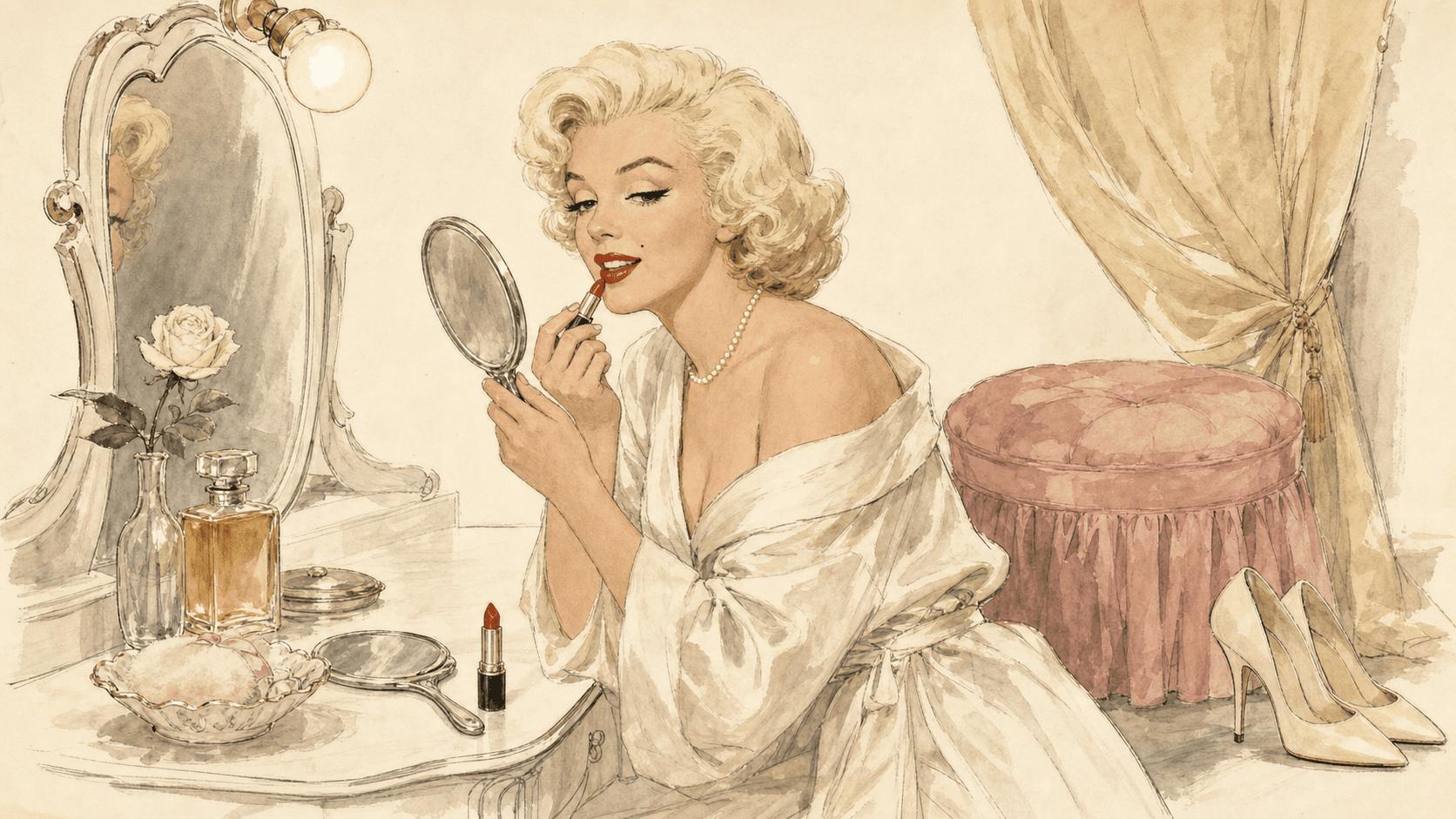
The private Marilyn. Off-camera she was bookish, anxious, devout about her image, and almost never without Chanel No. 5. The woman the world thought it knew was the most carefully constructed character in twentieth-century cinema.
he was not a designer. She did not run a fashion house. She did not have a couturier of her own. She did not sit in the front row of the Paris shows. And yet, no name on this list of one hundred and eight will be searched more often, copied more relentlessly, or quoted more endlessly than hers. Marilyn Monroe wore the 1950s — and the 1950s, in return, became her.
Christian Dior gave women a new shape. Cristóbal Balenciaga gave them a new architecture. Marilyn Monroe gave them something neither couturier could: a body to put it on. She showed the post-war world that you could be funny and sexy at the same time. That platinum hair and a working-class background did not stop you reading James Joyce in your trailer between takes. That glamour, properly understood, was an act of intelligence, not an accident of biology.
She made three dresses immortal. She married the country’s greatest athlete and its greatest playwright. She wore Chanel No. 5 to bed. And she died at thirty-six, leaving behind a wardrobe so beloved that a single one of her dresses, six decades later, would sell for more than the GDP of a small Pacific island.
Part 1The Girl from Hawthorne
She was born Norma Jeane Mortenson on 1 June 1926 at Los Angeles General Hospital. Her birth certificate listed no father. Her mother, Gladys, was a film negative-cutter at Consolidated Film Industries, twenty-four years old, mentally fragile, and unmarried. Within twelve days, Norma Jeane was placed with foster parents — evangelical Christians named Albert and Ida Bolender — in the suburb of Hawthorne, California. She would live with eleven different foster families and one orphanage before her sixteenth birthday.
The Bolenders were strict but kind. They wanted to adopt her. Gladys refused. When Norma Jeane was seven, her mother retrieved her, bought a small house in Hollywood, and tried for the first time to be a parent. Within a year, Gladys was diagnosed with paranoid schizophrenia and committed to a state mental hospital. She would spend most of the rest of her life institutionalised. Norma Jeane became a ward of the state of California at age nine.
She was tall for her age, painfully thin, and stuttered. She was teased at school for her clothes. She was sexually abused in at least two of her foster placements — she would later write about it in her unfinished memoir My Story, published posthumously in 1974. She told a friend that she had decided, at twelve, that she would become a movie star, because then no one could ever throw her away again.
At sixteen, to avoid being returned to the orphanage when her then-guardian’s family moved out of state, she married a twenty-one-year-old neighbour named James Dougherty. It was June 1942. He shipped out with the Merchant Marine. She moved into his mother’s house in Van Nuys and took a job at a defence-industry plant called Radioplane, spraying fire-retardant onto military drones.
In 1944, a US Army photographer named David Conover came to Radioplane to take morale pictures of the women on the assembly lines. He photographed an eighteen-year-old in coveralls with her hair tied up — and went back to his commanding officer to say he had just photographed the most photographable face he had ever seen. The commanding officer was a young captain named Ronald Reagan.
By 1946, Norma Jeane had divorced Dougherty, signed with the Blue Book modelling agency, dyed her hair platinum blonde, and been screen-tested by Twentieth Century-Fox. She also chose a new name. Marilyn was suggested by a Fox executive who thought it sounded like the actress Marilyn Miller. Monroe was her mother’s maiden name. She would carry her absent mother’s name for the rest of her life.
✦ ✦ ✦
Part 2Twelve Things You Probably Didn’t Know
One — She Read Constantly
Her personal library, auctioned at Christie’s in 1999, contained more than four hundred books. They included Joyce’s Ulysses (heavily annotated), Walt Whitman, Saul Bellow, Tolstoy, Dostoevsky, Camus, Carson McCullers, the complete plays of Shakespeare, Freud’s Letters, and a marked-up copy of The Thinking Body by Mabel Todd. She studied with Lee Strasberg at the Actors Studio in New York from 1955 — sitting in classes beside Marlon Brando, Anne Bancroft, and Paul Newman.
Two — The Chanel No. 5 Line Was Real
Asked by a magazine reporter in April 1952 what she wore to bed, she paused, then answered: “Chanel No. 5.” The line was not a paid endorsement. She was simply being truthful — she had worn it nightly since her early modelling days, when she had first been able to afford a small bottle. The remark was so charming, so disarming, and so quotable that Chanel sales soared overnight and have not stopped soaring since. In 2013, Chanel released archive recordings of her saying the line and licensed it as the centrepiece of their global No. 5 campaigns.
Three — She Designed Her Own Walk
The famous Marilyn walk — the slight sway, the small steps, the hip-tilt — was not natural. It was practised in front of a mirror for months when she was nineteen. She also cut a quarter-inch off the heel of one of every pair of shoes she owned to exaggerate the wiggle. Her drama coach Natasha Lytess called it “the most expensive limp in Hollywood.”
Four — She Wore Almost No Underwear
To preserve the line of her halter and bias-cut dresses, she famously avoided any visible bra or shaping garment. Her costume fittings were notorious for the same reason: her costumes had to be re-engineered from inside to support her without straps. The cost of the engineering — boning, internal harnessing, padded bodices — often exceeded the cost of the fabric.
Five — Her Costumes Were Sewn Onto Her
The Jean Louis “Happy Birthday” gown of 1962 was so close-fitting that her dresser sewed her into it the night of the JFK gala. To wear it, she could not sit, eat, or use the bathroom. She wore nothing beneath. After the gala, the seam was cut open with scissors. Multiple Travilla dresses from her Fox years were also sewn onto her body for shoots, then cut off at the end of the day.
Six — She Had Three Marriages, All Before Thirty-Five
James Dougherty (1942–46), the boy from down the street, when she was sixteen. Joe DiMaggio (Jan–Oct 1954), the baseball legend, lasted nine months — he hated the Seven Year Itch subway-grate scene, which he watched being filmed in New York, and the marriage ended within days. Arthur Miller (1956–61), the playwright, who converted to Judaism so they could marry, and for whom she famously said she felt finally “loved for her mind.” All three men attended her funeral.
Seven — She Had a Famous Crush on Albert Einstein
She kept a framed portrait of him on her bedroom dresser her entire adult life. Friends said she once told Truman Capote that if she could marry any man on earth living or dead, it would be Einstein. The Marilyn–Einstein meeting story (often retold and possibly apocryphal) has them connecting through a mutual friend in 1946; their photographs were once briefly hung side by side at her apartment.
Eight — She Could Not Sleep
From her late teens she suffered from severe insomnia. She had been prescribed sedatives — barbiturates, mostly Nembutal — since the mid-1940s. By the early 1960s she was taking up to ten capsules a night and washing them down with champagne. Her death on 4 August 1962 was officially ruled “probable suicide” by drug overdose. Many biographers since have argued it was accidental — and many others have suggested foul play. The truth, more than sixty years later, remains contested.
Nine — She Earned a Fraction of What Her Male Co-Stars Made
For Gentlemen Prefer Blondes (1953) — one of the biggest box-office hits of the decade — she was paid $1,500 a week. Her co-star Jane Russell was paid $200,000. In 1955, frustrated by Fox’s contracts, she became one of the first major film stars to form her own production company, Marilyn Monroe Productions, and renegotiated her contract on her own terms. It was a quietly revolutionary act: a young woman with a sixth-grade education taking on a Hollywood studio system and winning.
Ten — Her IQ Was Reportedly Around 168
The figure circulates with varying reliability, sourced from a 1950s test her drama coach said she took. Whatever the exact number, the people who worked with her — Strasberg, Miller, Olivier, Wilder — all said the same thing: she was sharper, faster, and more analytical than the “dumb blonde” she played. Billy Wilder, who directed her in Some Like It Hot, said, “She has feet of clay, but they are pretty feet.”
Eleven — Her Wardrobe Was Auctioned for Millions
In October 1999, Christie’s New York held a two-day sale of her personal property: jewellery, books, costumes, furniture. The grand prize lot was the Jean Louis “Happy Birthday” gown. It sold for $1,267,500 — at the time a world record for a single item of women’s clothing at auction. In 2016, it sold again for $4.8 million. The pink “Diamonds” dress from Gentlemen Prefer Blondes sold in 2011 for $370,000. The white halter dress sold in 2011 for $4.6 million.
Twelve — Joe DiMaggio Had Roses Delivered to Her Grave Every Week for Twenty Years
After her funeral on 8 August 1962, which DiMaggio arranged in defiance of her Hollywood circle (he barred Frank Sinatra, the Kennedy brothers, and the Strasbergs from attending), he sent fresh red roses to her crypt at Westwood Memorial Park three times a week — for twenty years. He died in 1999. Her crypt is still visited by thousands every year. Someone — anonymous, no one knows who — still leaves roses.
✦ ✦ ✦
Part 3The Three Dresses That Changed the World
Almost every star of the 1950s had a memorable wardrobe. Marilyn had three dresses that crossed from fashion into pure iconography — moments so visually loaded that they outlived the films they appeared in, the men who designed them, and the woman who wore them. Two were by William Travilla, the Fox studio designer who collaborated with her on eight films. The third was by Jean Louis. All three now live in museums.
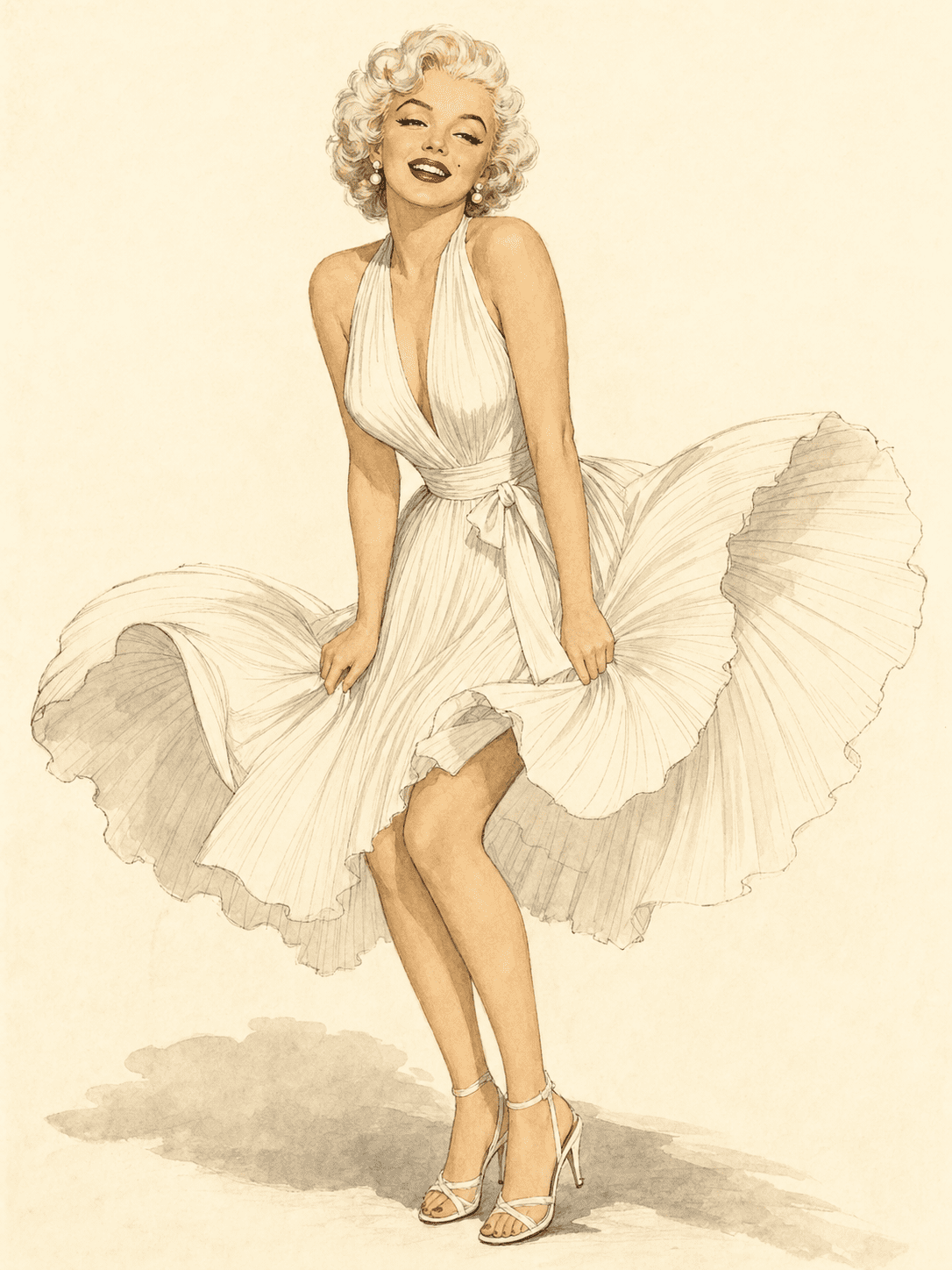
The white dress, 1954. William Travilla’s ivory rayon-crepe halter with knife-pleated skirt, designed for The Seven Year Itch. The single most photographed dress in cinematic history — and the one that ended a marriage.
The Subway Dress — Travilla, 1954
Designed by William Travilla for Billy Wilder’s The Seven Year Itch. Ivory rayon-acetate crepe, halter neck, deep V, narrow waist, sunray-pleated knee-length skirt. It cost $1,600 to make. The famous scene — Marilyn standing over a Lexington Avenue subway grate as a passing train lifts her skirt — was filmed twice. First, on a New York sidewalk at 1:00 a.m. on 15 September 1954, in front of a crowd of two thousand spectators and a furious Joe DiMaggio, watching from the back. The crowd noise made the footage unusable. Wilder reshot the scene in the studio days later. But the New York footage of the lifting skirt, taken by reporters and street photographers, was already circling the world.
DiMaggio reportedly slapped her in her hotel room that night. They divorced eighteen days later.
The dress itself — small, simple, almost ordinary in design — became one of the most copied garments in the history of fashion. Halston, Diane von Furstenberg, Norma Kamali, Donna Karan, and countless prom-dress manufacturers have variations of it in their archives. In 2011, the actress Debbie Reynolds sold the original from her costume collection. It made $4.6 million.
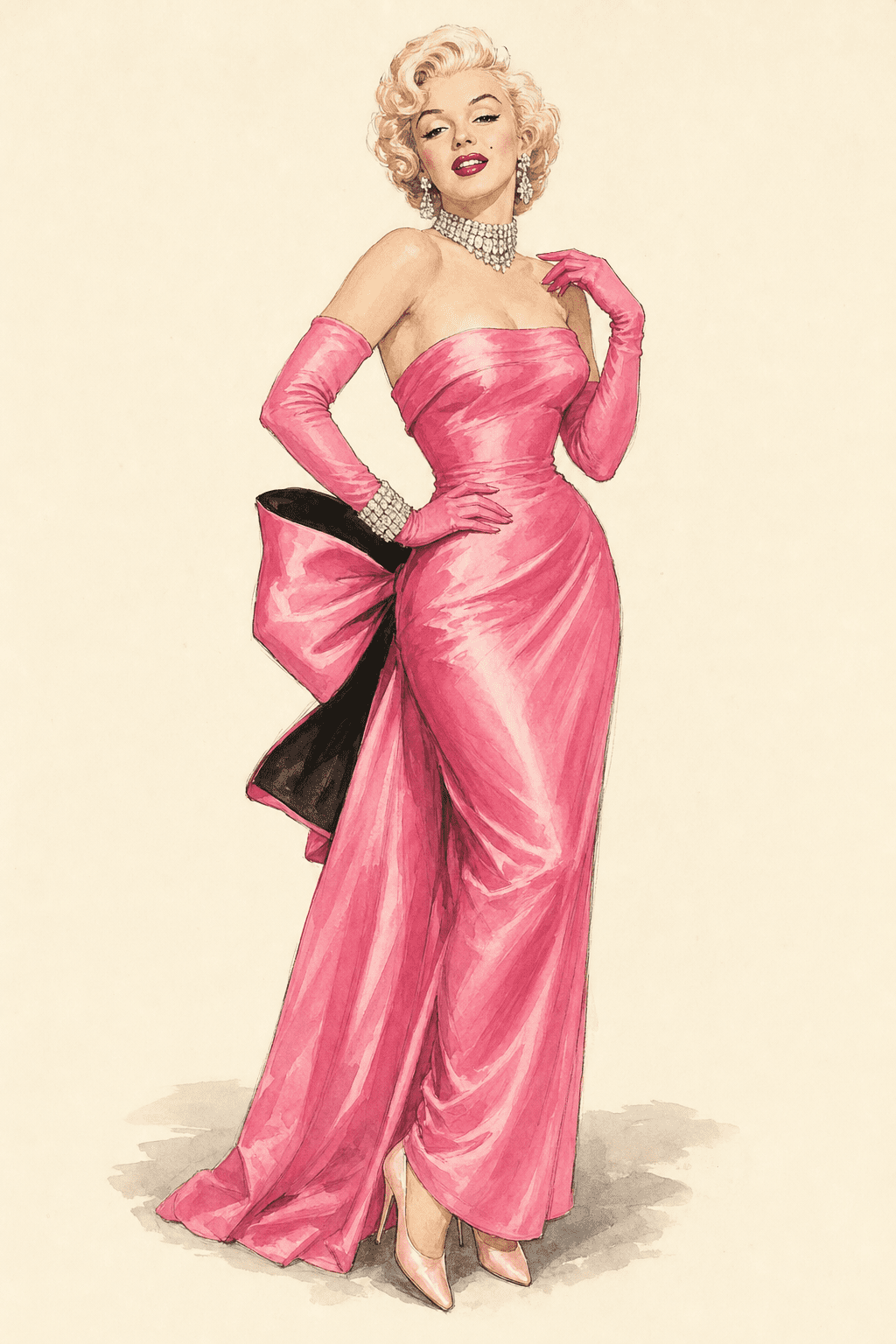
The pink dress, 1953. Travilla’s last-minute replacement for a banned earlier costume — and the shape that taught Madonna, in 1985, exactly how to be famous.
Diamonds Are a Girl’s Best Friend — Travilla, 1953
Originally she was to wear a far more revealing costume for the famous musical number in Gentlemen Prefer Blondes: a black mesh body-stocking heavily studded with rhinestones in strategic places, with a fishnet covering everything else. After a nude calendar photograph from her early modelling days resurfaced and threatened to derail her career, Fox panicked. The black mesh outfit was vetoed.
Travilla had four days. He sketched a shocking-pink peau d’ange silk satin floor-length strapless ball gown with a fitted bodice and a single oversized rectangular satin bow at the back hip, lined in black. He added matching opera gloves. He insisted on shocking pink because Technicolor would render anything paler as washed-out cream. The result is the most famous pink dress in cinematic history.
Madonna, in 1985, recreated the entire sequence — choreography, satin gown, gloves, diamonds, even the suitors in tuxedos — for her video to Material Girl. Kylie Minogue copied it. Anne Hathaway copied it. So have at least two dozen drag queens, three Oscar hosts, and one extremely famous Disney princess at a costume birthday party. The dress is now in the Hollywood Museum collection in Los Angeles.
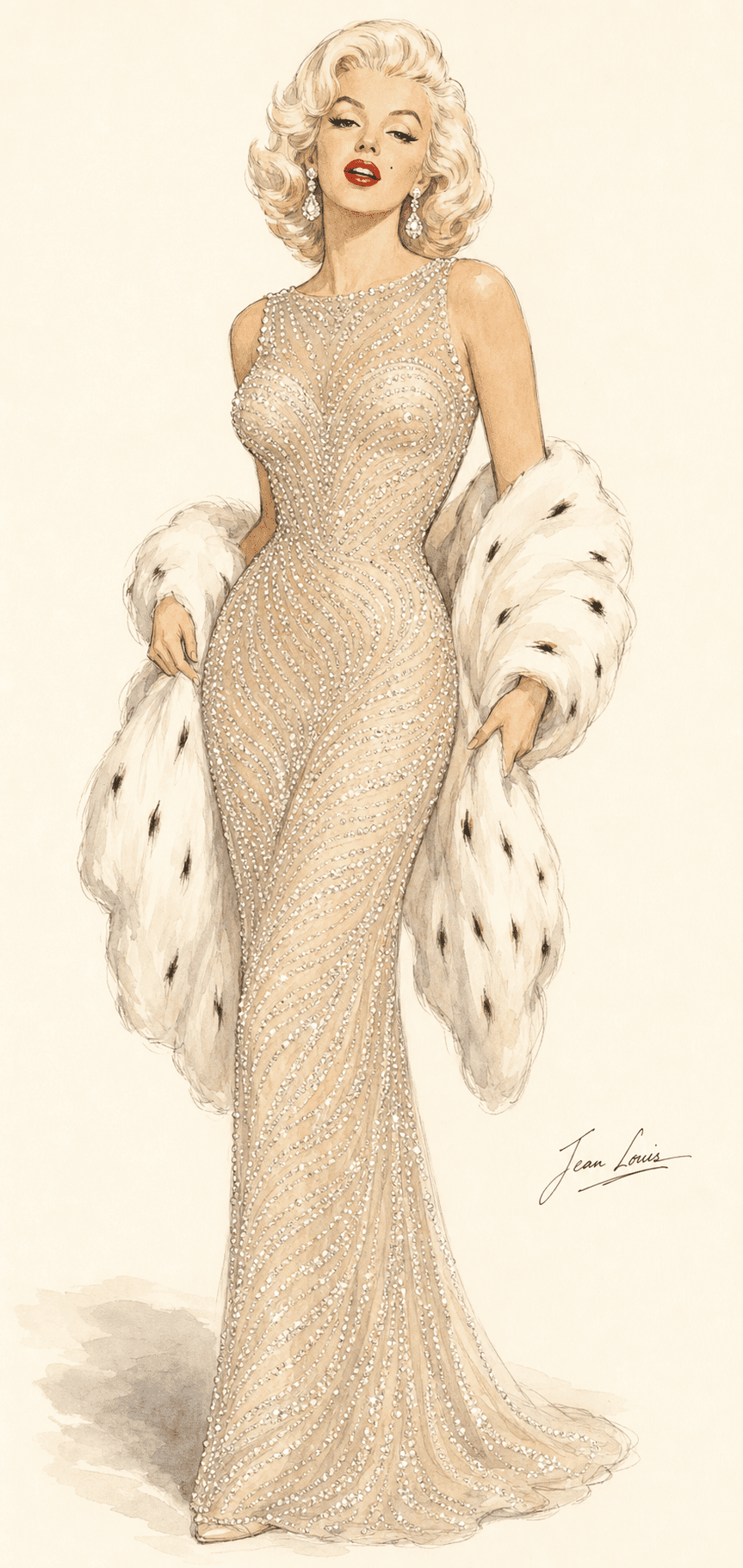
The Happy Birthday gown, 1962. Jean Louis’s nude silk soufflé encrusted with 2,500 hand-sewn rhinestones. The dress that single-handedly invented the modern concept of the “naked” red-carpet dress.
Happy Birthday, Mr. President — Jean Louis, 1962
On 19 May 1962, ten days before her thirty-sixth birthday, she sang two minutes and forty-seven seconds of a sultry, breathy reworking of “Happy Birthday” to President John F. Kennedy at Madison Square Garden, in front of fifteen thousand people. She emerged onto the stage in a fur stole. When she dropped it, the audience gasped. The dress beneath was so close-fitting that — from any distance — she appeared to be wearing nothing but sequins and skin.
It was designed by Jean Louis, who had previously dressed Marlene Dietrich. The fabric was a featherweight pale-champagne silk soufflé. Onto it, his beadworkers had hand-sewn approximately 2,500 individual rhinestones in swirling abstract patterns. She had been sewn into it backstage by her dresser. She paid $12,000 for it — about $130,000 today.
It is, fashion historians now agree, the moment the modern “naked dress” was invented. Every sheer beaded gown worn since — by Cher, Beyoncé, Rihanna, Kim Kardashian (who wore this exact dress to the 2022 Met Gala, sparking enormous controversy), and a thousand others — descends directly from those two minutes at Madison Square Garden. She invented red-carpet shock as a vocabulary.
It was the last formal occasion of her life. Less than three months later, she was dead.
✦ ✦ ✦
Part 4How She Built the Marilyn Look
She was not effortless. She was the opposite of effortless. The Marilyn look was the most engineered surface in twentieth-century cinema, and she was its architect.
The Hair
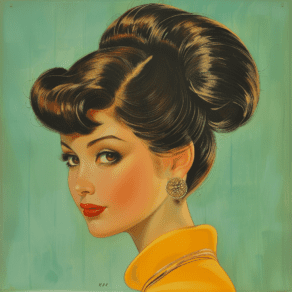
Her natural hair was light brown, soft, and wavy. Her famous platinum was achieved by Pearl Porterfield, a hair colourist at the Frank & Joseph salon in Hollywood, using a custom blend of bleach and silver toner that took approximately six hours every two weeks. She kept her hair short and rolled it nightly in pin curls.
The Face
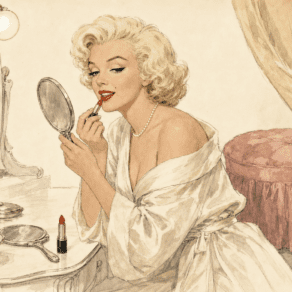
The beauty mark above her lip was small, natural, and exactly where everyone has always thought it was. She emphasised it with a tiny dab of brown pencil. Her brows were drawn high and dark over her natural arch. Her eyes were lined with thick black liquid liner — a single sweeping wing — and false lashes (she used only the outer corners). Her lips were always painted in a strong true red, never coral, never pink. Her makeup artist Allan “Whitey” Snyder worked with her from her first screen test in 1946 until her funeral. She had asked him, years before, to do her makeup if she died first. He did.
The Body
She was, by most accounts, between a US size 8 and a size 12 across her career — far closer to a normal woman of her era than to modern Hollywood standards. She had a 22-inch waist, 35-inch bust, 35-inch hips. Her hourglass shape was both natural and exaggerated by costume engineering. She did weight training at a time when almost no Hollywood actress did, lifting small dumbbells daily in her bedroom from her late twenties.
The Voice
The breathy, baby-soft voice was deliberate. Her natural speaking voice, audible in early radio interviews, was deeper and faster. She slowed it down and lifted it up — partly to disguise a childhood stutter, partly because she had observed that Hollywood prized girlishness. She also studied Russian-trained vocal exercises with the singer Hal Schaefer for the musical numbers in her films. Her singing voice in Some Like It Hot — particularly “I Wanna Be Loved By You” — was entirely her own.
✦ ✦ ✦
Part 5The Marilyn Timeline
✦ ✦ ✦
Part 6How Marilyn Changed the World
Before her, glamour belonged to the rich. After her, it belonged to anyone with a mirror and a tube of red lipstick.
1. She Made Glamour Democratic
Before Marilyn, the cinematic ideal was patrician — Grace Kelly, Audrey Hepburn, Lauren Bacall. Cool. Educated. Born into something. Marilyn was working-class. Foster-raised. From the factory floor. She didn’t pretend otherwise. She showed that you could be exquisite without being aristocratic — and millions of women, looking at her, understood for the first time that the codes of beauty were learnable, not inherited.
2. She Invented the Modern Sex Symbol
Before her: Mae West (a parody of seduction), Rita Hayworth (the femme fatale), Jean Harlow (the platinum bombshell, who Marilyn idolised). Marilyn fused all three with something new — innocence. The Marilyn type was sexy and sweet, knowing and trusting, available and unreachable. Every woman who has tried to occupy that paradox since — Madonna, Anna Nicole Smith, Pamela Anderson, Megan Fox, Sydney Sweeney — is working from her template.
3. She Made the Halter, the Pencil Skirt, and the Red Lip Permanent
Three garments she did not invent but completely owned: the halter dress, the wiggle pencil dress, the high-waisted cigarette pant. And one cosmetic: the strong red lip on a soft mouth. All four moved through her into the mass-market wardrobe and have never left.
4. She Was a Pioneer of Self-Owned Production
In 1955, fed up with Fox’s contracts that paid her a tenth of what her films earned, she walked off set and refused to come back until they renegotiated. She co-founded Marilyn Monroe Productions with the photographer Milton Greene — one of the earliest actress-owned production companies in Hollywood. The new Fox contract gave her director approval, the right to make outside films, and a four-times-higher salary. Reese Witherspoon, Sandra Bullock, Drew Barrymore, Margot Robbie — every actress-as-producer of the modern era walks through a door she opened.
5. She Made the Body-Conscious Dress Mainstream
Travilla’s costumes for her films were tighter, more revealing, and more body-aware than mainstream women’s clothing of the era. American women began asking dressmakers to copy her looks. By 1954, Vogue Pattern was selling halter-dress patterns at a record rate. The shift from corseted New Look fullness to body-skimming pencil silhouettes — typically credited to designers — was driven, on the ground, by women who wanted to look like Marilyn.
6. She Gave Birth to the Naked Dress
The 1962 Jean Louis gown is not just one of fashion’s great moments — it is the source code for an entire genre. Every sheer-and-beaded red-carpet gown of the last sixty years — from Cher’s 1974 Bob Mackie to Beyoncé’s 2015 Met Gala to Kim Kardashian wearing the original dress itself in 2022 — descends from those two minutes at Madison Square Garden. She invented red-carpet shock as a vocabulary.
7. She Made It Acceptable to Be Both Sexy and Sad
Her tragedy was visible in her work. The vulnerability under the laugh. The watery, slightly desperate quality of her smile. Marilyn proved that you could be the most desirable woman in the world and also be lonely, frightened, intellectually ambitious, and depressed — without one cancelling out the others. The next century of celebrity confession — Princess Diana, Britney Spears, Selena Gomez — speaks in a language she taught.
8. She Became a Permanent Cultural Word
Andy Warhol painted her in 1962 — the year she died — and the silkscreen series turned her face into the most reproduced image of any twentieth-century woman. Her name is now a noun (“a Marilyn moment”), an adjective (“Marilyn pink,” “Marilyn waves”), and a verb in drag culture (“to Marilyn” a dress). She has been impersonated by Madonna, Nicole Kidman, Michelle Williams, Ana de Armas, and roughly half the drag queens in North America. There is no end to her in sight.
✦ ✦ ✦
CodaThe Roses Still Come
On the night of 4 August 1962, Marilyn Monroe died in the small bungalow she had bought a few months earlier at 12305 Fifth Helena Drive in Brentwood, Los Angeles. She was thirty-six. She was alone. Her housekeeper Eunice Murray and her psychiatrist Dr Ralph Greenson found her body at around three in the morning. The official cause of death was acute barbiturate poisoning. The official manner of death was “probable suicide.”
Joe DiMaggio took charge of the funeral. He had not been her husband for nearly eight years, but he had never stopped loving her, and she had told friends in the months before her death that he was the only man who had ever truly understood her. He held a small, private service at Westwood Memorial Park on 8 August 1962. He barred the Hollywood circle he blamed for her unhappiness — the Strasbergs, the Kennedy brothers, Frank Sinatra, Peter Lawford. He let in her half-sister, her makeup artist, and the people from her childhood who had been kind to her. There were thirty-one mourners.
For the next twenty years, three times a week, fresh red roses were delivered to her crypt. They came from DiMaggio. He never gave another press interview about her. When he died in March 1999, his last recorded words were said to be, “I’ll finally get to see Marilyn.” The roses kept coming after his death — paid for, biographers later discovered, by a small bequest in his will and a few of his closest friends who knew the arrangement and continued it. They stopped, officially, in 1982. Unofficially, someone — anonymous, undocumented, devoted — has been leaving roses ever since.
The crypt is small. The plaque reads, simply, Marilyn Monroe, 1926–1962. There is no quotation, no decoration, nothing about Hollywood or stardom. She is buried, by her own wish, under her stage name.
Above her in the wall of the same mausoleum are buried Hugh Hefner (he bought the crypt for $75,000 in 1992, telling friends he wanted to “spend eternity next to Marilyn”), her drama coach Natasha Lytess, and the producer Walter Wanger. She is, posthumously, surrounded by the men of Hollywood — but the kindest gesture comes from Joe DiMaggio, who paid the bill for roses for two decades and never once attended the grave in front of cameras.
I am good, but not an angel. I do sin, but I am not the devil. I am just a small girl in a big world trying to find someone to love.— Marilyn Monroe, on the morning of her last birthday, 1 June 1962
✦ ✦ ✦
1950s Icons of Style & Cinema · Profile No. 3 · Original AI-rendered illustrations in the manner of a mid-century Hollywood portrait · 2026

Leave a Comment