
arl Lagerfeld did not revolutionize fashion in the 1950s in the same public way he later transformed Chloé, Fendi, Chanel, and his own image. The more accurate and more interesting story is that the 1950s were his ignition point: he moved to Paris in 1952, won a major wool-design prize in 1954, entered Pierre Balmain’s couture house in 1955, and became head designer at Jean Patou by the late 1950s. The decade did not show his full revolution. It gave him the tools of revolution.
The drama of Lagerfeld’s 1950s story is that he arrived exactly when fashion was changing. Paris couture was still at the height of its postwar prestige, Dior’s New Look had reset the silhouette, Balenciaga and Givenchy were challenging that silhouette, Chanel returned in 1954 after a fifteen-year absence, and ready-to-wear was beginning to pressure the couture system. Into this charged atmosphere came a young German-born illustrator who entered a design competition almost by chance and won.
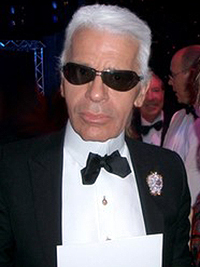
Karl Lagerfeld, Red Cross Ball, Monaco, 2005 — by the 2000s a global icon, but his story begins with a coat sketch in 1950s Paris. Photo: Christoph Schaefer. Wikimedia Commons (CC BY-SA/GFDL).
The 1950s Fashion World Lagerfeld Entered
The 1950s were not a quiet background to Lagerfeld’s career. They were a rebuilding decade, a couture decade, and a silhouette decade. The Victoria and Albert Museum frames 1947 to 1957 as the “golden age” of couture, beginning with Christian Dior’s New Look and ending with Dior’s death in 1957, while emphasising the postwar importance of couture to national prestige and the economies of France and Britain (V&A).
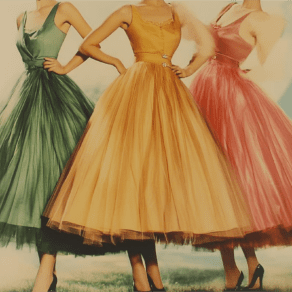
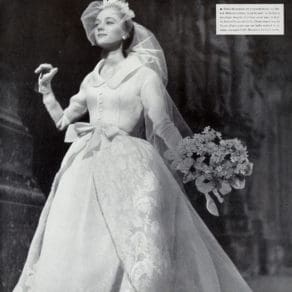
The dominant early-1950s fashion language was structured and feminine: nipped waists, full skirts, softened shoulders, padded hips, and a return to fabric-rich elegance after wartime austerity. The Fashion History Timeline notes that Dior’s New Look, introduced in February 1947, remained influential into the mid-1950s, while the decade also saw alternatives emerging — sheaths, sack dresses, swing outlines, and Balenciaga’s high-waisted chemise dresses in 1957 (Fashion History Timeline).
Paris couture houses such as Balenciaga, Balmain, Fath, Chanel, Schiaparelli, and Dior attracted worldwide attention in this period, but the system was already adapting to new markets through perfumes, boutique lines, and other commercial extensions (V&A). This matters for Lagerfeld because he would later become one of the most important designers in turning a fashion house into a total cultural and commercial universe. The 1950s gave him the model he would eventually reinvent.
Chanel’s 1954 comeback gave the decade an additional layer of historical tension. Gabrielle Chanel reopened her couture house at age 71 with a 5 February fashion show, and Chanel’s own historical timeline describes the comeback as extremely well received by the American press (Chanel). This was the exact year Lagerfeld won the wool competition, creating a striking historical symmetry: Chanel was returning to fashion while Lagerfeld was entering it. Three decades later, he would be the one to continue her legacy.
Lagerfeld’s Early Life and Move to Paris
Karl Lagerfeld was born in Hamburg, Germany, on 10 September 1933, although some sources add uncertainty around the exact year (Britannica). What is clear is that he moved to Paris in 1952, placing his arrival in the French capital at the moment when couture was still the dominant global fashion authority (Britannica). For a young man drawn to images, elegance, and visual culture, Paris in 1952 was not simply a city. It was the centre of the world he wanted to inhabit.
The official Karl Lagerfeld brand biography gives one of the most revealing details about his early ambition: he originally planned to become an illustrator, and his fashion career happened somewhat accidentally after he entered the 1954 International Woolmark Prize by chance (Karl Lagerfeld). That detail is crucial because drawing never stopped being central to him. The Metropolitan Museum of Art’s 2023 exhibition “Karl Lagerfeld: A Line of Beauty” emphasised his sketches as evidence of a complex creative process and described his “fluid lines” as uniting designs across Balmain, Patou, Chloé, Fendi, Chanel, and his own label (The Met).
In other words, Lagerfeld entered fashion as a draftsman before becoming a brand architect. That explains why his 1950s breakthrough was a sketch, not a finished garment under his own name. The line came first. Everything else followed.
The 1954 International Wool Secretariat Competition
The key event of Lagerfeld’s 1950s career was the 1954 International Wool Secretariat fashion design competition. The Woolmark Prize history explains that the International Wool Secretariat was founded in 1936 to promote wool globally and later produced an annual design competition in Paris that dates back to the 1950s (International Woolmark Prize). For young designers without established names or house connections, this competition was one of the few routes directly into the couture establishment.
Lagerfeld won first prize for a coat design in 1954. The official Karl Lagerfeld site says he won first place for a coat sketch at age 21, while Harper’s Bazaar dates the win specifically to 11 December 1954 and describes it as a first prize in the coat category that helped establish him within the fashion industry (Britannica, Karl Lagerfeld, Harper’s Bazaar). The winning design was a daffodil-yellow coat cut low across the collarbone — a detail that suggests both freshness and confidence, structural clarity and colour boldness.
AnOther Magazine adds the best storytelling detail: Lagerfeld was 21 and won the coat category with a daffodil-yellow coat, while 18-year-old Yves Saint Laurent won the dress category with a black cocktail dress. The jury included Hubert de Givenchy and Pierre Balmain.
This contest is important for three distinct reasons. It introduced Lagerfeld to the couture elite. It connected him to Pierre Balmain, who would hire him the following year. And it placed him in direct parallel with Yves Saint Laurent, creating one of fashion’s most fascinating generational comparisons — two futures visible in the same room, on the same afternoon, before either man had a house of his own.
Lagerfeld and Yves Saint Laurent: Two Different Futures on the Same Stage
The 1954 Wool Secretariat competition is one of those rare historical scenes where the future becomes visible all at once. Lagerfeld won for a coat, Saint Laurent won for a dress, and both would go on to redefine fashion in very different ways. The jury — which included Givenchy and Balmain — was not simply assessing student work. It was, without knowing it, selecting two of the people who would shape the next half-century of Paris fashion.
Saint Laurent’s path became associated with dramatic authorship: the trapeze line at Dior, the Mondrian dress, Le Smoking, and the cultural transformation of womenswear. His signature was the signature. Lagerfeld’s path was more polyphonic. He moved between houses, codes, archives, clients, and markets, becoming less the designer of one recognisable signature and more the master of reinvention. Where Saint Laurent built a monument, Lagerfeld built a method.
The comparison also clarifies what Lagerfeld learned in the 1950s. He was entering a system where the designer had to understand both silhouette and house identity. Later, that ability — to read a house’s codes and make them feel current without abandoning them — would become his superpower at Chanel, where he revived an archive without turning it into a museum.
The Balmain Years: Apprenticeship Inside Couture
In 1955, Pierre Balmain hired Lagerfeld after the Wool Secretariat win, and Britannica states that Balmain put Lagerfeld’s coat design into production (Britannica). That transition — from prize-winning sketch to manufactured couture garment — was the first practical test of whether Lagerfeld’s drawing could survive contact with a real atelier, real fabric, and real clients. Palais Galliera gives the broad date range of Lagerfeld’s assistant period at Pierre Balmain as 1955 to 1962, though other biographies note he was already moving toward Jean Patou by the late 1950s (Palais Galliera).
Balmain mattered because it was a real couture training ground. Balmain’s official house history notes that Pierre Balmain established his house just after the liberation of Paris near the end of World War II, tying the brand to the postwar rebirth of French fashion (Balmain). For a young designer, assisting inside a couture house at this moment meant learning how sketches became garments, how clients were served, how ateliers worked, and how luxury was built through proportion, finishing, and discipline. The details mattered: the seam, the lining, the fit across a shoulder, the drape of a hem.
The Balmain apprenticeship also positioned Lagerfeld inside a house known for polished elegance and a certain assured femininity. That matters because Lagerfeld’s later persona could look severe, modern, and witty, but his technical foundation was couture craft. The 1950s gave him the discipline he later used to make speed look effortless. His famous ability to produce collections rapidly and simultaneously across multiple houses was built on an architectural understanding of how clothes are constructed — and that understanding began in Balmain’s atelier.
Jean Patou: The First Real Test of Leadership
Lagerfeld’s next major 1950s step was Jean Patou. Patou’s own history says Lagerfeld joined the house as head designer in 1958, created memorable long flowing dresses inspired by the 1930s in homage to the founder, and left in 1963 to devote himself to ready-to-wear houses (Patou). Britannica states that he became artistic director of Jean Patou three years after being hired by Balmain in 1955, which points to 1958 (Britannica). Palais Galliera gives slightly different dates, saying he was appointed to lead Jean Patou from 1959 to 1963 (Palais Galliera). The safest framing is “by the late 1950s” — the transition clearly happened in the 1958–1959 window.
Patou is a fascinating chapter because it reveals an early Lagerfeld habit: working with the past without simply copying it. His Patou designs were long flowing dresses inspired by the 1930s and created in homage to Jean Patou himself. That foreshadows with striking clarity the archival intelligence he later brought to Chanel, where he could take pearls, tweed, camellias, chains, quilting, and the little black dress and make them feel contemporary again without erasing what they meant historically.
The Patou period also gave Lagerfeld something he did not have at Balmain: responsibility. At Balmain he was an assistant and a learner. At Patou, even before the age of thirty, he was the person making the decisions. That early experience of leadership — of being the one whose choices determined how a house presented itself to the world — was essential preparation for the decades that followed.
What Lagerfeld Absorbed from the 1950s
Couture discipline
The 1950s taught Lagerfeld how couture functioned as a complete system: drawing, fabric, atelier labour, fittings, client taste, press attention, and house codes. The V&A’s account of the postwar couture economy shows that couture was not only aesthetic; it was tied to prestige, exports, and national recovery (V&A). That systemic understanding — the idea that a fashion house was not just a creative workshop but an economic and cultural institution — would later define his approach to every house he worked for.
The power of silhouette
Dior’s New Look made silhouette the decade’s central fashion argument. The Fashion History Timeline describes the New Look’s tiny waists, softened shoulders, padded hips, and long skirts, while also noting the decade’s gradual move toward sheaths, sack dresses, swing outlines, and other alternatives (Fashion History Timeline). Lagerfeld’s career would repeatedly show this same sensitivity to line: the coat, the shoulder, the waist, the sketch, the profile. He understood that fashion was, at its most fundamental, an argument about the body’s silhouette.
The archive as a living tool
Jean Patou gave Lagerfeld an early encounter with archive-driven design. His Patou work referenced the 1930s in homage to the founder, which is exactly the kind of historical remix that later defined his work at Chanel (Patou). The lesson he drew was not that archives were sacred or untouchable, but that they were usable — that a house’s history was not a constraint but a vocabulary. He could speak it fluently or he could bend its grammar. The 1950s were where he learned to read it.
Fashion as media
Lagerfeld’s later genius was not only designing clothes. He understood photography, image, celebrity, staging, logos, retail, and spectacle. The Metropolitan Museum of Art’s exhibition framing highlights that his work across multiple houses was unified by drawing and a distinctive working method, while Palais Galliera credits him with helping invent the modern figure of the artistic director and turning his own silhouette — the white ponytail, the dark glasses, the fingerless gloves, the high collar — into a logo (The Met, Palais Galliera). That media intelligence did not appear fully formed. It was developing throughout the 1950s, in the Paris couture world where image had always been part of the product.
What Was Genuinely Revolutionary, and What Came Later
It is important to separate 1950s promise from later revolution. In the 1950s, Lagerfeld’s achievements were already impressive: a major international prize, a Balmain apprenticeship with production of his coat design, and leadership at Patou by the end of the decade. But his world-historical impact came later — through luxury ready-to-wear, Fendi from 1965, Chloé from 1966, and especially Chanel from 1983.
Palais Galliera describes Lagerfeld as a prolific figure who directed several international couture houses, his own brand, and many collaborations, while giving luxury ready-to-wear its nobility and bringing haute couture into the 21st century through Chanel’s revival (Palais Galliera). The Met similarly frames his career as a 65-year body of work stretching from the 1950s to his final collection in 2019 (The Met). Those 65 years all began with a coat sketch submitted by chance.
So the best way to write about Lagerfeld and the 1950s is this: the decade did not show his full revolution, but it gave him the tools of revolution. It gave him the contest, the coat, the couture room, the archive, the rivalry, the discipline, and the Paris stage.
Timeline: Karl Lagerfeld in and Around the 1950s
| Year | Moment | Why it matters |
|---|---|---|
| 1933 | Born in Hamburg, Germany, with some uncertainty around the exact year (Britannica) | Establishes his German origins before his Paris career |
| 1952 | Moves to Paris (Britannica) | Places him at the centre of postwar couture at its height |
| 1954 | Wins first prize for a coat design at the International Wool Secretariat competition (Britannica) | Launches his fashion career; introduces him to the couture establishment |
| 1954 | Yves Saint Laurent wins the dress category at the same competition; the jury includes Givenchy and Balmain (AnOther Magazine) | Creates a symbolic beginning for two major designers on the same stage |
| 1954 | Chanel reopens her couture house on 5 February (Chanel) | Lagerfeld enters fashion the same year Chanel returns to it |
| 1955 | Pierre Balmain hires Lagerfeld and puts his coat design into production (Britannica) | Turns a prize-winning sketch into a couture apprenticeship |
| 1958–1959 | Lagerfeld joins or leads Jean Patou, with Patou giving 1958 and Palais Galliera giving 1959 (Patou, Palais Galliera) | Gives him early leadership responsibility at a couture house |
| 1963 | Leaves Jean Patou to devote himself to ready-to-wear houses (Patou, Palais Galliera) | Opens the next phase: luxury ready-to-wear and multi-house work |
| 1983 | Becomes artistic director at Chanel (Palais Galliera) | The later revolution becomes fully visible |
The 1954 Coat: The Most Important Object in the Story
The most cinematic object in Lagerfeld’s 1950s story is not a Chanel jacket or a Fendi fur, but a coat sketch. In 1954, the 21-year-old Lagerfeld entered the International Wool Secretariat competition and won the coat category. The official Karl Lagerfeld site says he had originally intended to become an illustrator, entered the prize by chance, and won first place for his coat sketch, instantly launching his career (Karl Lagerfeld).
That coat mattered because it did what a great fashion sketch must do: it made people imagine the finished garment. AnOther Magazine describes the winning coat as daffodil-yellow and cut low across the collarbone, a detail that suggests both freshness and confidence (AnOther Magazine). The coat was also practical symbolism. In a competition designed to promote wool, Lagerfeld did not win with a fantasy ballgown. He won with outerwear — structure, surface, line, and commercial possibility. That combination of drama and utility would characterise his best work for decades.
The prize did not simply flatter him. It introduced him to Pierre Balmain, who hired him in 1955 and put the design into production (Britannica). That is why the coat belongs at the centre of any article on Lagerfeld in the 1950s. It is the bridge between illustrator and couturier. It is the line that launched 65 years.
Lagerfeld’s career began with a coat sketch, not a runway collection. He entered the competition almost by chance. He had originally planned to become an illustrator. Fashion found him before he fully decided to find it. — Adapted from Karl Lagerfeld official biography
Why the 1950s Still Matter to Lagerfeld’s Later Legacy
Lagerfeld’s later career was built on a paradox: he was modern because he knew how to use the past. That paradox begins in the 1950s. He entered a couture world still shaped by Dior’s postwar silhouette, worked for Balmain, and then interpreted Patou’s 1930s heritage through late-1950s design (Fashion History Timeline, Patou). In each case he was absorbing a set of codes from the institution around him and learning to restate them without simply repeating them.
This is the same logic that later made him so powerful at Chanel. He did not treat heritage as a cage. He treated it as a vocabulary. A Chanel jacket, a chain belt, a camellia, a quilted bag, a tweed suit, or a black-and-white palette could be recombined because he understood that fashion houses survive by changing while pretending to remain themselves. The 1950s taught him the rules. The rest of his career was about bending them.
- Lagerfeld’s career began with a coat sketch, not a runway collection (Karl Lagerfeld official biography).
- The 1954 competition linked Lagerfeld and Yves Saint Laurent before either became a household fashion name (AnOther Magazine).
- Chanel’s comeback and Lagerfeld’s breakthrough happened in the same year, 1954, although Lagerfeld would not join Chanel until 1983 (Chanel, Palais Galliera).
- Patou’s history says Lagerfeld’s early work there was inspired by the 1930s — foreshadowing his later talent for reviving house codes (Patou).
- The Met’s “A Line of Beauty” exhibition treated Lagerfeld’s sketches as central to understanding his design process across 65 years (The Met).
Final Thoughts
Karl Lagerfeld’s 1950s story is not the story of a fully formed fashion emperor. It is the story of a young illustrator becoming a couturier, a German-born outsider entering the Paris fashion system, and a future master of reinvention learning the rules of couture from the inside.
The 1954 International Wool Secretariat prize gave him visibility. Pierre Balmain gave him discipline. Jean Patou gave him responsibility. The wider 1950s fashion world gave him a language of silhouette, heritage, luxury, and reinvention. Decades later, those lessons would reappear at Chloé, Fendi, Chanel, and Karl Lagerfeld’s own brand.
That is why the 1950s matter so much to understanding him. They were not the decade when Lagerfeld became a legend. They were the decade that made the legend possible.
✦ ✦ ✦
Further reading: Britannica: Karl Lagerfeld · The Met: Karl Lagerfeld: A Line of Beauty · V&A: Dior and the golden age of couture · International Woolmark Prize history
Images reproduced for editorial and educational purposes under their respective licences. All rights remain with the originating authors and institutions.



Leave a Comment