
970s accessories were bold because the decade itself was full of competing moods. The same era gave us hippie craft, disco glamour, glam rock drama, punk rebellion, sportswear, and polished jet-set fashion. One person might wear oversized sunglasses and a silk scarf, another might wear a floppy hat and embroidered bag, and another might choose leather gloves, safety pins, and torn fabric. The accessories did not just finish an outfit. They helped people choose a tribe.
The Fashion Institute of Technology describes 1970s fashion as a decade where bold colors and patterns took centre stage. It also notes that the period moved from hippie-influenced prairie dresses and handmade decoration to flashy party wear for disco nightclubs, and the rise of athletic wear near the end of the decade. That range is what makes 1970s accessories so interesting today. They were not just finishing touches. They were declarations. Source: Fashion Institute of Technology, 1970–1979.

Farrah Fawcett, 1977 — her feathered hair, oversized sunglasses, and effortless glamour helped define the decade’s beauty ideal. Wikimedia Commons.
1970s Sunglasses: Big Frames, Coloured Lenses, and Movie-Star Mystery
Sunglasses in the 1970s were not simply practical. They were face-shaping accessories that could make someone look glamorous, mysterious, rebellious, or futuristic. Oversized frames, tinted lenses, aviators, shield styles, and funky geometric shapes all fit the decade’s love of drama. In a fashion era where scale and statement mattered, the size and tint of your sunglasses told the world exactly what kind of person you wanted to be.
Oversized sunglasses
Oversized sunglasses became one of the signature 1970s accessory looks. Frames were often large, rounded, square, or softly rectangular. Some were glamorous and polished, while others looked playful and almost cartoonish. Tortoiseshell, amber plastic, translucent frames, smoky lenses, and warm brown tones worked especially well with feathered hair, wrap dresses, wide-leg trousers, and platform shoes.
The appeal was obvious. Oversized sunglasses covered much of the face, adding privacy and star power. They also balanced the decade’s big hair and wide silhouettes. In a fashion period where “more” often looked better, tiny sunglasses simply could not compete.
Oversized sunglasses were one of the easiest ways to look famous without actually being famous. Add a headscarf, a floppy hat, and a dramatic exit from a car, and suddenly the grocery store becomes a paparazzi moment.
Aviators and sporty cool
Aviator sunglasses were older than the 1970s, but the decade helped turn them into a broad fashion symbol. Ray-Ban traces the Aviator Classic to 1937 and notes that the 1970s brought mirrored, tinted, and light-responsive lenses into a flamboyant sports scene. In the 1970s, aviators could look military, athletic, rebellious, masculine, or glamorous depending on the wearer. With denim, they looked rugged. With a leather jacket, they looked dangerous. With a silk shirt, they looked disco-ready. Source: Ray-Ban glasses history.

American Optical Original Pilot Aviator sunglasses — the aviator silhouette crossed from military use into broad 1970s fashion. Wikimedia Commons (CC BY-SA 2.0, Guy Sie).
One important note: Top Gun made aviators famous for a new generation, but that film came out in 1986. For a 1970s context, aviators belong to the decade’s sports, pilot, and celebrity-cool aesthetic rather than any specific film association.
Coloured, mirrored, and patterned lenses
Coloured lenses were a perfect fit for the 1970s because the decade loved warm, dreamy, and artificial colour. Amber, yellow, brown, green, blue, and rose-tinted lenses gave the world a soft-focus feeling. Mirrored lenses added a sharper, futuristic edge. Ray-Ban’s official history confirms the brand became a frontrunner in the sports world during the 1970s with mirrored, tinted, and light-responsive lenses. This trend connected with several 1970s moods at once: psychedelic colour, disco shine, outdoor leisure, and the new importance of sporty casualwear.
1970s Hats: Floppy, Funky, Glamorous, and Rebellious
Hats in the 1970s were expressive rather than uniform. Some looked soft and romantic. Some looked sharply masculine. Some looked theatrical enough for a disco floor. The strongest 1970s hat styles included floppy wide-brim hats, fedoras, berets, newsboy caps, knit caps, and head-hugging scarves used almost like hats. Each style carried its own cultural signal and worked with different parts of the decade’s varied wardrobe.
Floppy and wide-brim hats

Wide-brim hat silhouette — this dramatic shape returned strongly in 1970s bohemian and glamour fashion. Wikimedia Commons.
Floppy hats captured the bohemian side of the decade. They worked with peasant blouses, maxi dresses, suede vests, bell-bottoms, and long hair. Wide brims also created a glamorous silhouette, especially when paired with oversized sunglasses. These hats were dramatic without looking too formal. They suggested travel, festivals, craft markets, beaches, and a slightly romantic idea of freedom.
A floppy hat could make an outfit look softer, more artistic, and more relaxed. In an era that valued personal expression and natural beauty, the wide brim was one of the easiest ways to signal a bohemian sensibility without saying a word.
Fedoras, trilbies, and sharp hats
Fedoras and trilby-style hats carried a different message. They gave outfits a sharper, more urban edge. On men, they could suggest jazz, rock, or vintage cool. On women, they could add androgyny and confidence. The Fashion Institute of Technology notes that women’s 1970s fashion looked back to the 1940s by day while pumping up glamour by night. That retro borrowing made classic hat shapes feel fresh again. A fedora with platform shoes, flared trousers, and big sunglasses became unmistakably 1970s. Source: FIT, 1970–1979.
Berets and artsy headwear
Berets worked well with the decade’s artistic and political energy. They could look bohemian, intellectual, revolutionary, or simply stylish. In a decade shaped by protest movements, music scenes, and counterculture, the beret had a natural place. Knit caps and tight-fitting hats also worked with the more casual and sporty side of 1970s dressing. One note for accuracy: Kangol-style hats are sometimes mentioned in 1970s articles, but the brand’s strongest mainstream association belongs more clearly to 1980s hip-hop. Berets, floppy hats, fedoras, knit caps, and wide-brim hats are more historically accurate 1970s choices.
1970s Scarves and Bandanas: Boho, Disco, and Jet-Set Style
Scarves were among the most flexible 1970s accessories. They could be tied around the neck, wrapped around the head, worn as belts, looped through handbags, or used as hair accessories. A scarf could make an outfit look bohemian, elegant, sporty, or disco-ready without changing a single other item. That versatility made them essential to 1970s dressing across every style tribe.
Silk scarves and satin shine
Silk and satin scarves matched the decade’s love of movement and texture. They caught light, moved with the body, and added colour without needing a full outfit change. Prints often included florals, paisleys, geometric patterns, ethnic-inspired motifs, and psychedelic swirls.
Vogue’s historical overview of 1970s fashion notes that shawls, capes, and ponchos became staples and that the decade favoured wrapable, strapable, and rollable clothing. That explains why scarves fit the decade so well. In the 1970s, a scarf was not just a scarf. It could become a head wrap, belt, necktie, bag accent, or dramatic dance-floor flourish. Source: Vogue, 1970s fashion history.
Headbands, bandanas, and hippie influence

Red paisley bandana — bandanas and headbands carried the hippie and festival spirit of early 1970s fashion. Wikimedia Commons (CC0).
Headbands and bandanas carried the hippie and festival side of 1970s fashion. They looked handmade, casual, and personal. They also worked with long hair, centre parts, embroidery, denim, suede, fringe, and peasant-style clothing.
The Fashion Institute of Technology notes that early 1970s fashion continued the late 1960s hippie style, with handmade materials and decorations such as patchwork, crochet, knitting, embroidery, quilting, dyeing, beading, leather craft, and hand-painted fabrics entering fashion. A 1970s scarf could do more jobs than most modern accessories: hair control, sun protection, colour accent, handbag decoration, belt, and festival signal all at once. Source: FIT, 1970–1979.
1970s Gloves: Disco Glamour Meets Punk Attitude
Gloves in the 1970s had two very different lives. In glamorous settings, they could look elegant, theatrical, and old-Hollywood inspired. In punk and rock settings, they could look aggressive, DIY, and anti-fashion. Those two extremes capture the wider character of 1970s accessories: the same decade that gave us Halston’s sequined eveningwear also gave us safety pins and torn fabric.
Evening gloves and disco drama
Disco style loved shine, texture, and theatrical entrances. Gloves in satin, mesh, lace, metallic fabric, or embellished materials could work with evening dresses, jumpsuits, halter tops, and sequined looks. They made the body look styled from head to hand, which mattered on a dance floor where every move was visible.
The Fashion Institute of Technology’s 1970s timeline notes that evening wear for the disco dance floor used satin, sequins, and velvet, and highlights Halston’s shimmering sequined evening dress from around 1974 as an example of the era’s glamour standard. Source: FIT, 1970–1979.
Leather, PVC, and punk gloves
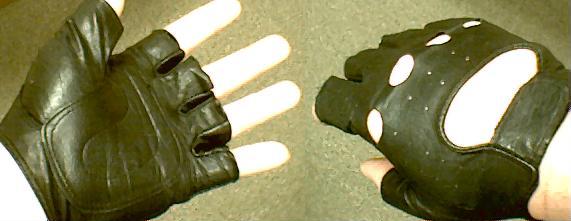
Leather fingerless gloves — a punk staple from the mid-to-late 1970s that made accessories look raw, functional, and confrontational. Wikimedia Commons.
By the mid-to-late 1970s, punk created a radically different accessory language. Gloves, wrist straps, leather, chains, studs, safety pins, and torn fabric all fit punk’s confrontational style. The Victoria and Albert Museum explains that Vivienne Westwood and Malcolm McLaren’s shop at 430 King’s Road became SEX in 1974, selling fetish wear, and was refitted as Seditionaries in 1976, where torn-looking tops, metal chains, safety pins, bondage trousers, rubber dresses, and provocative graphics became part of the punk look. Source: V&A, Vivienne Westwood.
The Metropolitan Museum of Art’s “PUNK: Chaos to Couture” exhibition describes punk’s visual symbols as including safety pins, razor blades, studs, spikes, chains, zippers, padlocks, and torn or shredded garments. Fingerless gloves fit that world perfectly. They looked functional, rough, and unfinished — exactly what punk wanted accessories to look like. Source: The Met, PUNK: Chaos to Couture.
Style Icons Who Made 1970s Accessories Memorable
No discussion of 1970s accessories is complete without the people who wore them most memorably. Several style figures from the decade defined what accessories could do: signal identity, amplify personality, and turn everyday dressing into a cultural statement.
Farrah Fawcett
Farrah Fawcett represented the sunny, glamorous side of 1970s style. Her feathered hair, casual glamour, and camera-ready look helped define the decade’s beauty ideal. Oversized sunglasses fit that image perfectly because they matched the scale of the hair and the softness of the silhouette. Her 1977 publicity photograph became one of the best-selling posters of all time and remains one of the clearest visual summaries of 1970s mainstream glamour.
David Bowie
David Bowie made 1970s accessories feel futuristic, theatrical, and gender-fluid. His Ziggy Stardust period used costume, colour, makeup, boots, dramatic shapes, and striking accessories to turn fashion into performance. The Fashion Institute of Technology’s 1970s timeline notes that Japanese designer Kansai Yamamoto designed costumes for Bowie’s Ziggy Stardust tour in 1972. Bowie showed that accessories were not just decoration. They were part of a complete artistic identity. Source: FIT, 1970–1979.
Bianca Jagger and disco socialites
Bianca Jagger and the Studio 54 crowd helped define the glamorous nightlife side of the decade. Their accessories tended to be polished and dramatic: silk scarves, wide-brim hats, metallic accents, large sunglasses, and jewellery that could survive flash photography. Studio 54 was a place where accessories needed to read clearly across a crowded, strobing dance floor, and the 1970s fashion world responded with pieces that were as bold as the setting demanded.
Vivienne Westwood and punk figures
Vivienne Westwood and Malcolm McLaren helped turn punk accessories into a visual language of provocation. Safety pins, bondage details, torn fabric, leather, chains, and deliberately shocking graphics turned clothing and accessories into cultural statements. Their work on King’s Road in London became one of the most influential retail experiments in fashion history, shaping how punk looked globally. Source: FIT, Westwood and McLaren.
Collecting 1970s Vintage Accessories Today
Collecting 1970s accessories is rewarding because the decade produced such a wide range of looks. You can focus on glamorous disco accessories, bohemian scarves, punk-inspired leather pieces, vintage sunglasses, floppy hats, or sporty casual items. Each category has its own collector community, price range, and set of things to look for.
For sunglasses, check hinges, lens scratches, warped plastic, missing screws, and whether the frames sit evenly. For hats, check the sweatband, brim shape, moth damage, and whether the material has become brittle. For scarves, inspect hems, stains, fading, and pulled threads. For gloves, check lining, stitching, leather dryness, and whether both gloves match in size and colour.
Look for period details such as acetate frames, warm amber lenses, paisley prints, synthetic fabrics, handcraft details, embroidery, suede, fringe, and disco-friendly shine. Labels can help with dating, but the overall construction and materials tell most of the story. Good places to search include vintage stores, thrift shops, estate sales, flea markets, online auctions, specialist eyewear dealers, and museum collections for reference.
A single 1970s accessory — amber sunglasses, a paisley scarf, a floppy hat, a leather glove — can update a modern outfit without turning it into a costume. That is the lasting magic of the decade’s accessories.
✦ ✦ ✦
Further reading: FIT 1970s fashion timeline · Ray-Ban glasses history · V&A on Vivienne Westwood · The Met: PUNK: Chaos to Couture · Vogue 1970s fashion overview
Museum object images are reproduced for editorial and educational purposes. All rights remain with the originating institutions.
Leave a Comment