
here is no decade in fashion history quite as misunderstood as the 1970s. Most people, asked to picture it, conjure the same image: a man in a white three-piece suit, dancing badly, surrounded by sequins. And while John Travolta in Saturday Night Fever is certainly part of the story, he is only about twenty minutes of a very long, very complicated, very spectacular film. The 1970s were not one look. They were at least six — all happening simultaneously, often on the same block, sometimes on the same person.
The decade began as a hangover from the 1960s, all tie-dye and peasant blouses and flowers in your hair. By the middle years, it had split three ways: the disco floor, the glam rock stadium, and the suburban leisure suit. By the end, punk had arrived to burn the whole thing down and call it a fashion statement. Through all of it, one thing remained constant: nobody was dressing quietly. Vogue magazine declared in the early 1970s that “there are no rules in the fashion game now” — and an entire generation took that as a personal challenge.
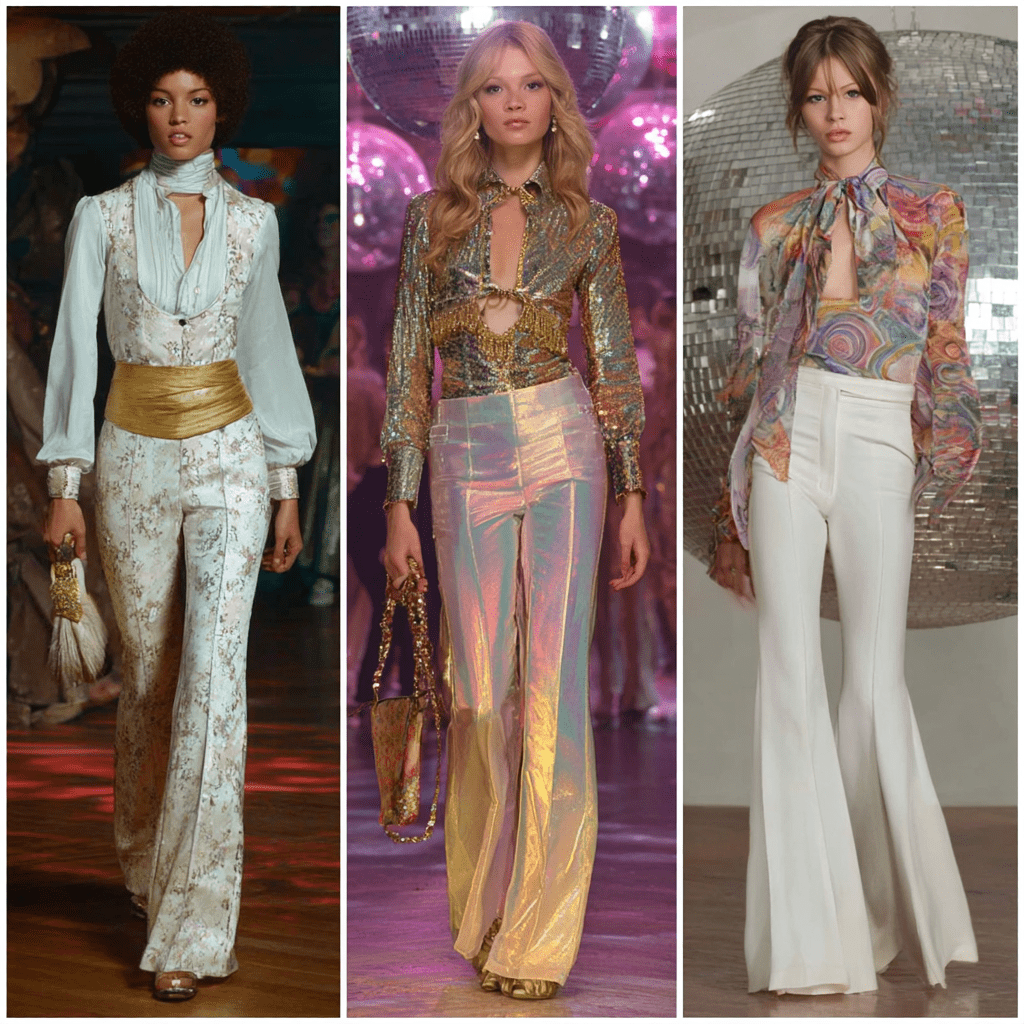
The 1970s disco wardrobe: brocade blouses with white flares, holographic sequin tops on the dance floor, psychedelic print against a mirror ball — three registers of the same decade’s ambition to be seen. Editorial illustration.
Why It Happened
The World That Made the Wardrobe
To understand why people dressed the way they did in the 1970s, you need to understand the extraordinary pressure cooker they were living inside. The decade opened with Vietnam still raging, Nixon in the White House, and a generation of young people who had just spent five years screaming at authority. The oil crisis of 1973 caused genuine economic terror. Inflation climbed. Unemployment climbed. And yet — perhaps because of all of this, perhaps in direct spite of it — hedonism absolutely exploded.
The logic was simple and human: if the world is going to be terrible, you might as well look extraordinary while it happens. The nightclub became a sanctuary. The dance floor became a place where race, sexuality, class, and politics briefly dissolved into something purely physical. Disco was born in Black, Latino, and gay communities in New York and Philadelphia as a reaction to the dominance of rock music — and the fashion that came with it was born of the same radical impulse toward freedom and visibility.
The broader fashion world took notice. Vogue was right: there were no rules. You could wear a floor-length ethnic caftan to a party in 1972 and a sequined halter to the same host’s house in 1977 and both choices would be considered entirely correct. It was a decade of extraordinary permission.
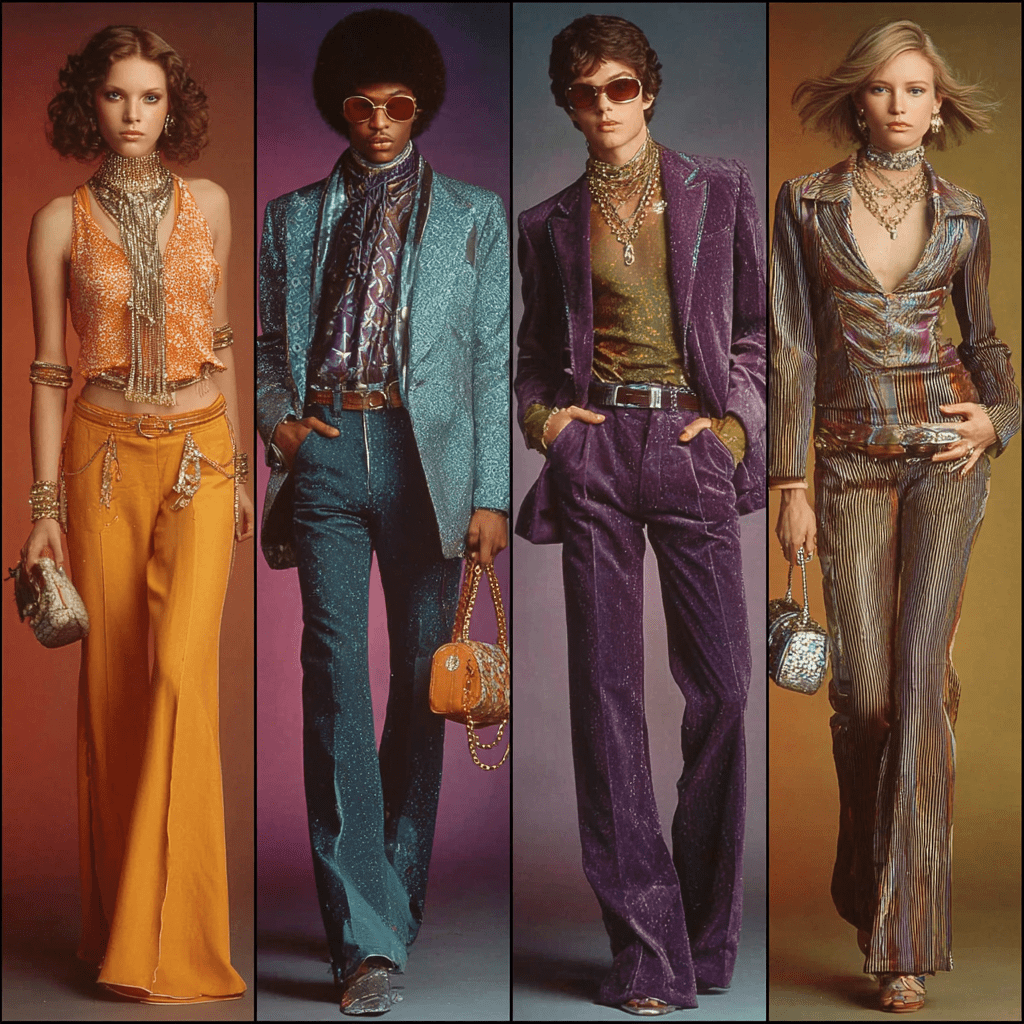
The full range of the 1970s disco wardrobe: orange fringe halter with amber flares, teal metallic blazer, purple velvet with gold chains, and iridescent striped suits — one dance floor, four entirely correct choices. Editorial illustration.
Women’s Disco Fashion
Sequins, Halters, and the Wrap Dress That Changed Everything
The woman walking into Studio 54 in 1978 had options. She could wear a Halston silk jersey gown, which would drape over her body with the elegant nonchalance of a waterfall and cost more than most people’s rent. She could wear a metallic jumpsuit in a colour that technically didn’t exist in nature. She could wear a DVF wrap dress — the single most democratic garment of the decade, which somehow looked equally good on every body type and took a 26-year-old Belgian designer from nobody to Newsweek cover in under two years. Or she could wear a sequined bodysuit, hot pants, and knee-high boots and be absolutely correct in every possible way.
Diane von Fürstenberg’s wrap dress deserves its own paragraph, and frankly its own monument. Introduced in 1974, it was a jersey knit dress that wrapped around the body and tied at the waist — simple in construction, revolutionary in effect. It went from desk to disco without changing. It was flattering on every size. By 1976, she had sold five million of them, appeared on the cover of Newsweek, and built a fashion empire. The Metropolitan Museum of Art has one in its collection. That’s not a small thing.
Halston was the other defining designer of the era — the unofficial couturier of Studio 54, the man who dressed Liza Minnelli, Bianca Jagger, and Elizabeth Taylor in silk jersey gowns of such liquid simplicity they looked almost effortless. They were not effortless. They were the product of a bias-cut technique that required extraordinary precision, and they cost accordingly. Halston was so associated with Studio 54 that when the club closed in 1980 and fashion moved on, his career effectively moved with it.
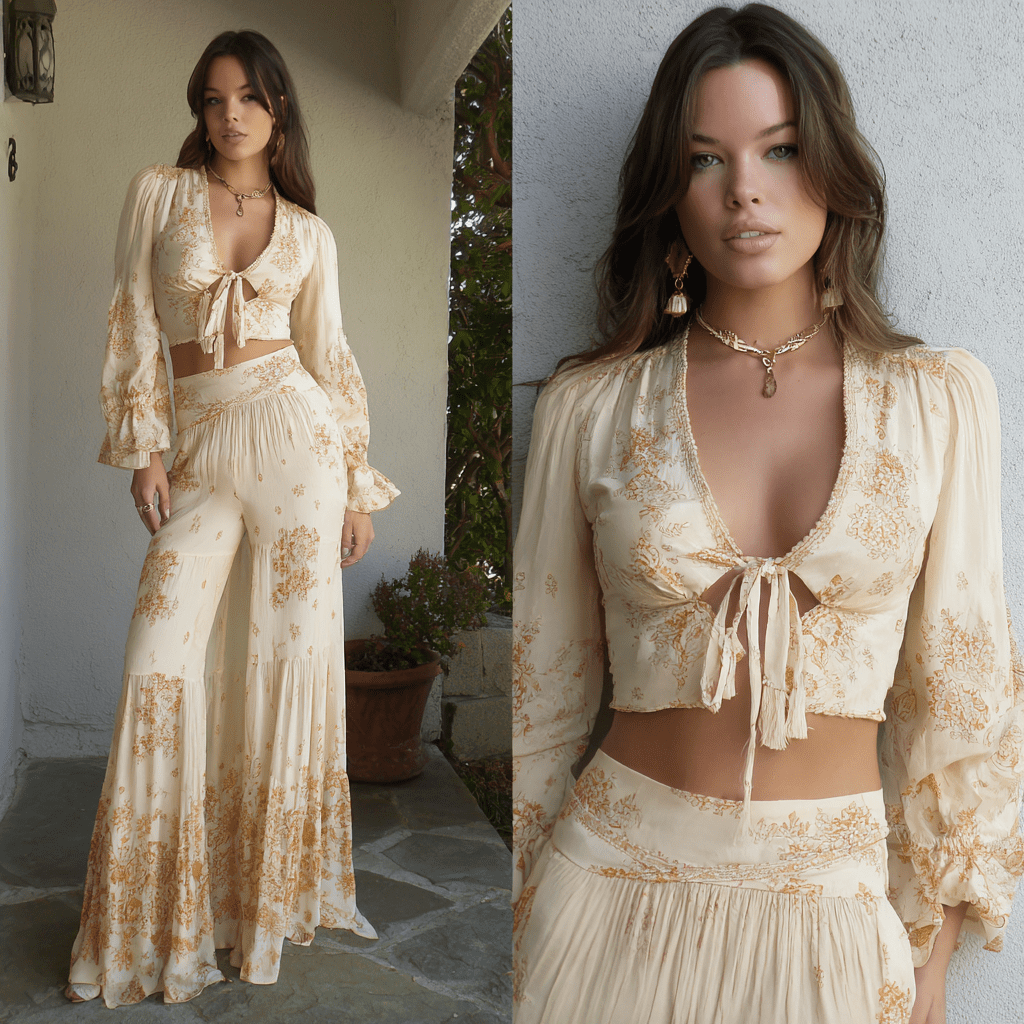
The 1970s silhouette in practice: a satin tie-front crop top in cream with golden floral print, paired with matching wide-leg flares and gold chain jewellery — the decade’s characteristic mix of bohemian ease and deliberate glamour. Editorial illustration.
“In the 1970s, people wore clothes that stood out in order to fit in. The dance floor was the only place that made sense.”
The Disco Wardrobe — Women
- —Sequined or metallic halter dress
- —DVF-style jersey wrap dress
- —Silk or satin jumpsuit, wide-leg
- —Spandex or disco pants (painted on)
- —Hot pants — micro-shorts in satin
- —Tube tops and bandeau tops
- —Palazzo pants — trousers that flowed like a skirt
- —Plunging necklines (practically mandatory)
- —Sheer fabric over a bodysuit
- —The caftan — for when you wanted to be dramatic without moving
The Everyday 70s Wardrobe — Women
- —Bell-bottom jeans (worn by literally everyone)
- —Peasant blouses — embroidered, floaty
- —Maxi dresses in floral prints
- —Mexican ponchos and capes
- —Tie-dye everything (early in the decade)
- —Midi skirts — the length nobody liked but everyone wore
- —Denim jackets with patches and embroidery
- —Earth shoes and clogs for daytime
- —Fringe vests over everything
- —Wrap skirts and tiered cotton skirts
It’s worth noting that designer jeans arrived in this decade and were an absolute social phenomenon. Calvin Klein launched his own jeans in 1976 for $50 a pair at Bloomingdale’s — which was considered an absurd price for denim at the time — after a stranger reportedly approached him on the Studio 54 dance floor at 4am and suggested the idea. Gloria Vanderbilt held her first jeans show at Studio 54. The jeans were tight, they were expensive, and they were everywhere.
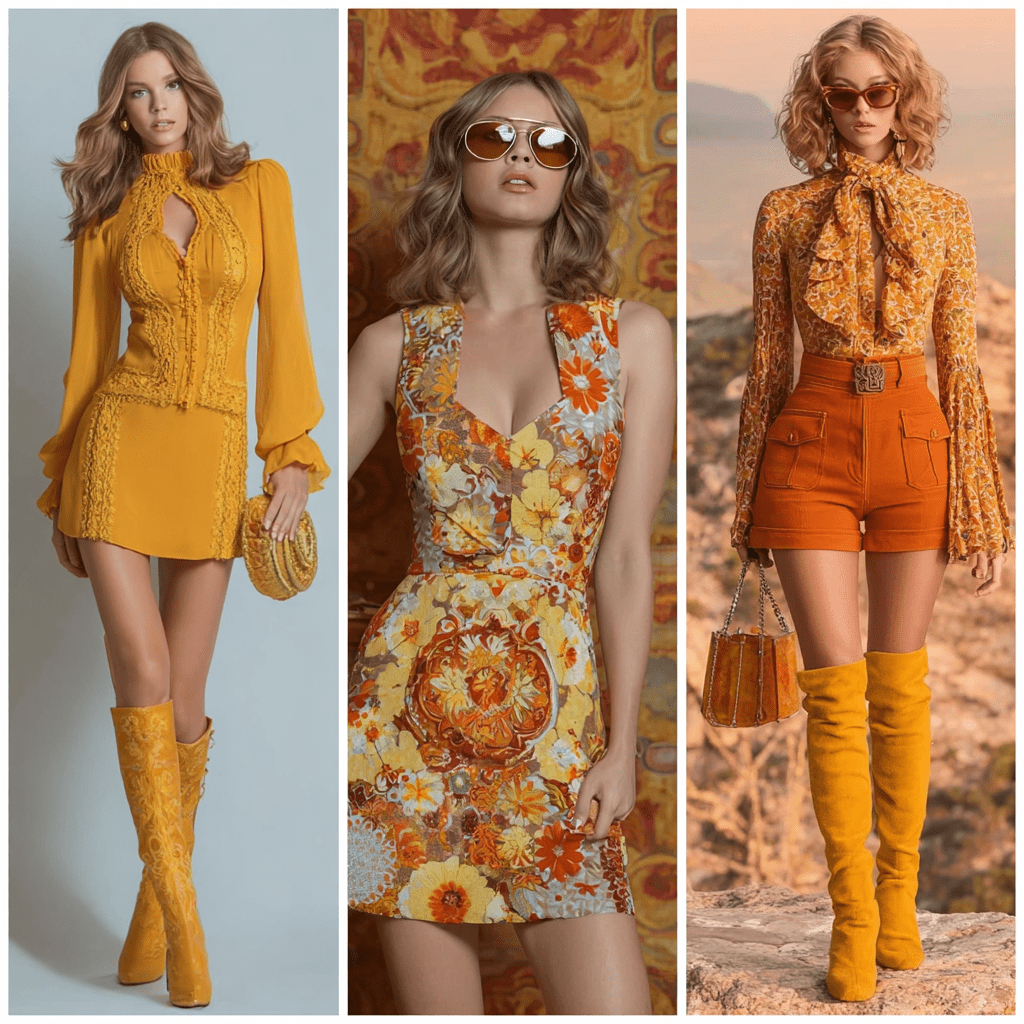
The everyday 1970s wardrobe: mustard ruffled blouses, floral mini dresses, bold printed blouses with orange shorts — the decade’s characteristic warmth of colour and layered personality. Editorial illustration.
Men’s Fashion — The Underrated Chapter
The Peacock Revolution: When Men Dressed Like They Meant It
Here is something fashion history doesn’t say loudly enough: the 1970s was one of the greatest decades for men’s fashion in history. Not because everything looked good — some of it looked spectacular, some of it looked like a sofa — but because men were trying. They were making choices. They were wearing colours that had names. After decades of grey suits and khaki chinos, an entire generation of men looked at their wardrobes and thought: no. Not today.
This was the tail end of what fashion historians call the Peacock Revolution — a term coined by consumer psychologist Ernest Dichter in 1965 and popularised by journalist George Frazier in Esquire. The movement began in London on Carnaby Street in the late 1950s, where boutiques started selling bright, flamboyant, explicitly queer-influenced clothing to young men who were done with their fathers’ wardrobes. By the time it reached mainstream America in the early 1970s, it had become something extraordinary: men in crushed velvet suits in emerald green, satin shirts with lace ruffles on the cuffs, wide-lapel jackets in colours that would embarrass a parrot.
The male trendsetters of the era were actually called Dandies, Dudes, and Peacocks — openly, approvingly, in the press. David Bowie as Ziggy Stardust wore spandex jumpsuits and six-inch platform boots and looked like a visitor from a more interesting planet. Mick Jagger performed in wide-legged satin trousers and shirts unbuttoned to the navel. Elton John competed to see how much could theoretically be attached to a single pair of glasses. These were the style icons of the decade, and teenage boys wanted to look like them.
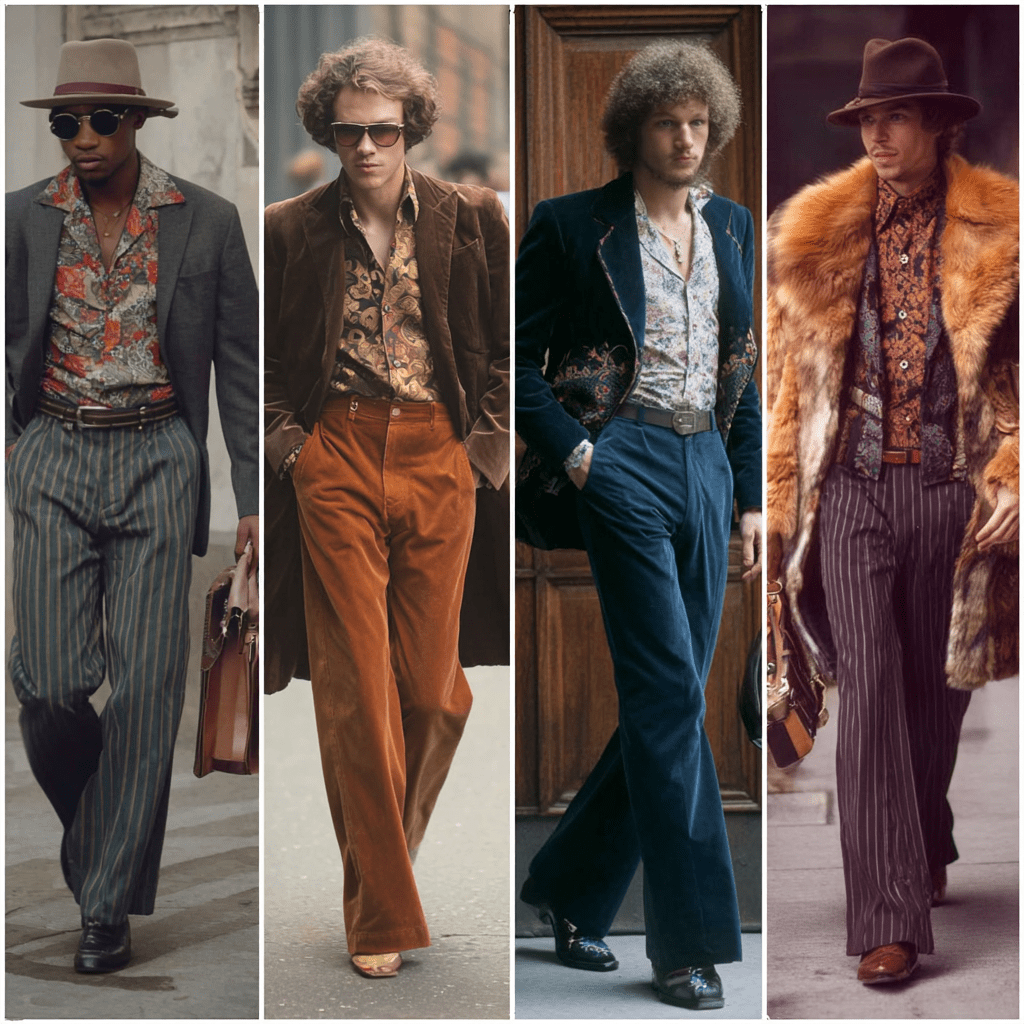
The 1970s man, in full: wide-brim hat and pinstripe flares, brown velvet and corduroy, navy velvet blazer, and a fur coat worn with the confidence of someone who has never once second-guessed a wardrobe choice. Editorial illustration.
Men’s Disco & Going-Out Wardrobe
- —White or cream three-piece suit (the Travolta)
- —Polyester leisure suit — yes, deliberately polyester
- —Silk or satin shirt, open three buttons minimum
- —Wide lapels (the wider, the better)
- —Bell-bottom trousers — “angel flights”
- —Gold chains — one per decade would have been insufficient
- —Platform shoes or boots in patent leather
- —Jumpsuits for the truly committed
- —Aviator sunglasses (indoors, at night, non-negotiably)
Men’s Everyday 70s Wardrobe
- —Corduroy everything — trousers, jackets, the hat somehow
- —Turtlenecks (worn by intellectuals and people who thought they were)
- —Flannel shirts, peacoats, tartan jackets
- —Denim bell-bottoms with embroidery or patches
- —Candy-striped blazers
- —Knit sweater vests over a collared shirt
- —Wide-collar shirts in bold prints
- —Earth shoes and cowboy boots
- —Long hair. Always long hair.
The leisure suit deserves special mention because it is both a genuine historical artefact and also quite funny. A two-piece polyester ensemble — fitted jacket, flared trousers, often with contrast stitching and wide lapels — it came in mustard yellow, powder blue, burnt orange, and olive green. It was designed to be worn without a tie. It was considered a relaxed look. Its popularity peaked with Saturday Night Fever in 1977 and was essentially finished by 1980, when the decade ended and men suddenly decided they had never owned one.
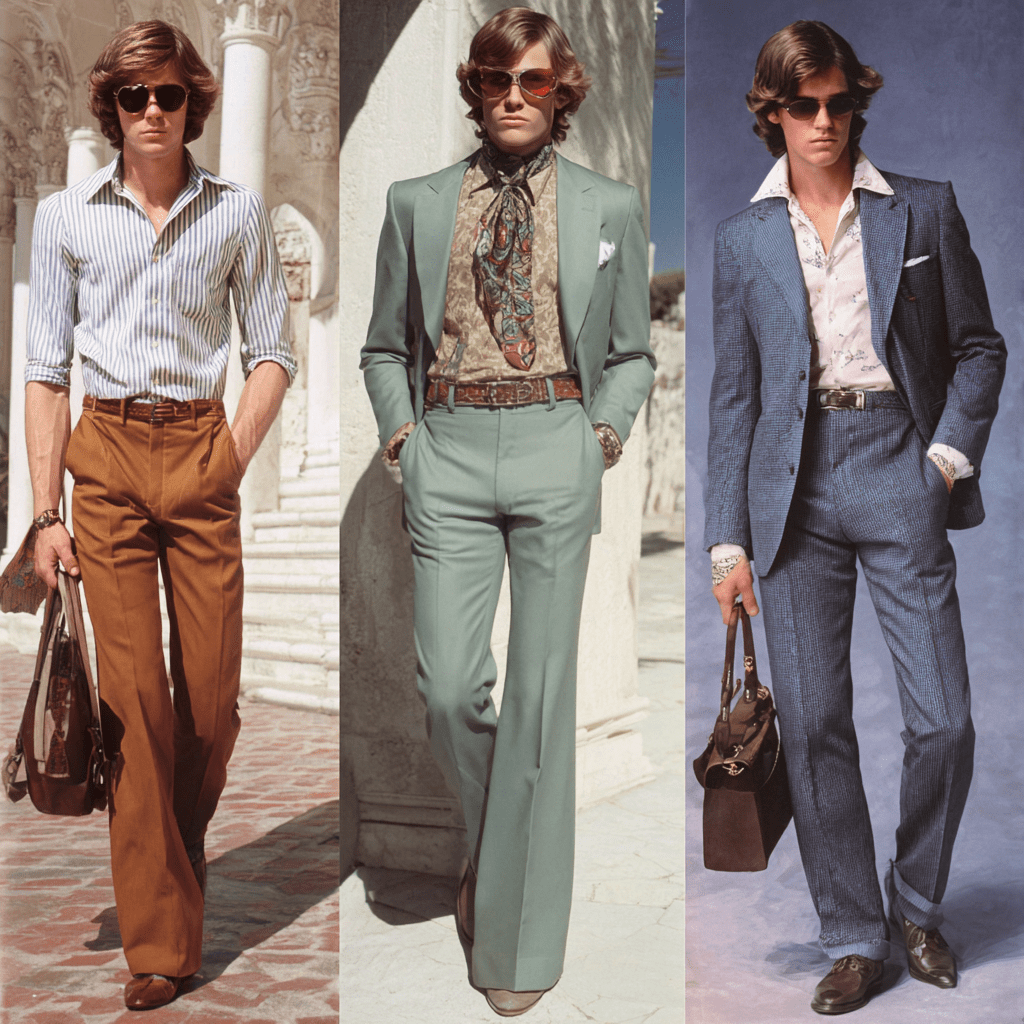
The 1970s man’s wardrobe in its full range: bold stripes with wide-leg trousers, a sage mint suit with paisley scarf, a textured blue wide-leg suit — men making choices, loudly and with conviction. Editorial illustration.
The Full Accessory Universe
The Stuff That Made the Look the Look
If the 1950s was the decade of pearl chokers and white gloves, the 1970s was the decade of more. More jewellery. More colour. More volume. More rings, chains, belts, bags, and hats than any reasonable person would need. Accessories in the 70s were not finishing touches — they were primary statements. You could, and many people did, walk into a room in a very simple outfit and communicate everything important about yourself through what you had attached to your person.
💍
Mood Rings
Invented in 1975, these thermochromic rings changed colour with your body heat and were sold as a guide to your emotional state. High-end versions sold for $250. Everyone wanted one. Nobody fully trusted them.
👟
Platform Shoes
Entered the mainstream via a 1970 issue of Seventeen magazine. Worn with bell-bottoms (which required the height to avoid dragging), covered in glitter or patent leather, sometimes 4–5 inches tall. David Bowie as Ziggy Stardust wore the definitive version.
🕶️
Aviator Sunglasses
Originally military pilot eyewear, repurposed by the 1970s as the universal symbol of cool. Oversized frames, gold or silver wire, slightly tinted lenses. Worn by everyone from Steve McQueen to the guy at the grocery store. Still correct today.
📿
Gold Chains
For men, the gold chain worn over an open shirt was as essential as a collar. One was fine. Several were better. The “medallion man” — open shirt, gold chain, slight tan — became a cultural archetype, later a gentle cultural joke, and is now quietly fashionable again.
🎀
Feather Boas
Marabou, ostrich, dyed in every possible colour. Worn to Studio 54, worn on stage, worn by Cher for what appeared to be Tuesday afternoon errands. The feather boa asked nothing of you except commitment.
👒
Wide-Brim Floppy Hats
The bohemian hat of the early 70s — floppy, wide, often in suede or felt. Worn tilted at an angle over long hair. Appeared in every folk music album cover between 1970 and 1974. Completely disappeared by 1976 when the disco hat took over.
🧲
Wide Belts
Braided leather, beaded Indian patterns, shiny vinyl, metal with rhinestones, velvet — the belt in the 1970s was a decorative statement as much as a functional one. Worn high on the waist over a wrap dress or cinching a jumpsuit.
👂
Hoop Earrings
The bigger the hoop, the more correctly 1970s you were. Gold, silver, bamboo-style, beaded — hoop earrings had existed for centuries but the 70s claimed them entirely. Still synonymous with the decade. Still in fashion.
👜
Clutch Bags & Metal Mesh
The disco bag was small, impractical, and beautiful. Metal mesh clutches, coin purse bags, tiny beaded evening bags that could hold exactly three items. Practical daytime bags were chunky tooled leather or wicker. Neither was subtle.
And then there were clogs. Wooden-soled, leather-upper, metal-studded, and suddenly everywhere. Platform clogs in particular — a chunky wooden wedge with a leather upper — were the practical daytime companion to the platform stiletto. They also made an extraordinary sound on a hard floor, which some consider a feature. The 1970s generally considered anything that announced your arrival to be a feature.
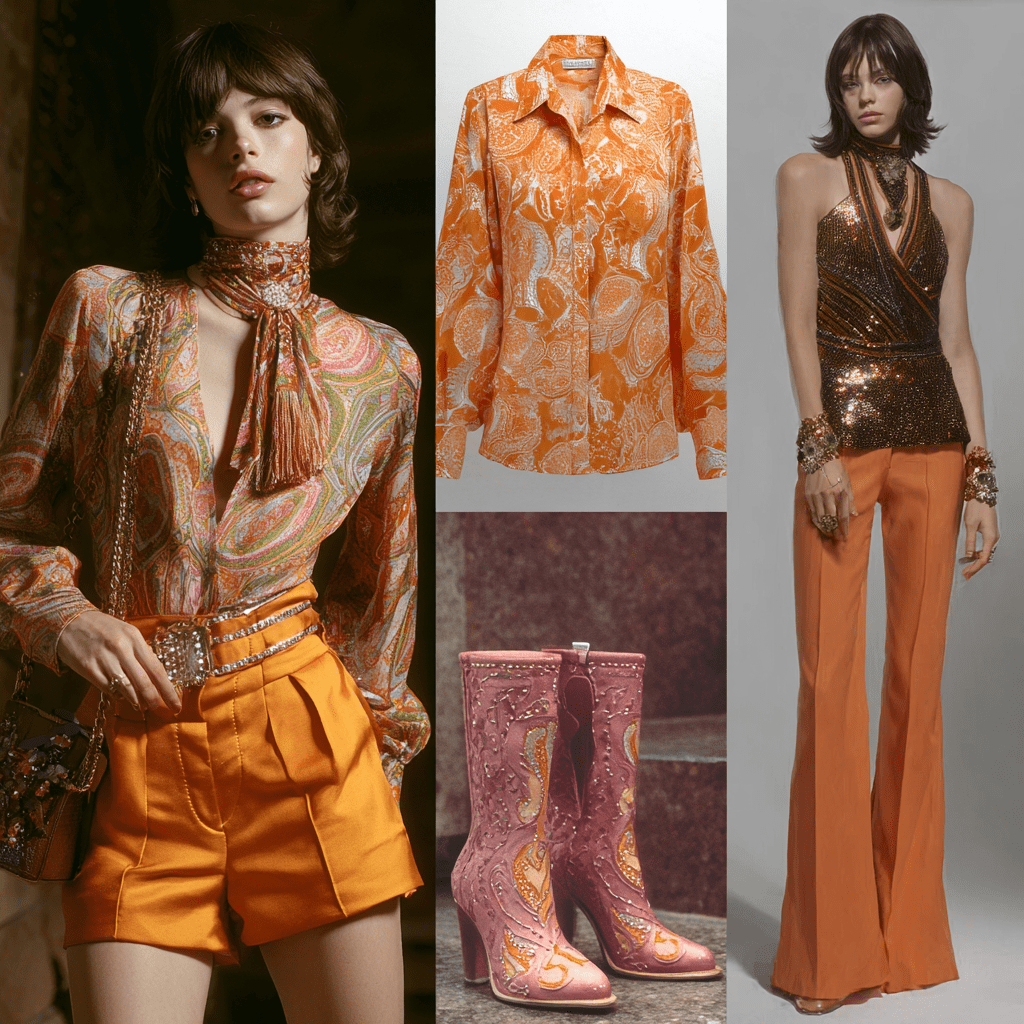
The 1970s accessories and outfit details: paisley blouses with jeweled belts, orange paisley silk shirts, pink embroidered cowboy boots, and sequin halter tops with wide-leg flares — the decade in four frames. Editorial illustration.
✦ ✦ ✦
The Epicentre
Studio 54: Open 33 Months, Culturally Immortal
It is almost impossible to overstate how much of 1970s fashion history ran through a single address: 254 West 54th Street, Midtown Manhattan. Studio 54 opened on April 26, 1977, operated for just over three years before its owners were arrested for tax evasion in 1980, and in that time managed to reshape global fashion, elevate designers to celebrity status, and create an aesthetic template that designers are still referencing today.
The owners, Steve Rubell and Ian Schrager, had a door policy of baroque selectivity. Rubell stood at the velvet rope personally, choosing who entered based on what they were wearing and how they looked — a system that was equal parts cruel and brilliant, because it meant the people inside were always the most extraordinarily dressed people in New York on any given night. An outfit wasn’t just worn at Studio 54. It was performed.
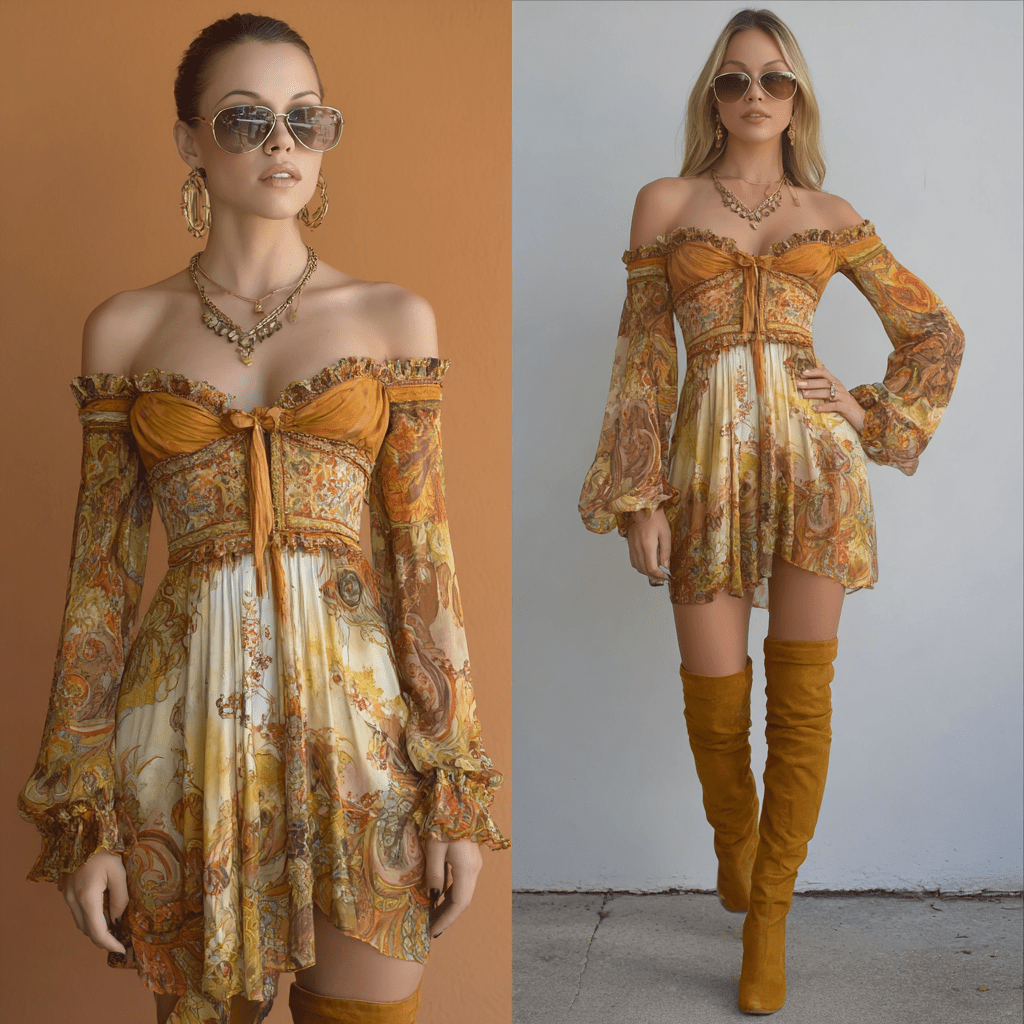
Studio 54 energy in daylight: an off-shoulder paisley baroque mini dress with bell sleeves in amber and cream, styled first with gold jewellery alone, then with yellow thigh-high boots — two versions of the same conviction. Editorial illustration.
The Icons
The People Who Defined the Decade
The Full Picture
It Wasn’t All Disco: The Other Three 70s
Here is where most articles about 1970s fashion fail you: they describe the disco floor and call it done. But the 70s contained multitudes, and if you’re going to understand the decade — or dress for a 70s-themed event without looking like you raided a costume shop’s “disco” rail — you need to know the rest of the story.
The early 70s hippie hangover is the version your mum or grandmother might remember. Tie-dye, bell-bottoms, peasant blouses, maxi dresses in floral prints, ponchos, military surplus jackets worn ironically, Birkenstocks, and handmade jewellery from natural materials like wood, shells, and leather. This was the 1960s counterculture settling into mainstream fashion — and it dominated from about 1970 to 1974 before the disco aesthetic began its takeover.
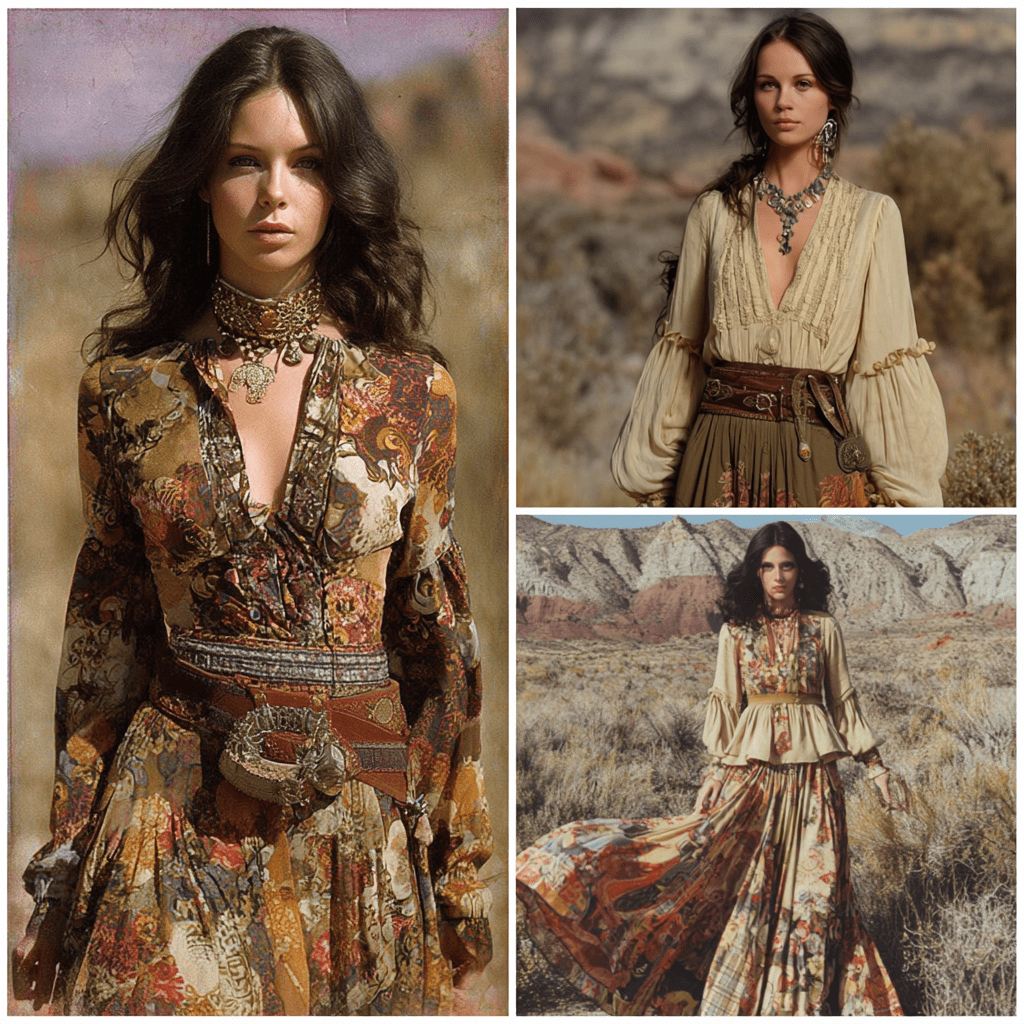
The early 1970s bohemian wardrobe: floral tapestry maxi dresses, cream poet blouses with olive skirts, and ivory billowing floral midis — the 1960s counterculture settling into mainstream fashion, photographed against the decade’s characteristic open landscapes. Editorial illustration.
Glam rock existed in parallel and was, if anything, even more extreme than disco. This was Bowie, Elton John, Marc Bolan, Gary Glitter — men in feather boas and platform boots performing in arenas, creating a visual language of theatrical excess that fed directly into the disco aesthetic while also feeding into punk. Glam rock gave permission. Disco took that permission and added a mirror ball.
Punk arrived at the end of the decade, mostly in the UK, as a deliberate rejection of everything that had come before. Ripped clothing, safety pins, bondage trousers, band T-shirts, DM boots, deliberately offensive graphics — punk was anti-fashion used as fashion, which is its own kind of genius. It was angry about the economy, angry about the leisure suit, and it dressed accordingly. The irony is that punk’s anti-fashion aesthetic has itself become one of the most referenced fashion movements in history. Nothing dates faster than trying to be timeless. Nothing lasts longer than trying to be offensive.
For the Practical Reader
How to Wear the 70s Without Looking Like a Costume
This is what you came for, so here it is: how to incorporate 1970s style into an actual contemporary wardrobe, or how to dress for a 70s-themed event without your outfit being “person who clearly just visited a Halloween shop.” The key difference between looking genuinely 70s and looking like a 70s costume is specificity. Generic is costume. Specific is fashion.
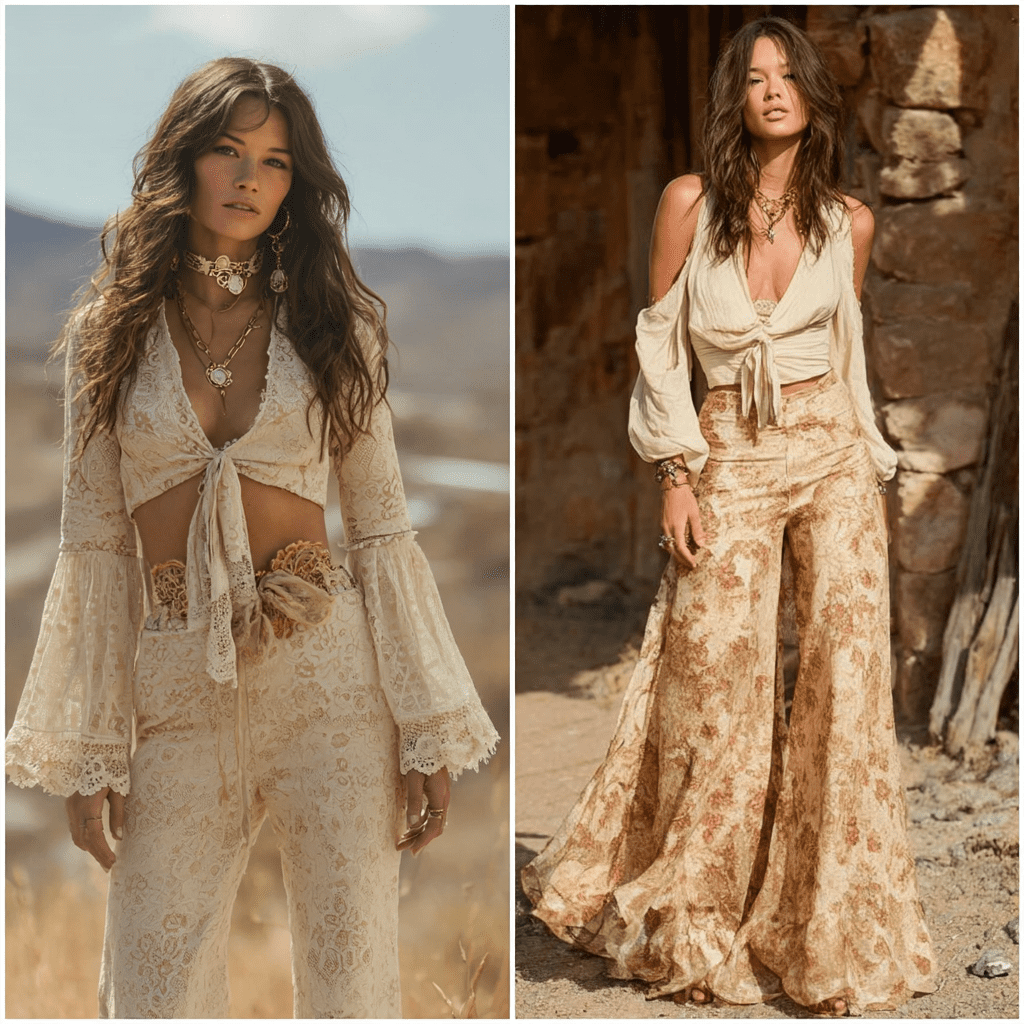
The wearable 1970s: lace bell-sleeve crop tops with matching lace flares, cold-shoulder tops with floral wide-leg trousers — the bohemian register of the decade that translates most directly into a contemporary wardrobe. Editorial illustration.
01
Pick One 70s Signal
A wide lapel blazer, a wrap dress, flared trousers, or platform boots. One strong period element reads as intentional. Four reads as fancy dress. The 70s icons themselves mixed period pieces with simpler items — Bianca Jagger’s iconic looks often featured one extraordinary piece and very clean everything else.
02
Colours Matter Enormously
The 70s palette is specific: burnt orange, mustard yellow, olive green, harvest gold, chocolate brown, rust, avocado. These earth tones are the everyday 70s. For disco, go metallic gold, silver, or midnight black with shine. Getting the colours right is 60% of the look.
03
The Wrap Dress
DVF’s wrap dress is still in production, has never stopped being flattering, and requires zero costume commitment. Wear it with heeled sandals and large hoop earrings and you will look excellent in every decade simultaneously. It is genuinely the most versatile garment of the twentieth century.
04
Men: Wide Lapels, Not Leisure Suit
A wide-lapel blazer in a solid colour over a simple open-collar shirt is sophisticated 70s. The full polyester leisure suit is its own commitment and requires confidence. If you have that confidence, respect. If not, a wide-lapel blazer from a vintage shop costs very little and reads as exactly right.
05
The Accessories Do the Work
Aviator sunglasses, a pair of hoop earrings, platform sandals, or a wide woven belt — any of these instantly signals the decade without requiring a full period outfit. The accessories are where you can go full 70s while the clothes stay contemporary.
06
For a Themed Event: Go All In
If you’ve been invited to an actual disco night or 70s party, do it properly. Sequined halter dress or metallic jumpsuit for women. White suit or silk shirt open to the chest with visible chain for men. Platform shoes for everyone. You will not regret committing. You will regret being the person who wore jeans.
Legacy
Why It All Still Matters
The 1970s comes back into fashion with such reliable regularity that at this point it barely makes sense to call it a revival. Wide-leg trousers, platform shoes, wrap dresses, aviator glasses, hoop earrings, metallic fabrics, bold prints, the silhouette of tight on top and volume on the bottom — all of these return to the runways roughly every eight years and are described as “fresh” and “new” each time. They are not fresh and new. They are 1970s. The 1970s was just correct.
What made the era’s fashion last is the same thing that made it remarkable at the time: it came from genuine cultural energy. Disco was born in communities that had been marginalised and had decided, defiantly, to be visible. Glam rock was born in the collision between art, sexuality, and rock and roll. Punk was born from economic anger. The clothes were the expression of something real — which is why they still communicate something real when you wear them today.
“Fashion is not about clothes. It is action, energy, and exultation. The 1970s proved this completely — and then kept proving it for ten years straight.”
The other thing the 1970s understood, which fashion periodically forgets and has to rediscover: dressing should be fun. Not careful, not self-conscious, not minimalist by default. The 1970s person looked in the mirror and asked not “is this too much?” but “is there anything I could add?” And then they added it. And then they went dancing.
We could all do with a bit more of that.
✦ ✦ ✦
Illustrations created for editorial and cultural reference purposes. Historical facts sourced from contemporaneous fashion publications, the CFDA, and archival records. Studio 54 facts sourced from Britannica and primary accounts from designers and patrons.


Leave a Comment