
here has never quite been a decade for weddings like the 1950s. After years of wartime austerity — modest civil ceremonies, borrowed dresses, rationed cake — America and much of the Western world collectively exhaled and threw the most extravagant parties it could afford. The boys had come home. The economy was booming. The baby boom was officially underway. And every bride in the land, it seemed, wanted a proper wedding.
What followed was a decade that essentially invented the modern wedding industry: professional photographers, tiered cakes, department-store bridal registries, engraved invitations, and ballroom receptions with live orchestras. It was formal, it was romantic, it was governed by rules most people today have never heard of — and it was absolutely, unapologetically spectacular.
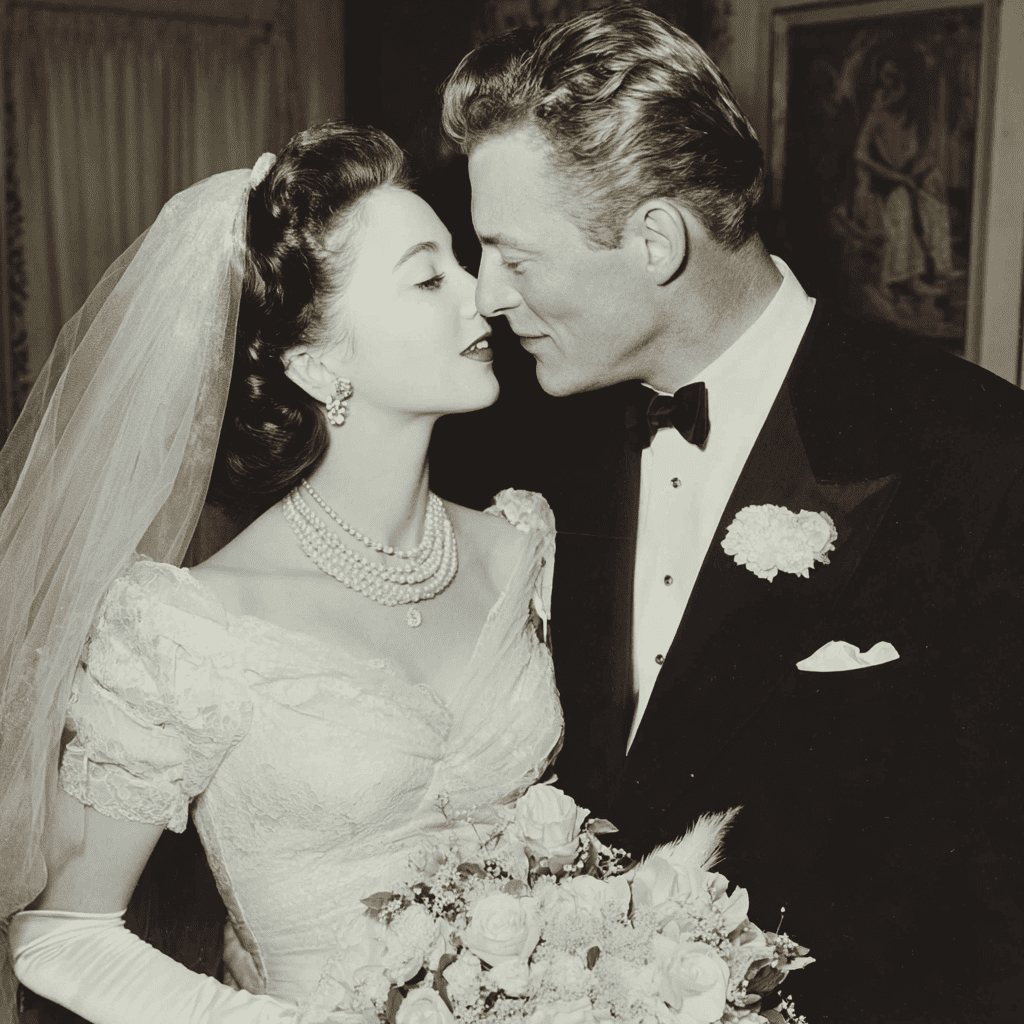
The 1950s wedding: a lace gown, a cathedral veil, pearl jewellery, and a groom in a formal dinner suit. The decade brought the grand romantic wedding back from years of wartime austerity. Editorial illustration.
Post-War Joy and the Return of Romance
The 1950s wedding was born of relief. The understated wartime wedding — often a quick civil ceremony before a soldier shipped out — had been a practical necessity. By 1950, with prosperity returning, couples were not just getting married; they were making a statement. A wedding was proof that life was good again.
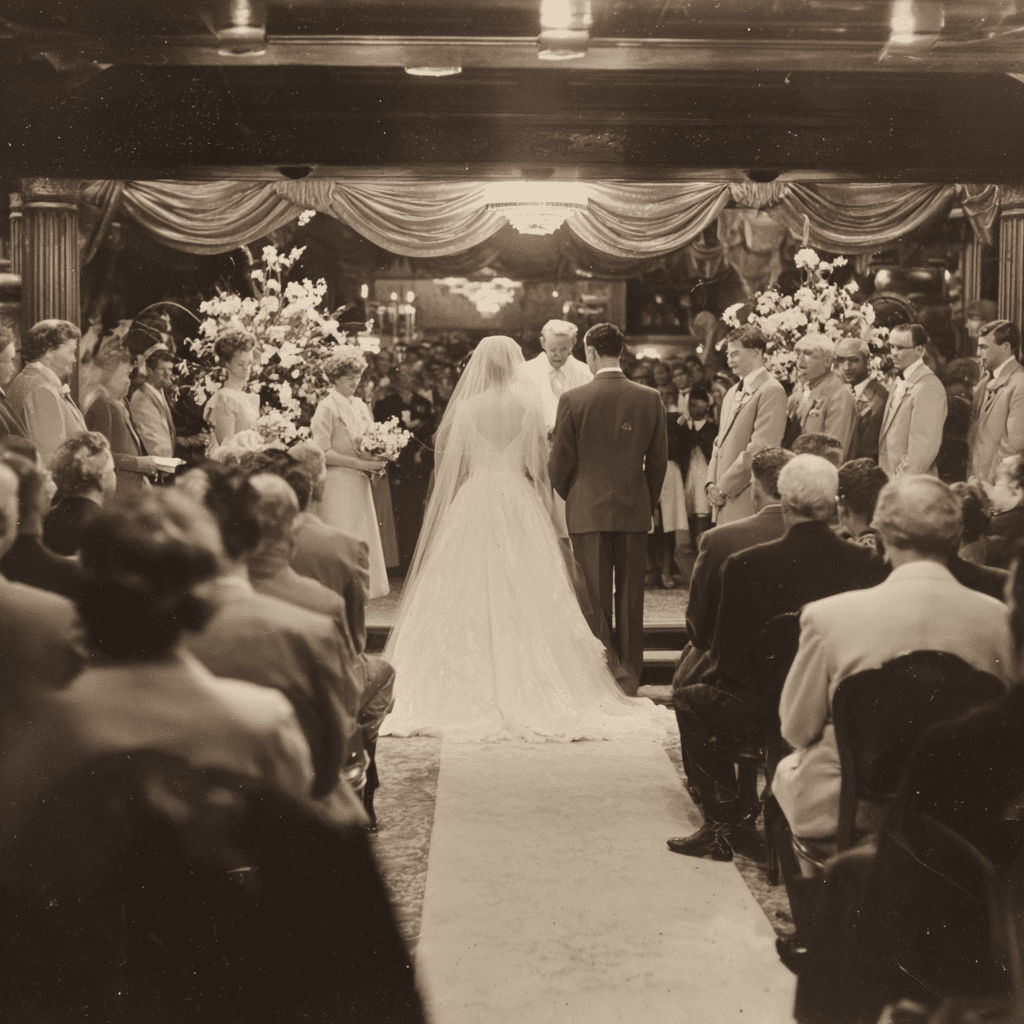
A 1950s church wedding in full: the couple at the altar, the aisle lined with white flowers, and every pew filled with formally dressed guests. Religious ceremonies were simply the default. Editorial illustration.
As one contemporary account put it, with the world safe again, the extravagant wedding was reborn, given new impetus by a blossoming economy and a generation of young couples eager to settle down and build the life they had been promised. Films such as Father of the Bride (1950) glamorised the whole affair; Grace Kelly’s marriage to Prince Rainier in 1956 turned bridal fashion into an international obsession.
“Brides who had married in somber suits just years before now wanted lovely gowns, enormous cakes, and a reception that their guests would never forget.”
The wedding industry as we know it crystallised in this decade. Caterers, cake designers, and professional photographers came into their own. Bridal wear arrived in department stores. Knockoffs of designer gowns — particularly those inspired by Hollywood couture — became widely available to the middle-class bride. For the first time, nearly every woman could have something approaching a dream wedding.
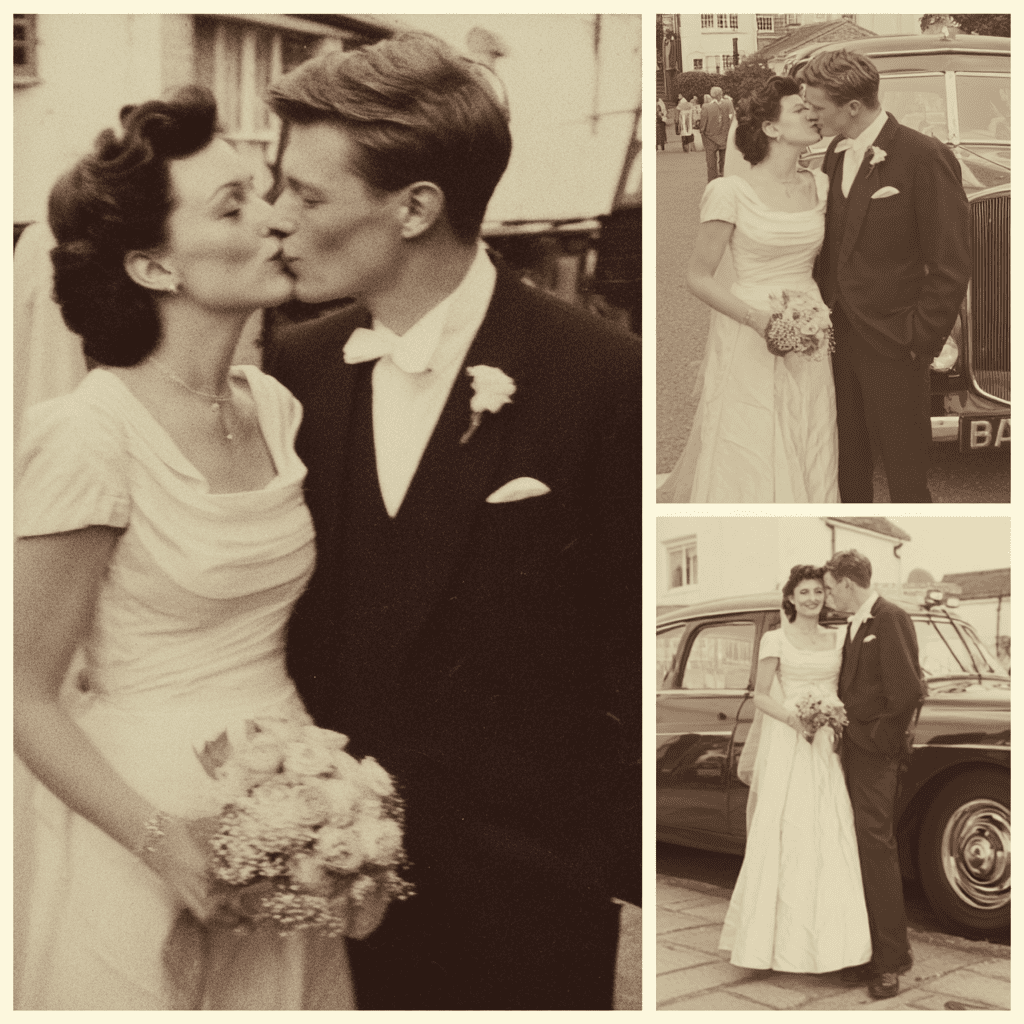
1950s newlyweds: a sepia record of the decade that made the grand wedding the universal ambition — couples photographed outside their churches, beside the decade’s gleaming automobiles. Editorial illustration.
The Dress, the Gloves, and the Juliet Cap
If one silhouette defines the 1950s bride, it is the tea-length or ballerina-length A-line gown — a nipped-in waist, a full skirt of tulle or taffeta, and enough lace to keep an entire French atelier busy. Dresses were designed with a singular purpose: to emphasise the smallest possible waist and the fullest possible skirt. Christian Dior’s post-war “New Look” — cinched waist, full hem — had seeped into bridal fashion completely, and brides embraced it with enthusiasm.
Modesty was paramount. Long sleeves or elbow-length gloves were essentially mandatory. Necklines were modest — a sweetheart or jewel cut rather than anything plunging. White gloves were so universal they were practically a uniform; to appear at the altar bare-handed would have been considered distinctly underdressed.
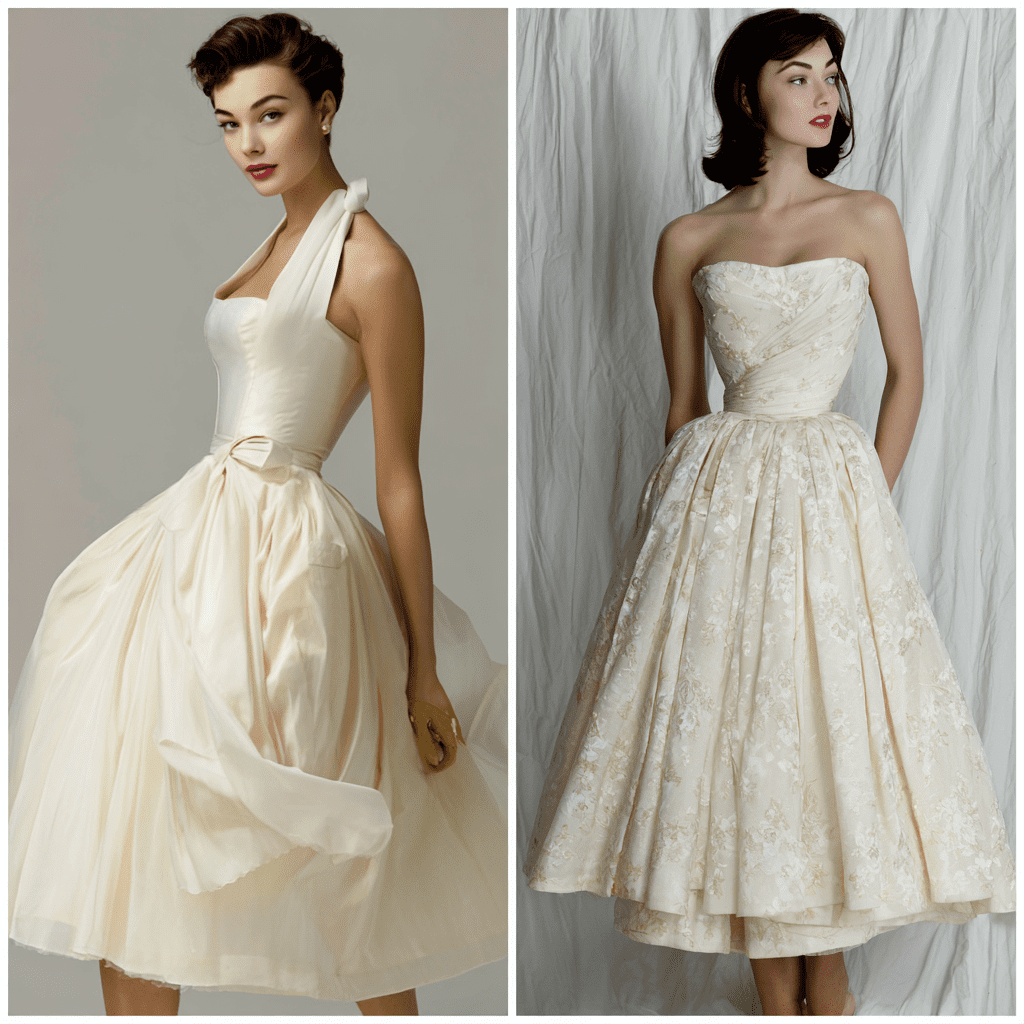
The 1950s bridal silhouette: from the halter-neck silk organza A-line to the strapless brocade tea-length gown — both defined by the era’s characteristic full, swirling skirt. Editorial illustration.
The Bride
- —Tea-length or ballerina-length A-line gown
- —Tulle, taffeta, or silk fabric
- —White elbow-length gloves
- —Juliet cap or birdcage veil
- —Red lipstick & “bedroom eyes” makeup
- —Pearl necklace or vintage brooch
- —Stockings (always)
The Groom
- —Black or dark navy tuxedo
- —Single-breasted jacket (new in the ’50s)
- —White dress shirt & black bow tie
- —Cummerbund
- —Tapered trousers (more fitted than before)
- —White pocket square
- —Patent leather shoes
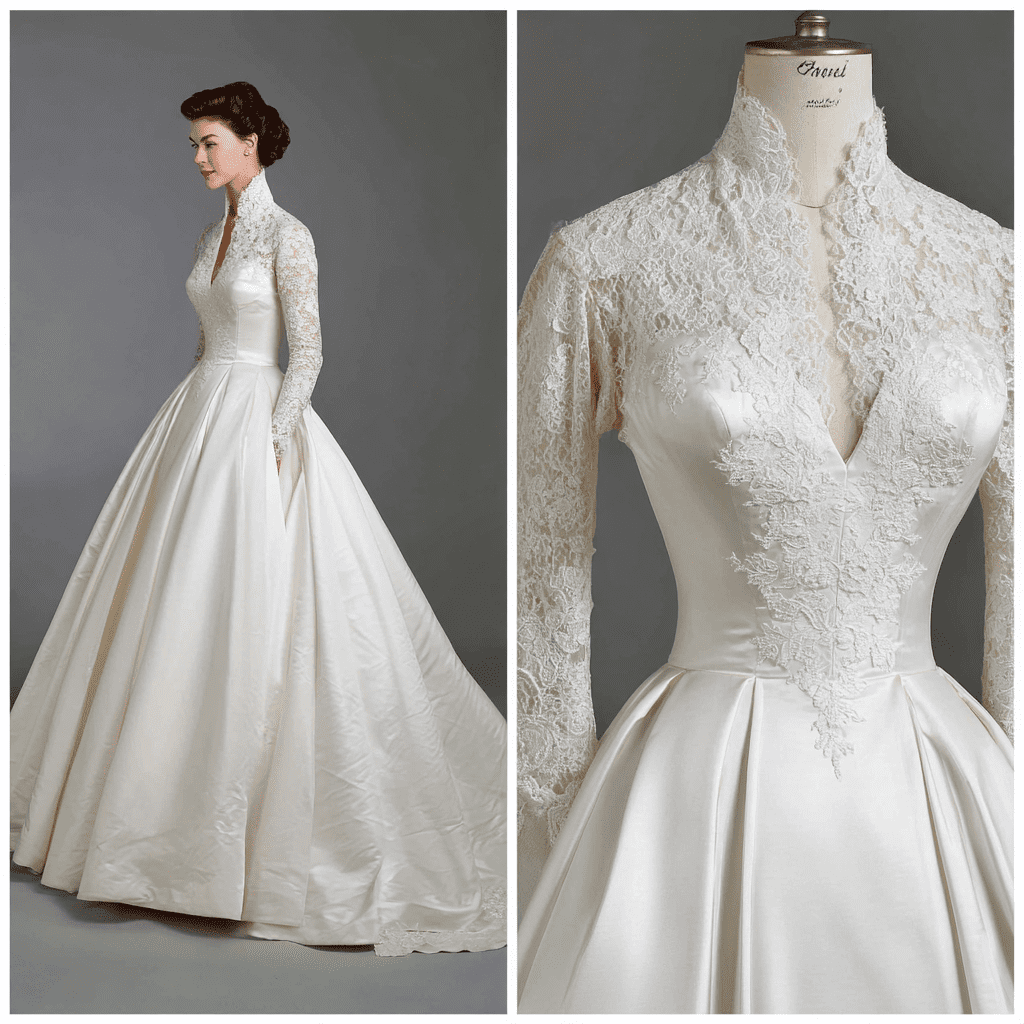
Bridal detail: a high-necked lace bodice with long sleeves over a full satin skirt — the quintessential 1950s gown that balanced modesty with architectural grandeur. Editorial illustration.
For headwear, the Juliet cap — a small, close-fitting skullcap often decorated with seed pearls — reigned supreme. Short birdcage veils attached to a pillbox hat gave brides what fashion writers called “a slight modern edge” while still preserving tradition. The full-length cathedral veil existed but was considered rather formal even by 1950s standards.
As for jewellery: pearls were everything. A pearl choker, pearl earrings, or a treasured pearl necklace passed down from a grandmother were the accessories of choice. Vintage brooches were also fashionable — brides would raid their mothers’ jewellery boxes to find ornate Art Deco pins to add to their bouquets or attach to their gowns. Diamonds existed, but subtlety was considered more elegant than flash.
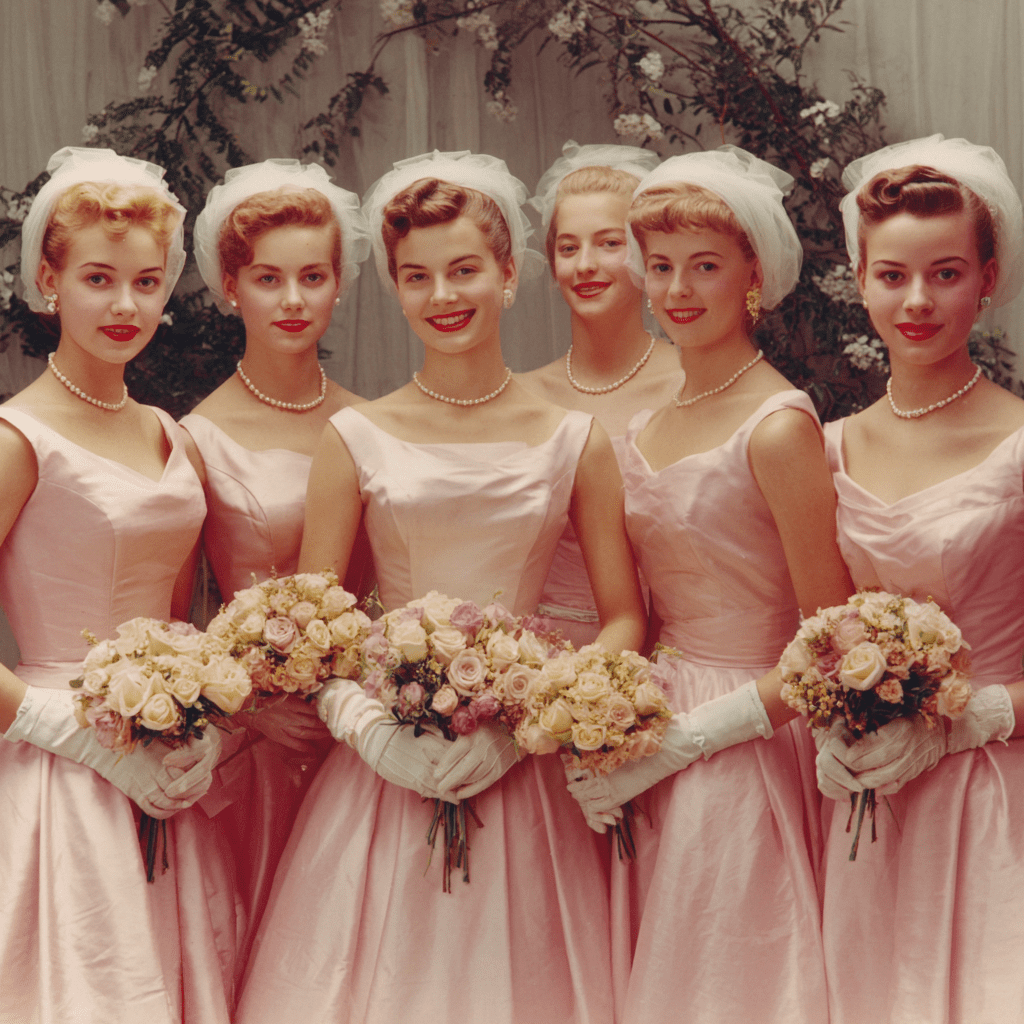
The bridal party: co-ordinated pink gowns, white gloves, matching veils, and rose bouquets held just so. A 1950s invention that every subsequent decade has borrowed wholesale. Editorial illustration.
Church, Vows, and the March Down the Aisle
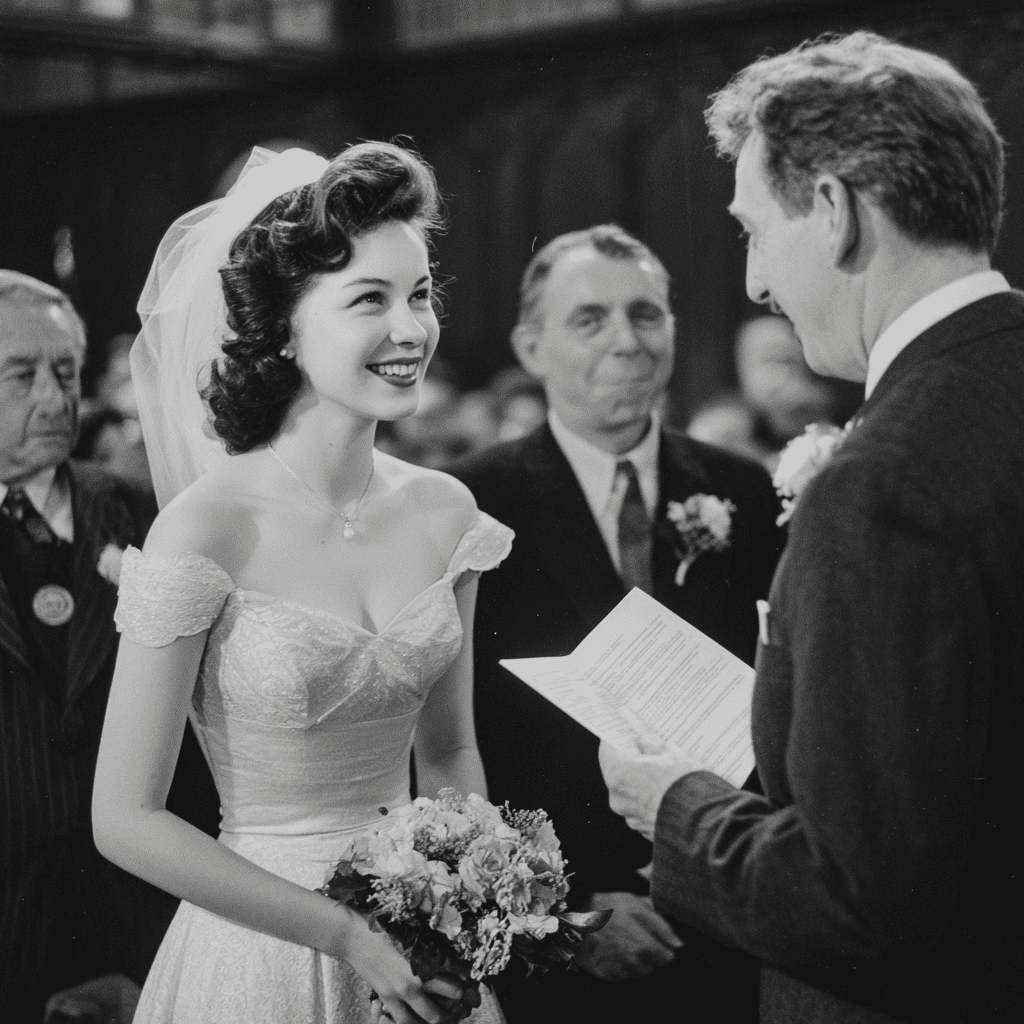
At the altar. The groom reads his vows to a radiant bride, the congregation bearing witness. In the 1950s, the exchange of vows was solemn, witnessed, and taken with complete seriousness. Editorial illustration.
Religious ceremonies were simply the default. The idea of a secular wedding venue — a barn, a garden, a winery — would have been genuinely baffling to most 1950s couples. Churches, synagogues, and other houses of worship were where weddings happened, full stop. The ceremony was solemn, dignified, and followed a strict order that everyone knew and respected.
Mendelssohn’s Wedding March played as the bride walked down the aisle. The bride’s father escorted her — “giving her away” in the most literal sense — before stepping back to greet special guests and usher old friends to the refreshment table. Interestingly, the father did not stand in the receiving line. That honour belonged to the mothers.
The exchange of vows was the absolute centrepiece of the event. No speeches, no readings from printed cards, no personalised poetry. The ceremony was about the vows, and the vows were taken seriously. Guests dressed accordingly — formal attire was mandatory not just for the wedding party but for everyone in attendance. A guest turning up to a 1950s wedding in anything less than a suit or day dress would have been considered an insult to the hosts.
“The ceremony was solemn and dignified, with the exchange of vows as its absolute, unquestionable centre.”
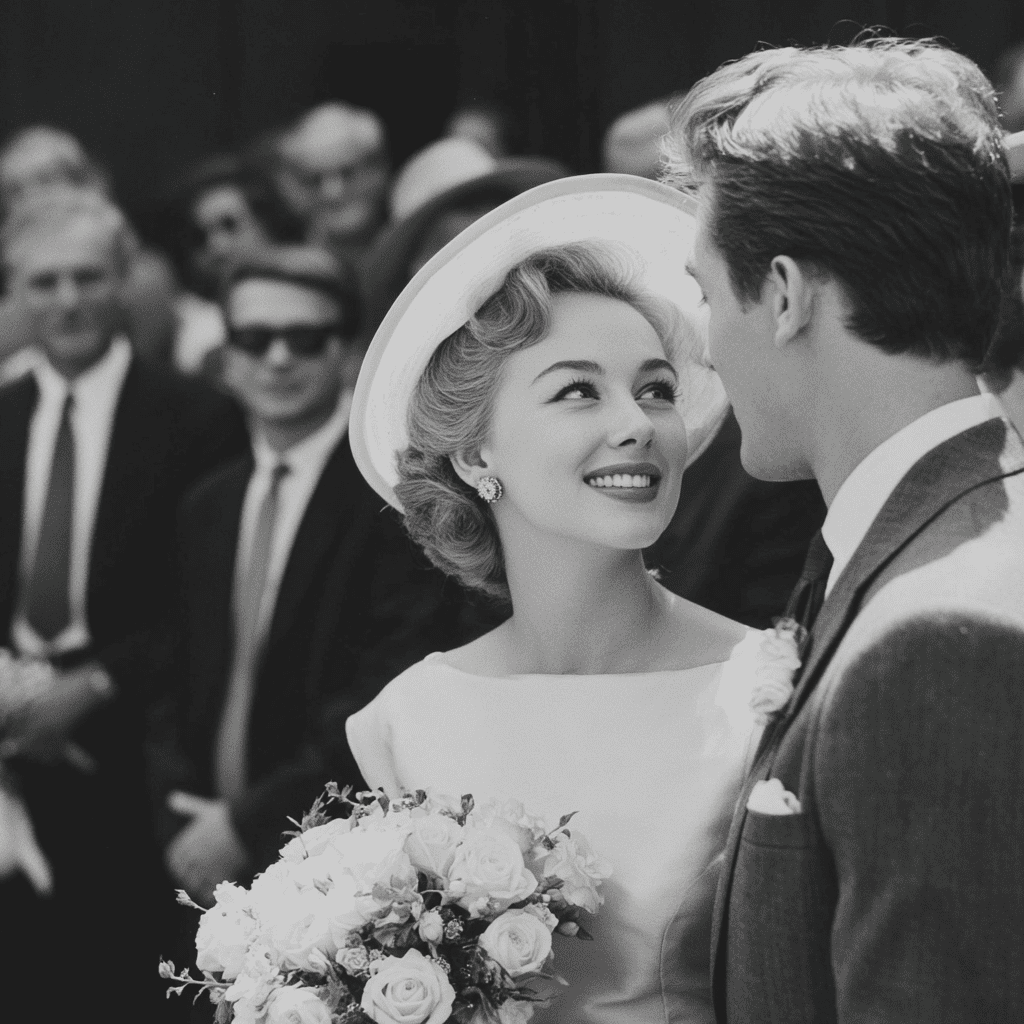
After the ceremony. A bride steps into the light — pillbox hat, white bouquet, the well-wishers pressing close. The formal portrait session followed immediately, as carefully staged as the ceremony itself. Editorial illustration.
A Strict Code: Wedding Etiquette in the 1950s
The 1950s wedding was one of the most rule-governed social events imaginable. Etiquette books — and there were many, consulted constantly — covered everything from the precise order of the receiving line to what food could be served at what time of day. Breaking these rules was not just embarrassing; it reflected poorly on the entire family.
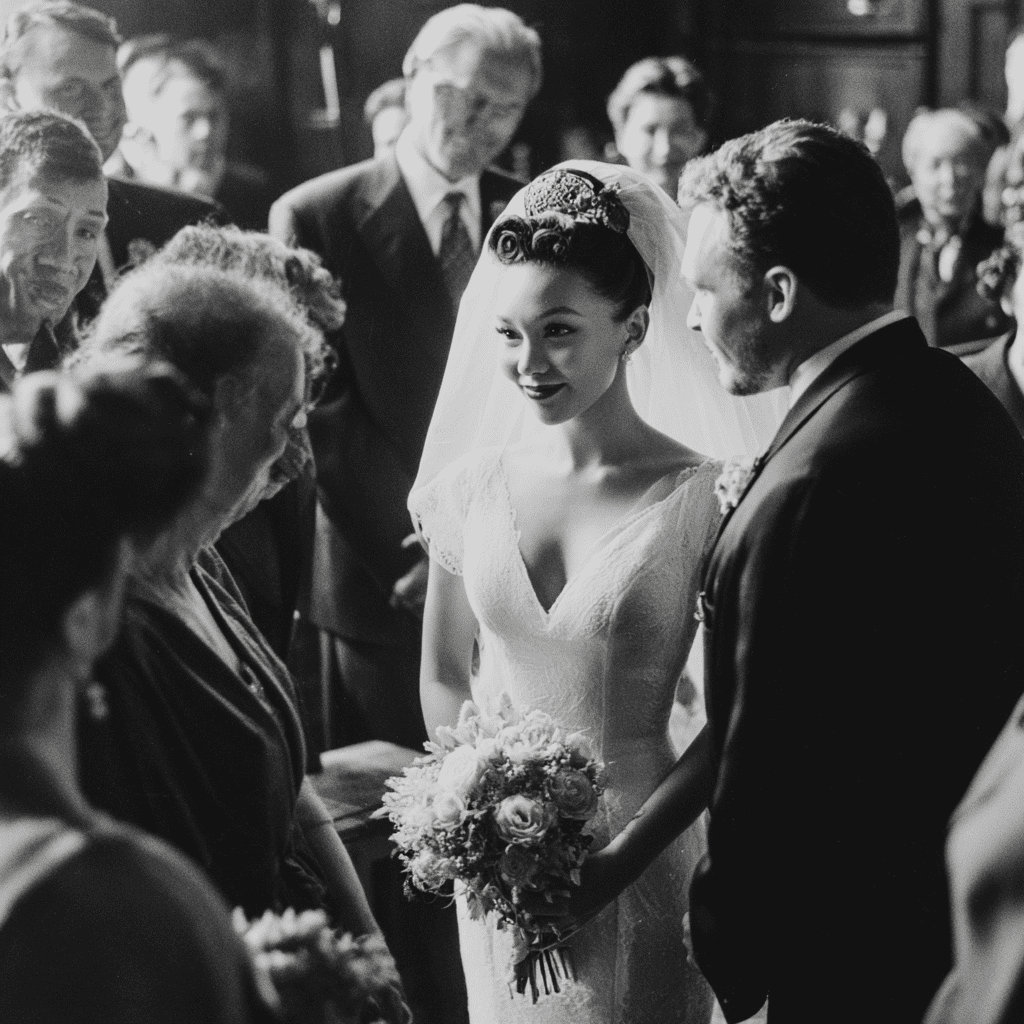
The receiving line in action. The bride greets each guest in turn — bouquet in hand, smile fixed. Etiquette books were precise: bride’s mother first, then groom’s mother, then the couple. Deviating reflected on the entire family. Editorial illustration.
Ballrooms, Foxtrots, and Towering Cakes
If the ceremony was solemn, the reception was its joyful counterpart — and by the 1950s, receptions had become genuinely lavish affairs. Banquet halls and hotel ballrooms replaced the modest at-home celebrations of previous decades. Tables were dressed in white linen and laden with floral centrepieces, typically in pastel pinks and mint greens. Formal place settings, printed menus, and assigned seating were all expected.
The entertainment was live. An orchestra or dance band — never a DJ, which would not become a wedding fixture for another two decades — played waltzes, foxtrots, and the slow romantic ballads of the era. The first dance was the emotional highlight of the evening, with couples typically choosing something by Frank Sinatra, Nat King Cole, or Doris Day. Guests who did not know how to waltz were expected to at least make a respectable attempt.
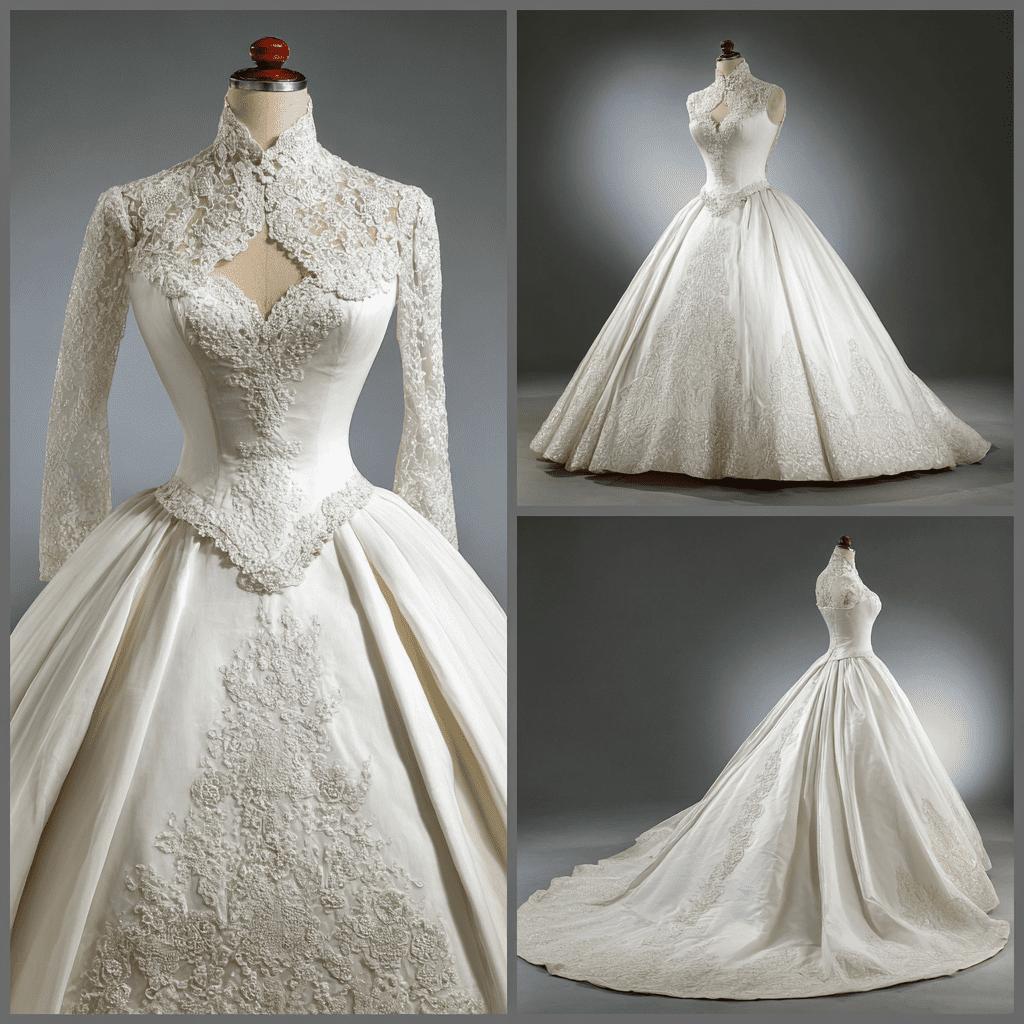
The gown as a statement. Three, four, sometimes five tiers of tulle — but the dress could rival the cake for sheer architectural ambition: intricate lace, a cathedral train, and needlework that took months to complete. Editorial illustration.
And then there was the cake. 1950s wedding cakes were architectural statements. They were stacked high — three, four, sometimes five tiers — on platforms separated by ornate pillars or columns. Intricate piped royal icing scrollwork, lace patterns, and fresh roses decorated every surface. The topper was invariably a ceramic or plastic figurine of the bride and groom beneath an arch. Grace Kelly’s cake for her Monaco wedding reportedly had six tiers, and brides across the world immediately aspired to something similarly grand.
The food itself followed a formal three-course structure: a light soup, a roast meat main course with seasonal vegetables and rich gravy, and dessert — the cake being its ceremonial climax rather than the entire sweet course. Champagne flowed throughout. The whole affair ran on a strict timetable, and departing early was considered rude.
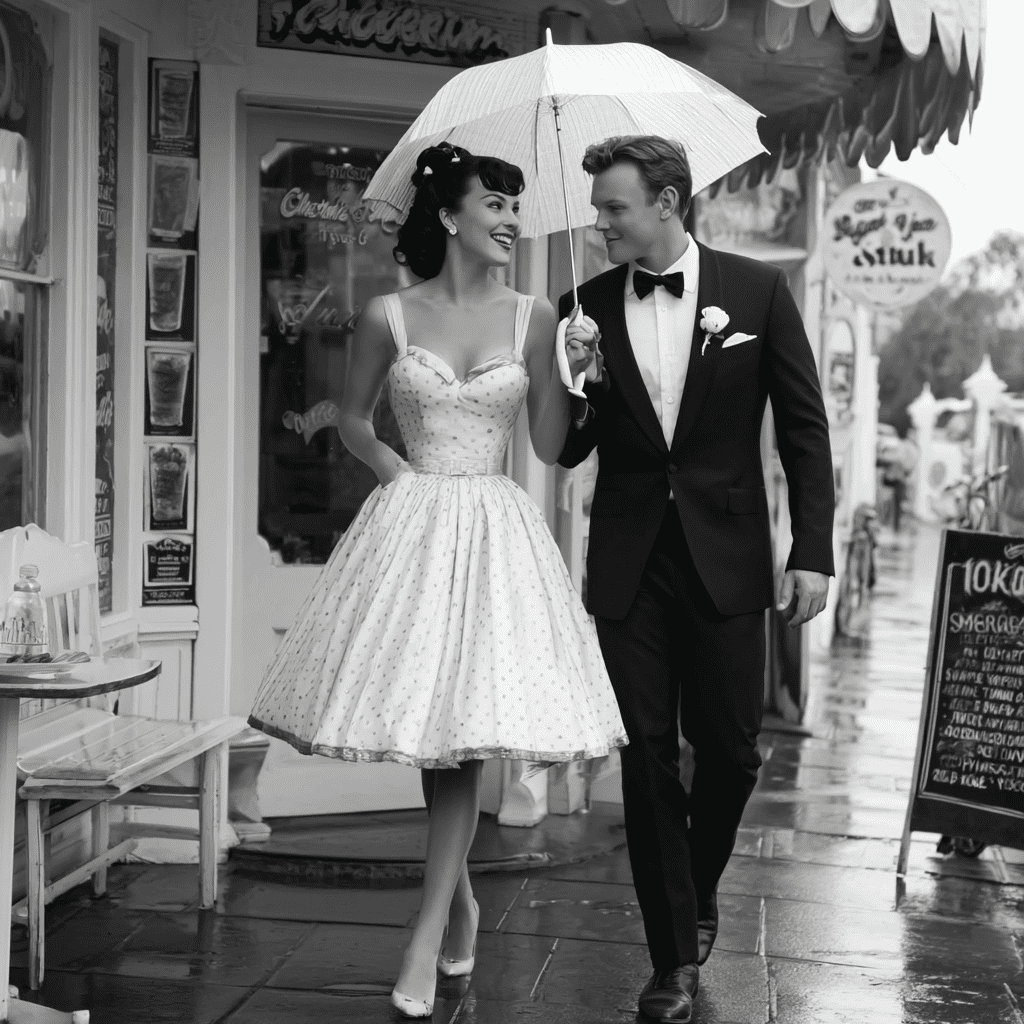
The going-away. Between ceremony and reception, the 1950s couple changed into a smart going-away outfit and slipped away into whatever the honeymoon held — sometimes, memorably, into the rain. Editorial illustration.
The Famous Weddings That Defined the Decade
Celebrity weddings of the 1950s did not just make headlines — they set the cultural agenda. The gowns were copied, the cakes were replicated, and the guest lists were pored over in every gossip column in the country. Here are the weddings that mattered most.
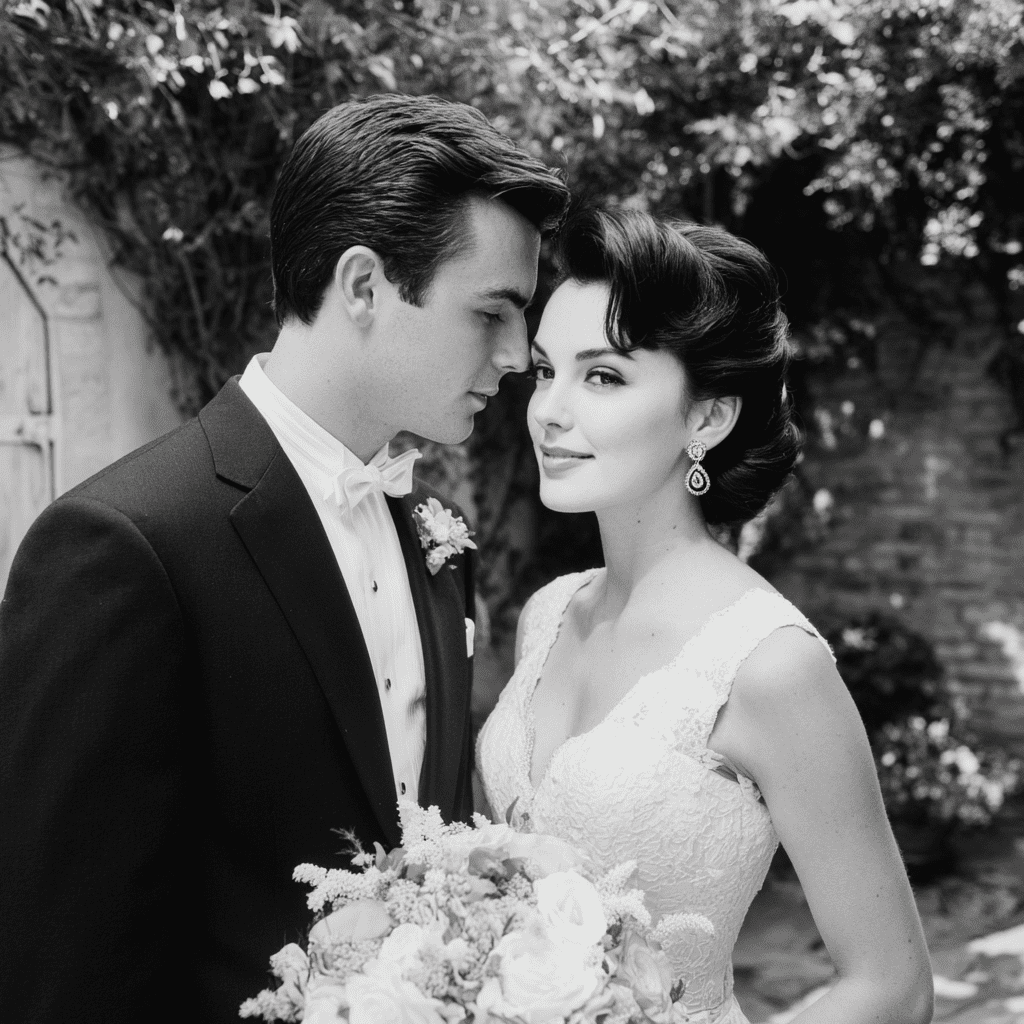
The decade’s weddings set the cultural agenda. Their gowns were copied, their cakes replicated, and their guest lists pored over in every gossip column in the country. Editorial illustration.
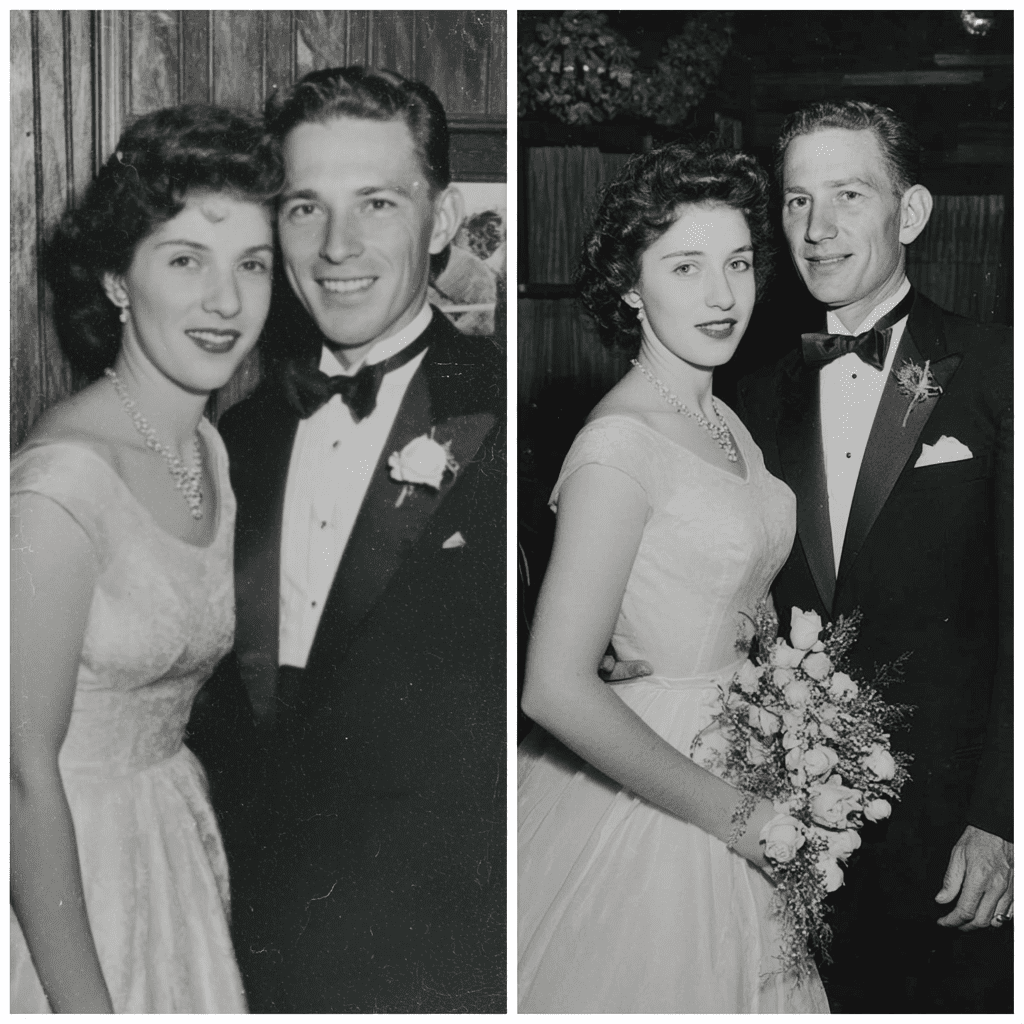
The formal portrait was a non-negotiable event: stiff, posed, and taken in the best available light. These photographs would be displayed for decades — on mantelpieces, in albums, and eventually handed to grandchildren. Editorial illustration.
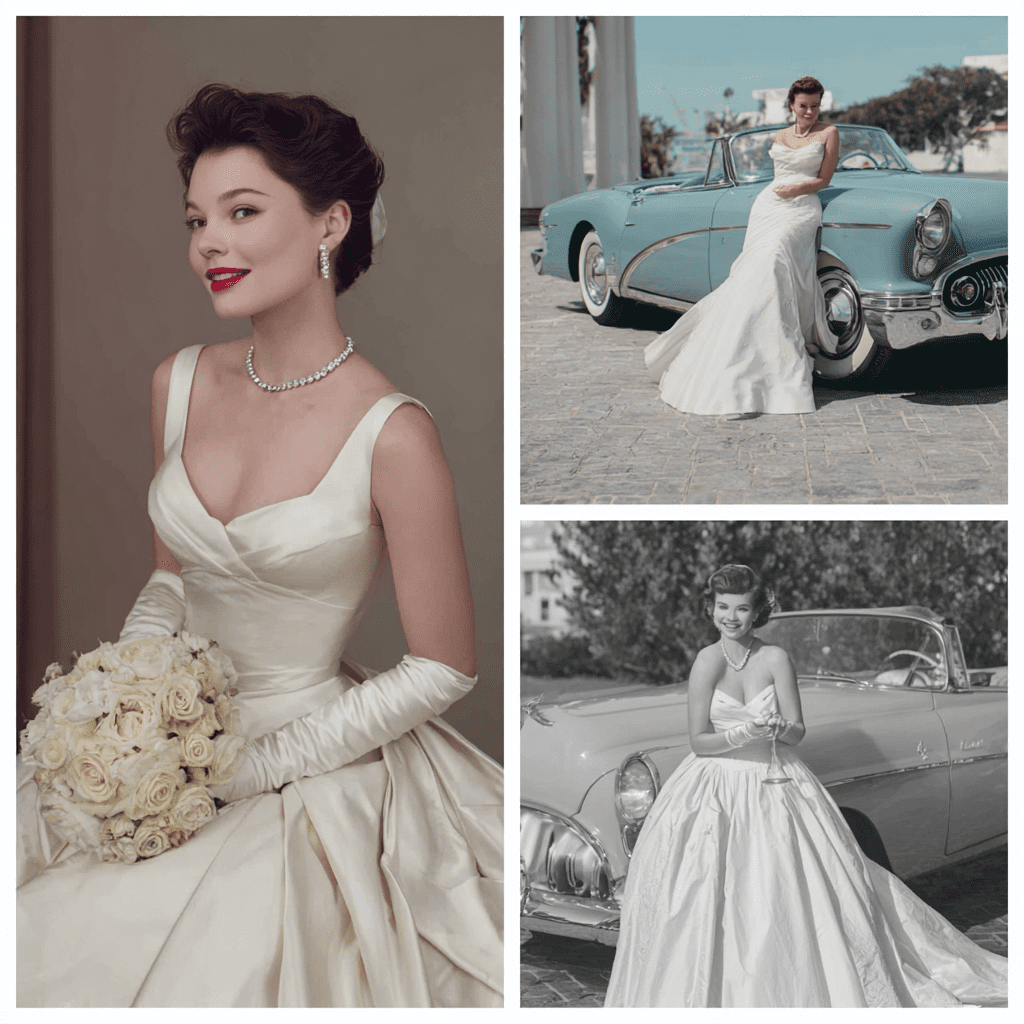
The 1950s bride in full glamour: long satin gloves, a diamond necklace, a full rose bouquet — and outside, the decade’s iconic convertibles waiting to carry the couple away. Editorial illustration.
The Hope Chest, the Rice, and Other Forgotten Rituals
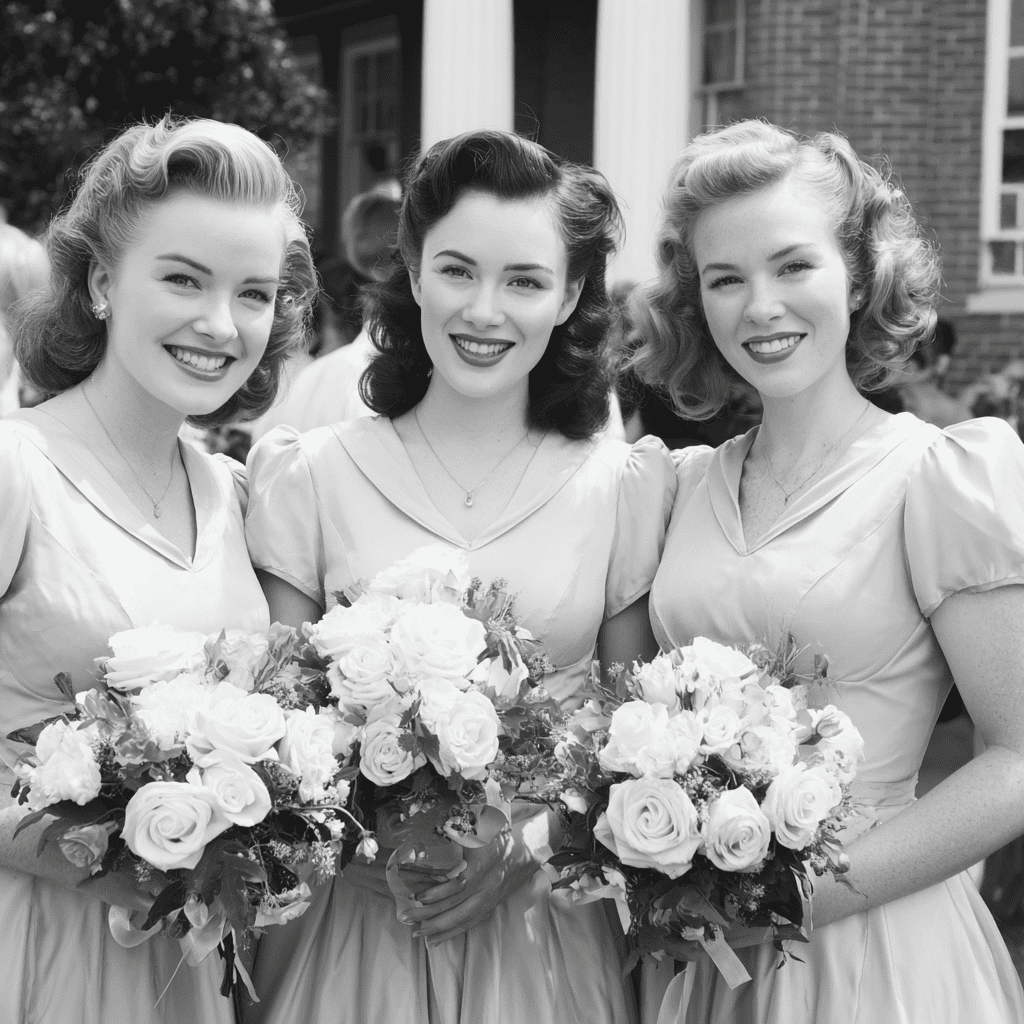
The bridal party was a cornerstone of the 1950s wedding: co-ordinated dresses, matching bouquets, and a formal role in the procession and receiving line that has since become largely ceremonial. Editorial illustration.
Much of what made a 1950s wedding recognisable has since disappeared entirely. The hope chest — a cedar-lined chest filled by the bride’s parents with linens, dishes, and household necessities — was still common at the start of the decade, though fading. It was a practical tradition rooted in the assumption that a bride was moving from one household to another and needed to arrive equipped.
The send-off was its own ceremony within the ceremony. As the couple prepared to leave for their honeymoon, guests gathered to throw rice in great enthusiastic handfuls. Later studies would show rice was essentially harmless to birds — the myth that it killed them prompted its replacement with birdseed and bubbles in subsequent decades, but the original version was purely celebratory.
The couple then changed into a fresh outfit — the bride typically into a “going-away suit,” a smart tailored ensemble in which she would begin her honeymoon — and departed in a car decorated with tin cans tied to the bumper and “Just Married” painted on the rear window. It was considered enormously good fun to make as much noise as possible.
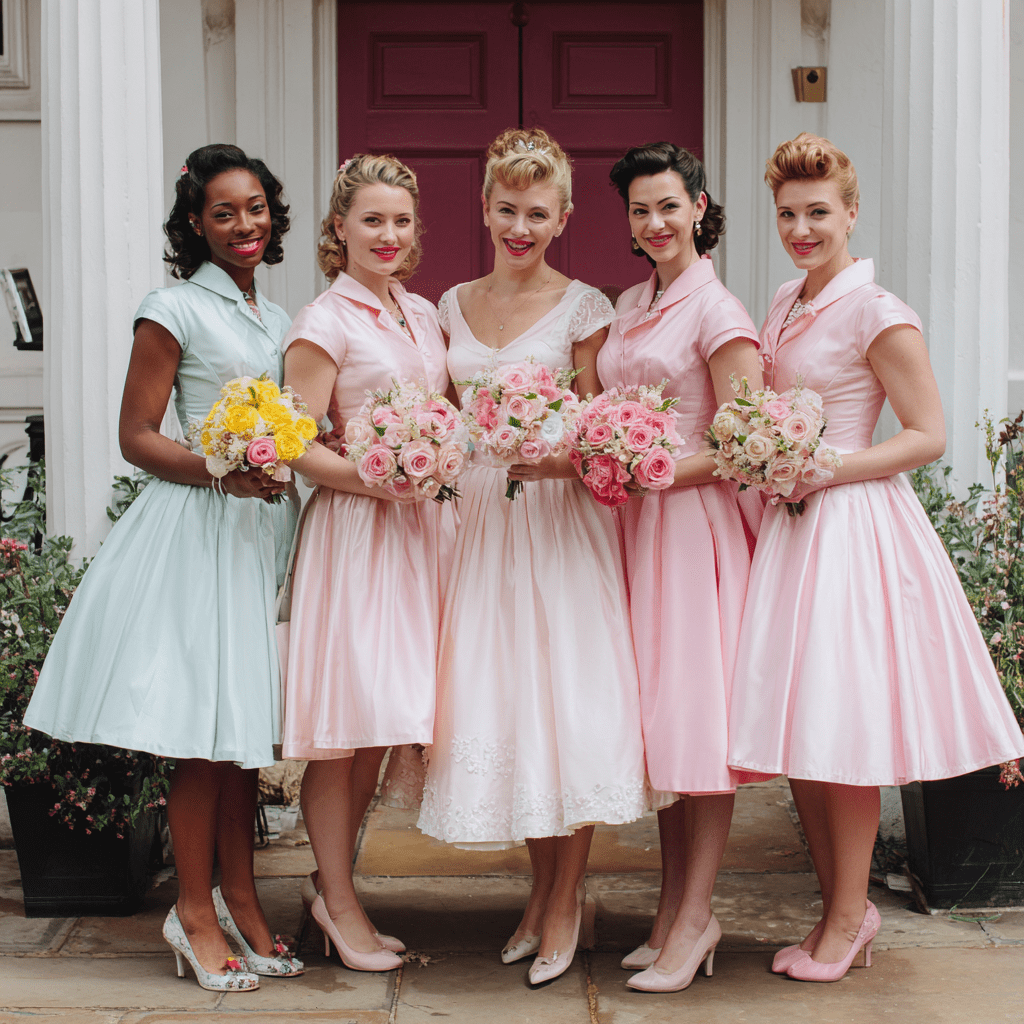
The group photograph: bride and bridesmaids assembled outside — the shot that the professional wedding photographer choreographed as carefully as a film director. The 1950s essentially invented the wedding album as a formal institution. Editorial illustration.
Photographers had become essential by the 1950s, documenting everything from the church arrival to the cake cutting in what we would now recognise as the standard progression of wedding photography. The resulting album — typically a formal, posed studio-style record — was treated as a serious document. The 1950s essentially invented the wedding album as an institution.
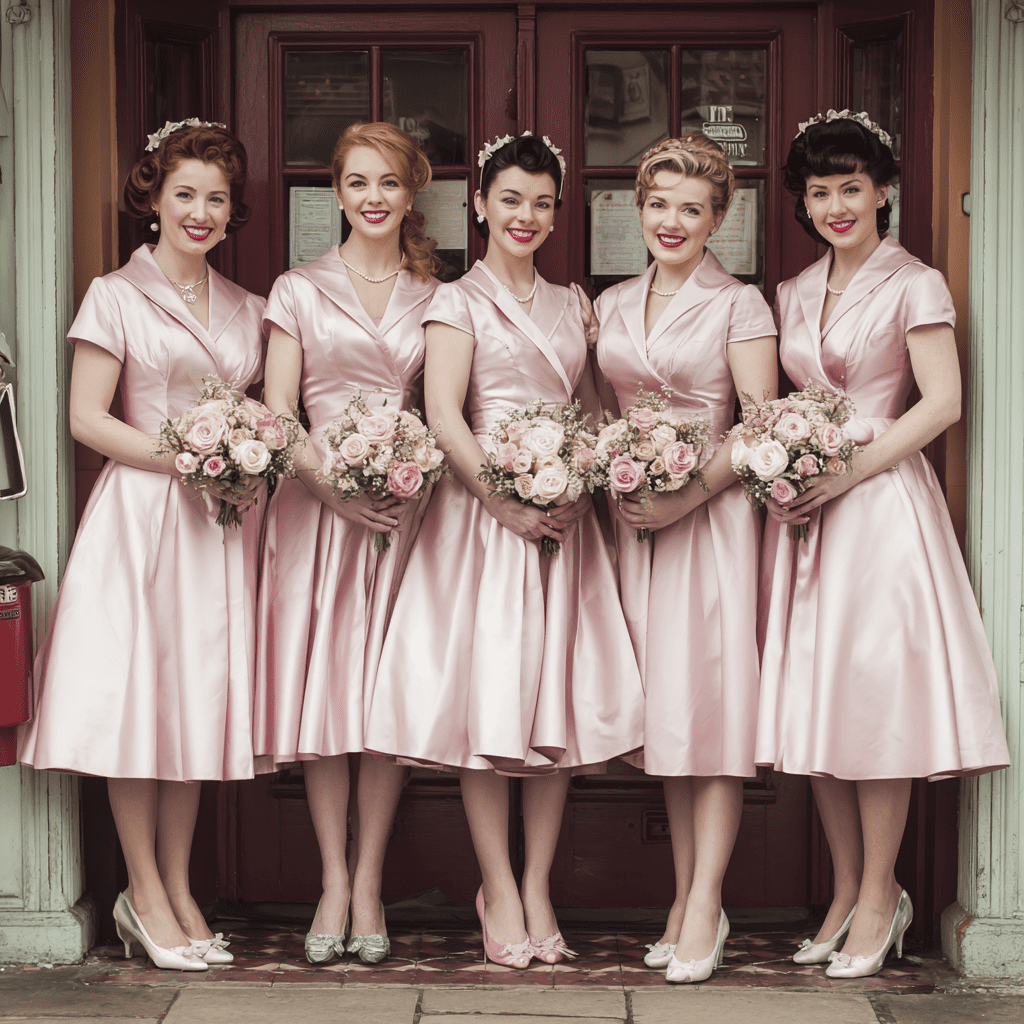
The co-ordinated bridal party in the decade’s signature blush pink — a convention that required months of planning, several fittings, and the willing agreement of five women to wear the same dress. Editorial illustration.
What the 1950s Wedding Left Behind
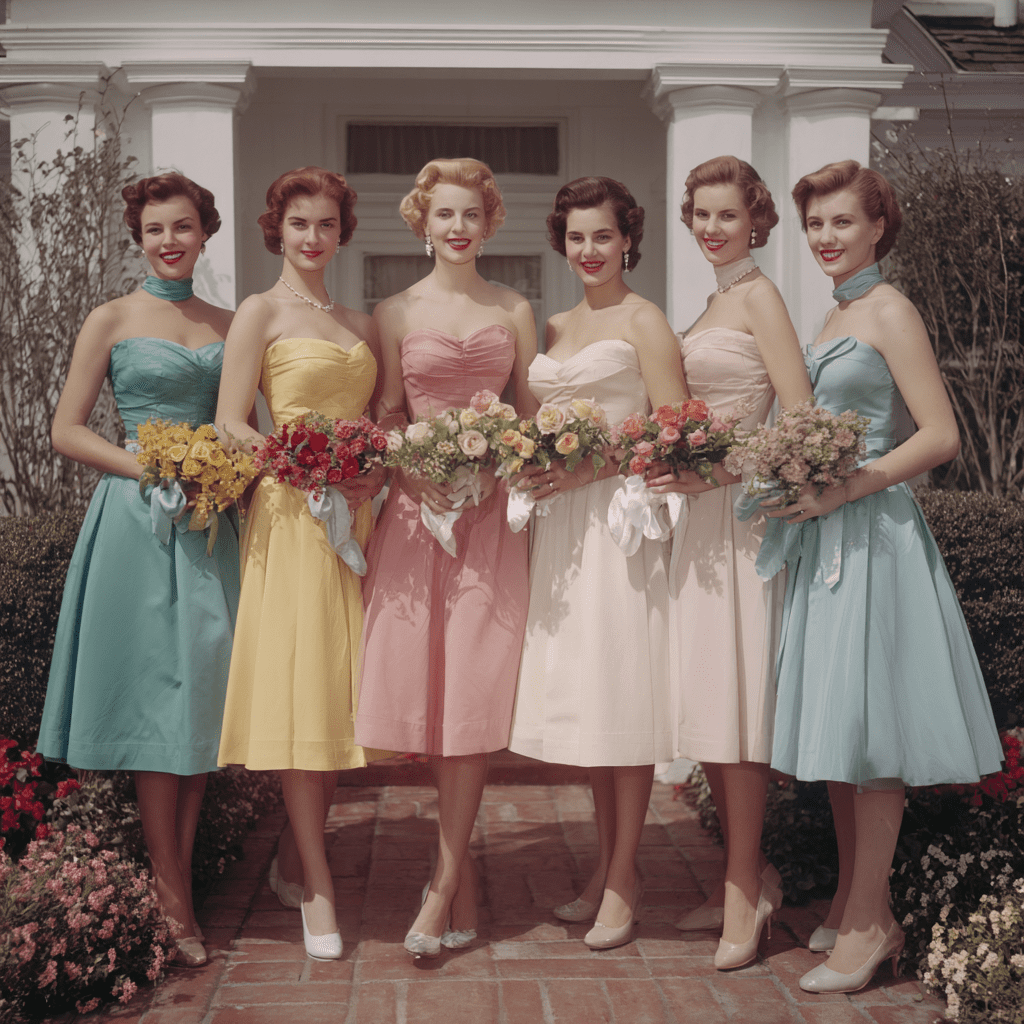
The enduring palette. Aqua, buttercup yellow, coral, blush, cream — the 1950s pastel palette for the bridal party has never fully left wedding culture. It cycles back, generation after generation. Editorial illustration.
The decade left an enormous legacy in wedding culture. The multi-tier cake, the professional photographer, the wedding registry at a department store, the bridal party in coordinated dresses, the first dance, the champagne toast — all of these became standard in the 1950s and have never fully left. Even in the age of barn weddings, destination ceremonies, and food trucks instead of sit-down dinners, the ghost of the 1950s formal wedding haunts every bridal catalogue and Pinterest board.
The fashion is perhaps the most enduring element. The full-skirted tea-length gown, the elbow gloves, the Juliet cap — they cycle back into bridal fashion with remarkable regularity. Every generation rediscovers the 1950s silhouette and calls it “vintage chic.” Grace Kelly’s gown remains the single most referenced wedding dress in history, still inspiring designers seventy years later.
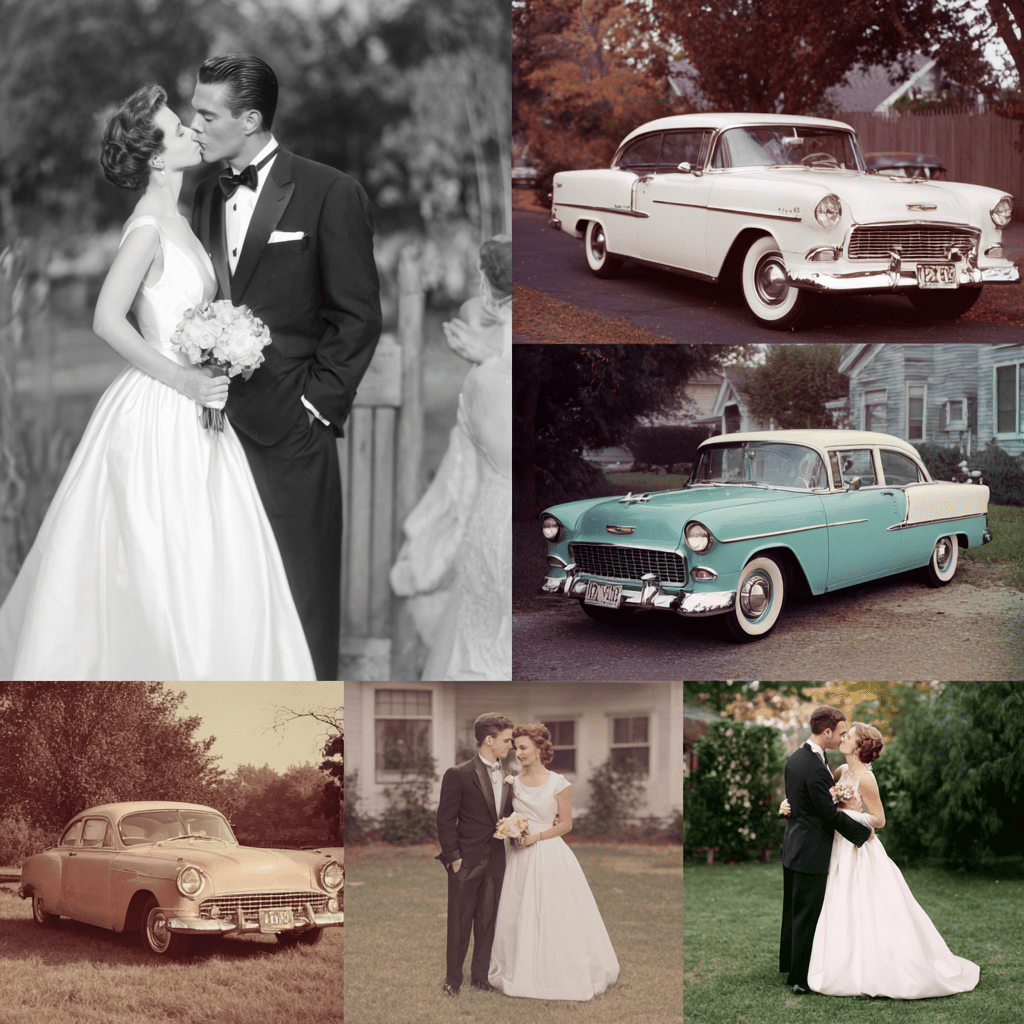
The 1950s wedding at its most iconic: young couples in formal attire, the decade’s chrome-finished Chevrolet Bel Airs, and the unmistakable confidence of a generation that had survived the worst and was now, joyfully, celebrating love. Editorial illustration.
What feels most striking about the 1950s wedding, viewed from today, is its seriousness. Every element — the receiving line order, the cake tiers, the engraved invitation wording, the precise timing of the champagne toast — was treated as genuinely important. It was not perfectionism for its own sake; it was the expression of a society that had survived enormous hardship and was now, joyfully, going to celebrate love with every ounce of ceremony it could muster.
“It was the expression of a society that had survived enormous hardship and was now, joyfully, going to celebrate love with every ounce of ceremony it could muster.”
You couldn’t fault them for that.
✦ ✦ ✦
Illustrations created for editorial and cultural reference purposes. Historical facts sourced from contemporaneous etiquette guides, bridal publications, and archival records.

Leave a Comment