
ockabilly began as a mid-1950s musical and youth-culture shock wave, not as a fashion trend first. The word described a high-energy Southern sound that mixed country and western styles with blues, rhythm and blues, gospel, western swing, hillbilly boogie, bluegrass and honky-tonk, with Elvis Presley’s early Sun recordings helping define the term in the press (Britannica). For women, the look became a hybrid of 1950s femininity, pin-up glamour, teen dance-floor practicality and rock-and-roll rebellion: full skirts, wiggle dresses, capri pants, halter tops, leopard print, gingham, cherries, bandanas, cat-eye glasses, victory-roll or bumper-bang hair, red lipstick, and shoes made for dancing.
The key answer to “who led it?” is layered. Musically, Elvis Presley, Carl Perkins, Jerry Lee Lewis, Johnny Cash, Gene Vincent, Eddie Cochran and others carried the male-dominated commercial explosion, while Wanda Jackson, Janis Martin, Brenda Lee and the Collins Kids showed that women could perform rockabilly with equal force (Britannica). Fashion-wise, Christian Dior’s 1947 New Look supplied the nipped waist and full skirt that shaped much of 1950s womenswear, while teen culture, poodle skirts, Hollywood, pin-up photography and working-class music scenes gave rockabilly its youthful edge.
The style never disappeared. It revived in the late 1970s, according to Britannica, and today survives through festivals, vintage reproduction brands, dancers, burlesque performers, hot-rod communities, pin-up contests, tattoos, hair and makeup artists, social media, and musicians such as Imelda May (Britannica, Viva Las Vegas, NPR). The best way to understand ladies’ rockabilly dressing is to see it as a menu, not a uniform: some women lean sweet 1950s teen, some pin-up bombshell, some bad-girl greaser, some country-western cowgirl, and some psychobilly with darker punk elements.
What Rockabilly Was Before It Became a “Look”
Rockabilly was one of the earliest forms of rock music, popular from the mid-1950s to around 1960, with a later revival in the late 1970s (Britannica). Its sound came from white working-class Southern musicians mixing Black musical styles such as blues, rhythm and blues and gospel with country styles such as western swing, hillbilly boogie, bluegrass and honky-tonk (Britannica). The term itself was coined by reviewers to describe the intense rhythm-driven style introduced by Elvis Presley’s first recordings, including “That’s All Right” and “Blue Moon of Kentucky” (Britannica).

Elvis Presley, CBS Television publicity image, 1956 — the musical revolution that gave rockabilly its name and attitude; women’s rockabilly style borrowed the same contrast: neat grooming, rebellious signals. Wikimedia Commons (public domain).
That musical origin matters for women’s fashion because the clothes were designed, consciously or not, for movement, display and attitude. Full skirts looked dramatic while dancing, fitted tops and wide belts emphasised the waist, rolled jeans and capris made a girl look ready for a jukebox date or a car-club night, and hair and makeup gave a polished face to a culture that was otherwise framed as unruly youth culture. Rockabilly style was not only “vintage pretty”; it was pretty plus rhythm, flirtation, independence and a little danger.
The Southern music industry mattered too. Sun Records in Memphis is central to the rockabilly story because its catalogue is associated with artists such as Jerry Lee Lewis, Roy Orbison, Warren Smith, Johnny Cash, Carl Perkins and Billy Lee Riley (Sun Records). Elvis Presley’s 1954 breakthrough is repeatedly framed as a musical and cultural revolution because he joined blues, country, R&B, pop, bluegrass and gospel into a mainstream rock-and-roll image that shocked and fascinated audiences (Rock & Roll Hall of Fame). Women’s rockabilly style borrowed that same contrast: neat grooming, but rebellious signals.
The Women Who Mattered
Wanda Jackson

Wanda Jackson, Capitol Records promotional photo, c. 1958 — described by the Rock & Roll Hall of Fame as one of the first women to break into rock and roll’s boys’ club, and one of the most important style references for women’s rockabilly dressing. Wikimedia Commons / Rock and Roll Hall of Fame (public domain).
Wanda Jackson is the essential female rockabilly name. The Rock & Roll Hall of Fame describes her as a rockabilly, rock-and-roll and country artist who sang with “wild, reckless abandon,” and says she was one of the first women to break into rock and roll’s boys’ club (Rock & Roll Hall of Fame). The Smithsonian states that in the 1950s she was one of the first women to record rock ‘n’ roll, and Jackson herself recalled that she was “the only girl doing it” when describing how she “romped and roared and stomped” through those songs (Smithsonian Music).
For ladies’ style, Jackson is interesting because she made rockabilly femininity sound assertive rather than decorative. Her stage image showed that a woman could be glamorous, country-rooted and fierce at once. A rockabilly outfit inspired by Jackson can include fringe, a fitted western shirt, pencil skirt or cigarette trousers, a high ponytail, curled bangs, boots, a statement belt, and jewellery that catches stage light.
Janis Martin, Brenda Lee and the Collins Kids
Britannica includes Janis Martin, Brenda Lee and the Collins Kids among the performers associated with rockabilly’s early era (Britannica). These names matter because the popular memory of 1950s rockabilly often centres on male stars, but girls and young women were not merely fans. They were singers, dancers, record buyers, fashion adopters and audience-makers.
Janis Martin was often marketed through the idea of a female answer to Elvis, which reveals both opportunity and limitation for women in the 1950s music business. Brenda Lee’s early career shows how teenage female performers could move between country, pop and rock-and-roll contexts. The Collins Kids, especially Lorrie Collins, gave the scene a young, television-friendly version of rockabilly energy. Each of these figures dressed for performance in a way that influenced how ordinary women thought about the look.
Bettie Page and the pin-up bridge
Bettie Page was not a rockabilly musician, but she is one of the most important visual bridges into modern women’s rockabilly style. Her official biography states that she built her first pin-up portfolio in 1950 after meeting photographer Jerry Tibbs at Coney Island, became “Miss Pinup Girl of the World” in 1955, and appeared as Playboy’s January 1955 centrefold (BettiePage.com). Bettie Page’s official fashion page emphasises her jet-black bangs, self-made clothing, floral dresses, pin-up swimsuits and lingerie as part of her continuing influence on women’s vintage style.
This is why Bettie bangs, leopard print, halter tops, high-waist shorts and pin-up poses appear so often in rockabilly wardrobes today. Pure rockabilly comes from music and youth rebellion; pin-up adds studio glamour, posing, swimsuit culture, burlesque confidence and a more deliberate celebration of curves. Modern women often mix both, even though historically they are related but not identical.
Jayne Mansfield and screen bombshell style
Jayne Mansfield helped define a louder, more cartoon-bright version of 1950s bombshell glamour. The Girl Can’t Help It, released in 1956 and directed by Frank Tashlin, starred Jayne Mansfield and featured major music performers including Fats Domino, Little Richard, Gene Vincent and the Platters (IMDb). For rockabilly style, Mansfield represents the Hollywood side: tight sweaters, hourglass dresses, platinum hair, exaggerated curves and comedy-bright colour. The film is also one of the richest visual archives of how music performance and glamour fashion intersected in the mid-1950s.
Imelda May and Dita Von Teese: modern vintage women
Modern rockabilly style continues through women who treat mid-century aesthetics as a living language. NPR described Imelda May as embodying the 1950s, wearing leopard-print sweaters and form-fitting jeans, and styling her hair in a ponytail with bangs curled into a quiff while making music that pays homage to 1950s rockabilly (NPR). Dita Von Teese is more properly a burlesque and pin-up revival figure than a rockabilly musician, but her official biography describes her as internationally recognised as the “Queen of Burlesque,” a performer, creative director, choreographer and producer whose shows use haute couture costumes and spectacle (Dita Von Teese). Both figures show that the visual language of 1950s rockabilly and pin-up is very much alive.
The 1950s Fashion Base: Dior, Teenagers and the Waist
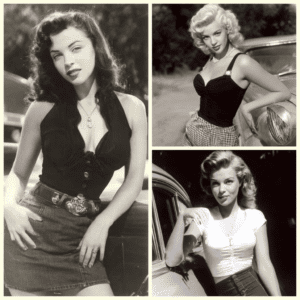
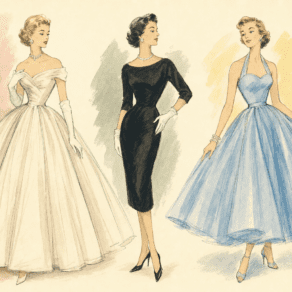
The classic ladies’ rockabilly silhouette borrows heavily from mainstream 1950s womenswear. Fashion History Timeline explains that the dominant 1950s womenswear look emerged in the late 1940s after Christian Dior’s New Look appeared in February 1947, and that its nipped waist and full skirt remained the leading silhouette until the mid-1950s (Fashion History Timeline). The Met’s record for Dior’s spring/summer 1947 “Bar” suit states that the American press immediately dubbed the collection the “New Look,” identifying the suit as the collection’s most iconic model with its wasp-waisted and hip-padded design (The Met).
The V&A’s object record for a 1947–1948 Dior New Look coat describes the formula in plain fashion terms: rounded shoulders, a womanly bust, a hand-span waist, enormous skirts, padding at the hips and an antithesis to lean wartime styles (V&A Collections). That is the couture ancestor of the rockabilly swing dress, even when the street version is cheaper cotton rather than silk. Rockabilly women took the high-fashion shape and made it younger, louder, more washable and more danceable.
The V&A also notes that the launch of Dior’s New Look in 1947 began what Dior called a “golden age” of couture, while Paris houses such as Balenciaga, Balmain and Fath gained global attention for elegance and glamour (V&A). These houses are not rockabilly designers, but they shaped the decade’s ideas of waist, bust, skirt volume, gloves, hats and polish. Rockabilly is what happens when that postwar femininity meets jukeboxes, cars, guitars, diner culture and teenage freedom.
Core Rockabilly Outfit Formulas for Ladies
| Outfit formula | Key pieces | Mood | Best styling details |
|---|---|---|---|
| Sweet dance-hall rockabilly | Swing dress, petticoat, cardigan, Mary Janes or flats | Cute, approachable, dance-ready | Gingham, polka dots, cherries, wide belt, ponytail, red lip |
| Pin-up bombshell | Wiggle dress, bullet bra or structured foundation, seamed stockings, heels | Glamorous, curvy, camera-ready | Leopard print, sweetheart neckline, victory rolls, cat-eye liner |
| Bad-girl greaser | High-waist jeans, tight knit top, leather or denim jacket, loafers or creepers | Rebellious, practical, streetwise | Rolled cuffs, bandana, quiff, hoop earrings, tattoos |
| Country rockabilly | Western shirt, pencil skirt or cuffed jeans, cowboy boots, neck scarf | Wanda Jackson energy | Fringe, embroidery, rhinestones, ponytail, statement belt |
| Summer pin-up | Halter top, high-waist shorts, playsuit, wedge sandals | Beach, car show, tiki party | Tropical prints, hair flower, bamboo bangles, cat-eye sunglasses |
| Psychobilly-leaning | Pencil skirt or leopard pants, band tee, creepers, moto jacket | Darker, punkier revival | Black and red palette, skulls, tattoos, Bettie bangs |
Garments: What to Buy, Sew or Style
Swing and circle dresses
The swing dress is the most recognisable ladies’ rockabilly dress because it translates the New Look into an everyday dance silhouette. It usually has a fitted bodice, defined waist and full skirt that moves when dancing. Add a petticoat when drama is needed, or wear it without one for a softer daytime shape.
Good details include sweetheart necklines, halter straps, boat necks, cap sleeves, novelty prints, contrast piping, bows, large buttons and wide waist belts. For a more authentic 1950s feel, choose cotton, rayon, polished cotton or sateen rather than thin costume fabric. For a more stage-ready rockabilly look, use a bright print or a black-ground cherry, rose, leopard or tattoo-flash motif.
Wiggle dresses and pencil skirts
The wiggle dress is the fitted sister of the swing dress. It belongs more to pin-up and bombshell dressing than to teenage sock-hop style, but it has become central to modern women’s rockabilly wardrobes. It works best with structured underwear or modern shapewear, a good back vent, and enough stretch or tailoring to walk comfortably.
Pencil skirts are easier to wear than wiggle dresses because they can be mixed with knit tops, peasant blouses, western shirts, cardigans or cropped jackets. A black pencil skirt with a leopard cardigan, red belt and curled bangs can read rockabilly immediately without becoming costume.
Capri pants, cigarette trousers and cuffed jeans
As the 1950s progressed, womenswear became less exclusively full-skirted and allowed more casual separates. Fashion History Timeline notes that the decade saw changing silhouettes and increasing attention to teenagers and casual style, including trousers and capris in women’s wardrobes (Fashion History Timeline). For rockabilly, high-waist capris, cigarette pants and cuffed jeans are essential because they bring in the rebellious, music-scene side of the look.
Look for a natural waist, a narrow leg, a cropped ankle, and enough structure to avoid looking like modern leggings. Pair them with a tied blouse, a fitted knit, a boat-neck top, a western shirt or a cropped cardigan. Loafers, ballet flats, wedges, saddle shoes or creepers change the mood dramatically.
Poodle skirts and novelty skirts
The poodle skirt is strongly associated with 1950s teen nostalgia and rock-and-roll dance culture. Folkwear’s history credits Julie Lynn Charlot with creating the first version after needing a party skirt, using felt connected to her mother’s factory, and then developing appliquéd designs that became widely associated with postwar 1950s fun and the dance-floor energy of rock ‘n’ roll (Folkwear).
For rockabilly, a poodle skirt can look charming but also costume-like if styled too literally. To make it more sophisticated, choose a plain full felt or wool skirt with one bold appliqué, or replace the poodle with dice, records, swallows, roses, musical notes, spiderwebs, cocktail glasses or western motifs.
Tops, blouses and knits
The most useful tops are fitted and waist-aware. Choose peasant blouses, tied-front shirts, western shirts, tight sweaters, boat-neck knits, halters, camp-collar blouses, slash-neck tops and cropped cardigans. A rockabilly top often has one strong feature: a sweetheart neckline, contrast collar, gingham fabric, cherries, leopard print, embroidery, ric-rac trim or a little puff sleeve.
The rule is simple: if the skirt is full, define the waist; if the pants are tight, add a top with personality; if the dress is plain, let the hair, lipstick, belt and shoes do the work. Rockabilly is rarely minimal, but it is often cleanly composed.
Jackets and outerwear
Leather jackets, denim jackets, cropped cardigans, varsity jackets, boleros, western jackets and leopard coats all work. A short jacket is usually better than a long one because it preserves the waistline. For a feminine look, a cropped cardigan over a swing dress is classic; for a harder look, a moto jacket over a pencil skirt or cigarette pants creates the greaser contrast.
Prints, colours and fabrics
Rockabilly prints are graphic, readable and slightly theatrical. The classics are polka dots, gingham, cherries, roses, leopard, zebra, dice, playing cards, swallows, anchors, tattoo flash, flames, records, music notes, checks, stripes, western embroidery and tiki florals. A good rule for women is to choose one loud print and keep the rest simple, unless the goal is full festival styling.
Colour palettes usually fall into a few families. Sweet 1950s looks use red, white, navy, pink, mint, butter yellow, pale blue and black accents. Bad-girl looks use black, red, leopard, denim and cream. Western rockabilly uses turquoise, red, black, white, tan and silver. Tiki or summer pin-up looks use tropical green, coral, yellow, orange, aqua and bamboo neutrals.
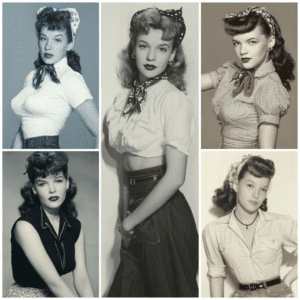
The most convincing fabrics are cotton, sateen, denim, gabardine, wool felt, rayon, crêpe, stretch bengaline, sturdy knits and polished cotton. Shiny costume satin can look cheap, while overly thin stretch fabric can make a vintage silhouette collapse. Structure is the secret: the waist, bust, hem and collar need enough body to hold the line.
Hair and Makeup
Hair is often what turns a nice vintage outfit into a rockabilly outfit. The most recognisable options are victory rolls, bumper bangs, Bettie bangs, a curled ponytail, a quiff, rolled fringe, scarf-tied hair, waves, a pageboy bob or a pompadour-inspired updo. Bettie Page’s official fashion page specifically highlights her jet-black bangs as a signature feature that continues to inspire women (BettiePage.com).
Makeup is usually structured and high-contrast: matte or satin skin, arched brows, black cat-eye liner, mascara, red lipstick, defined blush and sometimes a beauty mark. For daywear, red lipstick can be swapped for coral or pink; for evening, add stronger liner and a deeper red. The important thing is crispness, because rockabilly makeup often looks best when the lines are deliberate.
Bettie bangs are a commitment. They are iconic, but they need regular trims and careful styling. Clip-in bangs are a safer first step.
Shoes, Bags and Accessories
Saddle shoes, ballet flats, loafers, wedges, Mary Janes, peep-toe heels, cowboy boots, ankle boots and creepers all belong somewhere in the rockabilly wardrobe. Shoes should match the substyle: saddle shoes for sock-hop sweetness, wedges for summer pin-up, cowboy boots for Wanda Jackson western energy, and creepers for psychobilly or punk-leaning looks.
Accessories do much of the storytelling. Useful pieces include wide belts, skinny belts, bandanas, chiffon scarves, hair flowers, cat-eye sunglasses, bamboo bangles, hoop earrings, charm bracelets, pearl studs, lucite bags, wicker bags, box purses, gloves, seamed stockings, fishnets, brooches, western belts, novelty earrings and small neckerchiefs. Cat-eye sunglasses and pink bomber jackets became especially famous as part of Grease’s later 1950s-style visual vocabulary (Golden Globes).
Designers and Brands
Original 1940s and 1950s design context
Christian Dior is the first designer to mention because his 1947 New Look shaped the decade’s waist-and-skirt ideal, even if rockabilly itself was a street and music culture rather than a couture movement (Fashion History Timeline, The Met). Balenciaga, Balmain and Jacques Fath are worth mentioning as part of the Paris couture climate that made the 1950s synonymous with elegance and glamour (V&A). Hardy Amies is relevant on the British tailoring side of the 1950s couture world (V&A).
Claire McCardell is worth mentioning when discussing American casualness and sportswear, although she is not a rockabilly designer. The Met describes McCardell as a pioneer of American fashion who designed functional, affordable clothes for American women using natural fabrics such as cotton, denim and wool with flattering silhouettes (The Met). Her importance is that rockabilly women often depend on the American side of 1950s dressing: separates, comfort, movement, flats, denim, practical pockets and washable fabrics.
Costume and screen-fashion names
Albert Wolsky designed the costumes for Grease, a 1978 film set in the 1950s whose visual language turned poodle skirts, cropped pants, cat-eye sunglasses, pink jackets, leather jackets and Sandy’s black final outfit into endlessly repeated 1950s fashion references (Golden Globes). For rockabilly research, costume design is useful less as a list of labels and more as a screen archive of silhouettes, hairstyles, jackets, shoes and attitude.
Modern reproduction and revival brands
Vivien of Holloway is a major contemporary brand for women who want authentic-feeling 1940s and 1950s-inspired dresses, skirts, trousers and separates; the brand describes itself as a British vintage-inspired fashion brand specialising in 1940s and 1950s silhouettes, handmade in London using traditional techniques (Vivien of Holloway). Pinup Girl Clothing, founded by Laura Byrnes in 1997, is important for modern pin-up and vintage-inspired fashion because its own history frames the company around “Couture For Every Body” and body inclusivity (Pinup Girl Clothing). Dolly & Dotty positions itself as a vintage-inspired clothing store offering retro dresses, separates and accessories, with references to the 1940s, 1950s, mid-century fashion and the rockabilly scene. (Dolly & Dotty)
Vixen by Micheline Pitt is another notable modern retro brand, with the official site identifying Micheline Pitt as founder and designer and describing vintage-inspired clothing with products such as wiggle dresses, swing dresses, cat-eye sunglasses and 1950s-inspired scarves (Vixen by Micheline Pitt). These modern brands matter because they transformed rockabilly style from thrifted subculture into a market: size ranges, stretch fabrics, online drops, matching accessories, novelty prints and community-driven styling.
Movies and Screen References
| Film or screen reference | Year | Why it matters for rockabilly ladies’ style |
|---|---|---|
| The Girl Can’t Help It | 1956 | A bright early rock-and-roll film directed by Frank Tashlin, starring Jayne Mansfield and featuring Fats Domino, Little Richard, Gene Vincent and the Platters. Useful for bombshell colour, novelty glamour and music-scene visuals (IMDb). |
| Jailhouse Rock | 1957 | Elvis’s black-and-white rebellious image became one of the strongest visual codes for rock-and-roll style; public-domain promotional images remain useful for mood boards. |
| Rock Around the Clock | 1956 | A major rock-and-roll musical presenting teenage dance culture, Bill Haley and His Comets, Alan Freed, the Platters and the “Rock Around the Clock” recording — essential for youth, dance and music-scene visual references. |
| Grease | 1978 | Although made later, it permanently popularised a nostalgic 1950s wardrobe of poodle skirts, cropped pants, cat-eye sunglasses, pink bomber jackets, leather jackets and Sandy’s black transformation outfit (Golden Globes). |
| Cry-Baby | 1990 | John Waters’ film set in 1950s Baltimore parodies 1950s teen rebel musicals with affection, making it a major retro reference for exaggerated greaser, bad-girl and rockabilly revival styling (IMDb). |
| Bettie Page films and photography | 1950s | Bettie Page’s pin-up portfolio, centrefold fame and later revival gave modern rockabilly women the bangs, posing, swimwear and pin-up confidence that often sit beside rockabilly music style (BettiePage.com). |
Who Is Still Embracing the Style Today?
Viva Las Vegas Rockabilly Weekend is one of the clearest modern examples. Its official general-information page calls it the largest rockabilly event in the world and the longest-running music festival in Las Vegas, says it began in 1998, and lists music, DJs, dancing, burlesque, tiki pool parties, hot rods, vendors, vintage clothing, vintage reproduction goods, tattoo culture, a pin-up contest, a vintage swimsuit competition and a fashion show (Viva Las Vegas). This is basically the modern ecosystem in one place: music, cars, clothes, hair, dancing, shopping, photography and performance.
Modern rockabilly women include several overlapping communities. Vintage reproduction shoppers wear the style as everyday fashion. Swing and jive dancers choose practical full skirts, flats and secure hair. Burlesque and pin-up performers emphasise glamour, corsetry, stockings and stage makeup. Hot-rod and tattoo communities push the style toward denim, leather, leopard, bandanas and black-and-red palettes. Psychobilly fans add punk, horror, creepers, skulls, dyed hair and sharper attitude.
The modern style is global. Viva Las Vegas says its annual attendees come from more than 20 countries, including Europe, South America, Japan and New Zealand (Viva Las Vegas). Rockabilly is no longer only a Southern American music culture. It is a global vintage lifestyle with local variations in Japan, the UK, continental Europe, Australia, Latin America and the United States.
Pin-Up versus Rockabilly: The Useful Distinction
Pin-up and rockabilly are related, but they are not exactly the same. Collectif London’s brand explanation describes pin-up style as rooted in late 1940s to early 1960s feminine lines, curves, romantic patterns and elegant silhouettes, while rockabilly emerged in the early 1950s with a stronger tie to rock ‘n’ roll music, rebellious attitude and youthful energy (Collectif London). In practical styling terms, pin-up asks, “Would this photograph beautifully?” while rockabilly asks, “Would this move, dance and signal attitude?”
Most women today blend them. A wiggle dress with red lipstick and seamed stockings is pin-up. Add leopard, tattoos, a quiff, a western jacket or creepers, and it moves toward rockabilly. A swing dress with petticoat and Mary Janes is 1950s sweet. Add a bandana, hot-rod earrings and a tattoo-flash cardigan, and it becomes rockabilly sweet.
Body-Shape and Confidence Notes for Women
Rockabilly is unusually friendly to different body types because it has several silhouettes. A full skirt balances hips and creates a waist even when the body is straighter. A wiggle dress celebrates curves but needs good fit through the bust, waist, hip and back vent. High-waist trousers lengthen the leg line and look strong with tucked tops. Cropped cardigans are useful because they define the waist without hiding the outfit.
For a fuller bust, halter tops, sweetheart necklines, structured bodices and wide straps often work better than flimsy spaghetti straps. For a smaller bust, gathered bust details, contrast collars, boat necks, peasant tops and padded vintage-style bras can create the period line. For petite women, keep skirt length just below the knee rather than mid-calf, and choose smaller prints. For tall women, dramatic full skirts, wide belts, cuffed jeans and big hair can look especially strong.
The most important fit rule is that the waist must sit in the right place. Many modern dresses call themselves “1950s” but have a waist seam too high, too low or too elastic. A true rockabilly effect needs the waistline to feel intentional, because nearly everything in the look is built around that line.
Shopping and Sewing Guidance
If buying vintage, check underarms, zipper condition, hem allowance, seam stress, fabric brittleness and whether the garment has been altered. True 1950s sizing is much smaller than modern sizing, so measurements matter more than the label. If buying reproduction, prioritise fabric weight, waist placement, print scale, bust fit and return policy.
If sewing, start with a circle skirt, gathered skirt, peasant blouse, high-waist trouser or simple halter dress. Felt appliqué is beginner-friendly because it does not fray, which is one reason poodle-skirt-style decoration became so accessible. For a professional finish, use a proper hem, stable zipper, interfaced waistband and enough skirt volume to move.
Fun Details Women Often Love
- The petticoat secret: One dress can look completely different with no petticoat, a soft petticoat, or a very full crinoline. This makes swing dresses flexible for day, evening and festival wear.
- The bandana trick: A bandana can hide second-day hair, secure curls, create Rosie-the-Riveter energy, or move an outfit from sweet to rebellious in seconds.
- Bettie bangs are a commitment: They are iconic, but they need regular trims and careful styling. Clip-in bangs are a safer first step.
- Shoes change the subculture: The same black swing dress reads sweet with Mary Janes, pin-up with peep-toe heels, western with cowboy boots, and psychobilly with creepers.
- Novelty prints are conversation pieces: Cherries, dice, records, swallows and roses work because they read from a distance and photograph clearly.
- Red lipstick is not mandatory: Coral, berry, brick, cherry, rose and deep wine can all work, especially when matched to skin tone and outfit palette.
- Rockabilly can be modest or sexy: A buttoned blouse and full skirt can be just as authentic as a halter wiggle dress. The shared language is waist, grooming, rhythm and attitude.
Quick Outfit Recipes
Beginner, easy and wearable
Start with high-waist dark jeans, a striped boat-neck top, red flats, a red bandana, cat-eye liner and lipstick. This avoids looking like costume while still giving a clear rockabilly signal.
Feminine daytime
Wear a gingham swing dress with a thin belt, cardigan, ballet flats, ponytail, small hoops and soft red lipstick. Add a petticoat only if the setting can handle more drama.
Pin-up evening
Choose a black wiggle dress, leopard belt or shoes, seamed stockings, peep-toe heels, structured curls, cat-eye liner and a red lip. Keep jewellery simple so the silhouette stays central.
Wanda Jackson-inspired
Wear a western shirt with piping or embroidery, a black pencil skirt or cuffed jeans, cowboy boots, a high ponytail, hoop earrings and a bold belt. Add fringe or rhinestones for stage effect.
Car show or festival
Choose high-waist capris, a tied blouse, wedges or flats, a hair flower, cat-eye sunglasses, bangles and a small box bag. Bring a scarf for wind and a cardigan for evening.
What to Avoid If You Want It to Look Stylish Rather Than Costume
Avoid combining every cliché at once. A poodle skirt, saddle shoes, ponytail, neck scarf, cat-eye glasses and novelty prints all at the same time can become fancy dress rather than fashion. Choose two or three strong signals and make the fit excellent.
Avoid cheap costume petticoats that collapse, overly shiny polyester satin, waist seams that sit in the wrong place, novelty prints that are too childish, and shoes you cannot dance or walk in. Rockabilly style works best when it looks lived-in, not packaged.
Avoid treating 1950s femininity as one fixed ideal. The decade included couture elegance, teenage novelty dressing, western stagewear, working women’s separates, beachwear, pin-up photography and early rock-and-roll rebellion. The best modern women’s rockabilly outfits choose a lane and then personalise it.
The Big Picture
1950s rockabilly style for women is powerful because it combines contradictions. It is polished but rebellious, feminine but tough, nostalgic but performative, sweet but sexy, and historically rooted but constantly remixed. The musical founders gave it rhythm and attitude; Dior-era fashion gave it waist and silhouette; pin-up culture gave it pose and glamour; film gave it colour and myth; modern festivals and brands keep it alive.
For ladies, the most useful lesson is not to copy one exact outfit. Build from the waist, choose a substyle, make the hair and makeup intentional, and let one detail carry the attitude: a quiff, a cherry print, a western shirt, a leopard cardigan, a full skirt, a pencil silhouette, a red lip or a pair of creepers. That is how rockabilly stops being a costume and becomes personal style.
✦ ✦ ✦
Further reading: Britannica: Rockabilly · Rock & Roll Hall of Fame: Wanda Jackson · Viva Las Vegas Rockabilly Weekend · Fashion History Timeline: 1950s
Images reproduced for editorial and educational purposes under their respective licences. All rights remain with the originating authors and institutions.


Leave a Comment