
hen Yves Saint Laurent presented his spring-summer collection in Paris in 1970, he confirmed a soft, body-skimming line in printed chiffon and jersey that would help define 1970 dress style. Yet the year refused a single answer: London offered Ossie Clark’s sensuous bias cuts, Biba’s affordable velvet midis, and Thea Porter’s caftan glamour, all at once.
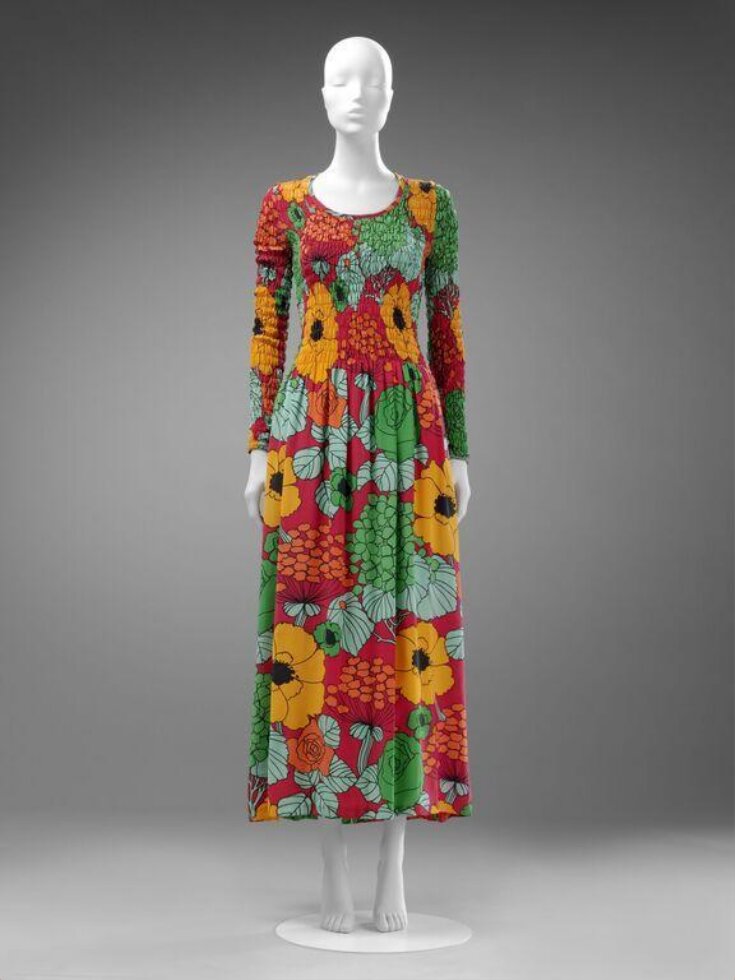
Dress by Mary Quant, 1973. Victoria and Albert Museum.
1970 dress style began with contradiction, not consensus
The most revealing thing about the decade is how many dress ideas coexisted from the start. In Britain alone, a shopper could move from Ossie Clark and Celia Birtwell at Quorum on King’s Road to a low-cost Biba purchase on Kensington High Street, or toward the long printed cotton revival associated with Laura Ashley. Mini, midi, and maxi lengths all remained active alternatives in 1970 and 1971. That variety is exactly why the period still feels modern.
Several of the nine dresses in the image make that pluralism visible. The 1971 dress by Barbara Hulanicki and the two 1973 Biba examples sit squarely within the house’s known language of rayon crepe, velvet, dark florals, high necks, bishop sleeves, and hems that translated Edwardian and 1930s references for young British consumers. By contrast, the 1970 dress by James Wedge belongs to the same moment of experimentation in London when historical reference, theatricality, and youth fashion fed one another. A 1973 dress by Mary Quant, meanwhile, reminds us that the mini never simply vanished when the midi and maxi arrived.
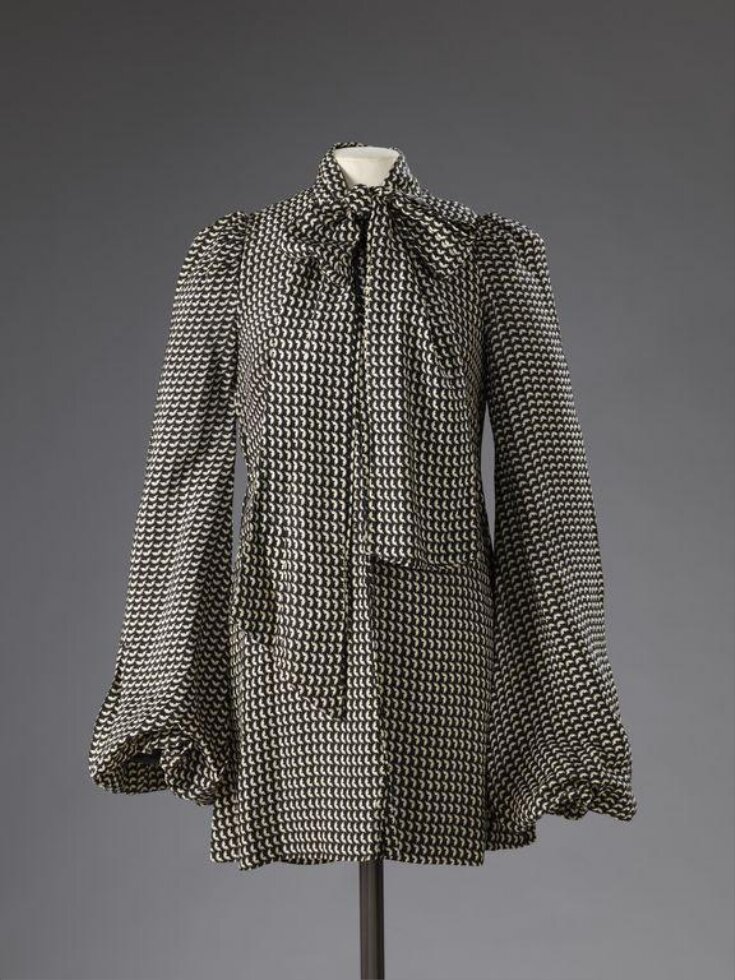
Dress by Hulanicki, Barbara, 1971. Victoria and Albert Museum.
Beyond this, the dossier makes clear that the era’s wider conditions shaped these clothes. The women’s movement, expanding white-collar work, and the normalization of informal dress all encouraged garments that allowed movement and self-styling. That helps explain why softly cut day dresses, shirtdresses, and eventually wrap silhouettes became so persuasive. At the same time, nostalgia and escapism flourished amid inflation and the aftershocks of the 1973 oil crisis, giving prairie and revival dresses unusual emotional force.
“Fashion had become ‘the most marvelous and sensitive of all arts.’” — Diana Vreeland, 1971
Key figures who gave the decade its many identities
Thea Porter, Barbara Hulanicki, Saint Laurent, Clark, Laura Ashley, and later Halston and Diane von Furstenberg did not push one shared silhouette. They built parallel worlds. Porter’s caftan-based evening dresses relied on rectangular or lightly fitted pattern pieces, with impact coming from textile, metallic braid, and border placement rather than tailoring. Saint Laurent, by contrast, refined fluid transparency in chiffon and silk jersey, while Clark used bias cutting so crepe and chiffon could cling and move without stiff structure.
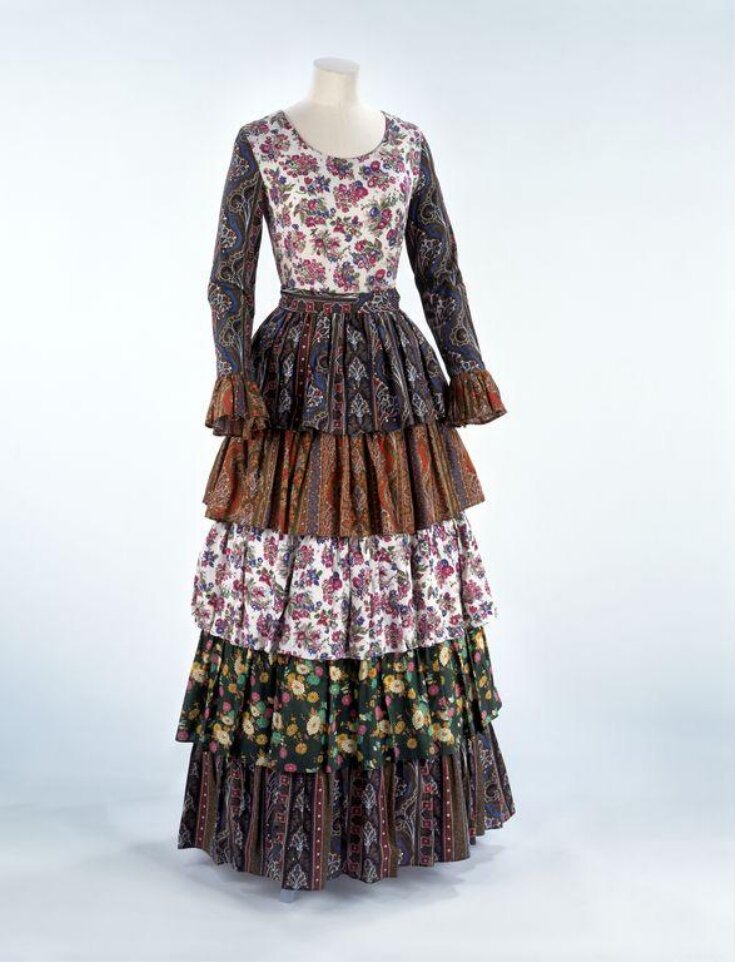
Dress by Wedge, James, 1970. Victoria and Albert Museum.
American fashion took a distinct turn by 1972. Halston’s collections popularized sleeveless, streamlined dresses in Ultrasuede and matte jersey, bringing ease and minimalism to both daywear and eveningwear. His 1972 Ultrasuede shirtdress is especially important because it applied a synthetic nonwoven microfiber, associated with industrial innovation, to refined sportswear. What sets Halston apart is not decoration but discipline: clean lines, body-skimming shape, and a sense of effortlessness that felt entirely urban.
Then came Diane von Furstenberg in 1974, whose first jersey wrap dresses became one of the decade’s most commercially influential forms in the United States. The knitted jersey tie-front design combined stretch, ease of movement, and a body-conscious but office-ready silhouette. If Halston offered cool control, von Furstenberg offered adaptable confidence. Together they show how 1970 dress style could move from fantasy and romance toward practical modern dressing without losing glamour.
Nine dresses, nine versions of the decade
The museum objects in the image work best when read as a spectrum rather than a set. Zandra Rhodes appears twice, in 1973 and again in 1979, and that pair neatly frames her move toward the theatrical chiffon evening mode that became so significant late in the decade. Her better-known 1977 and 1978 collections featured vividly screen-printed chiffon dresses with torn edges and hand-beaded details; the 1979 evening dress in the image belongs to that same late-1970s appetite for expressive surface. Seen beside Biba’s 1973 evening dress and Emanuel Ungaro’s 1975 design, it shows how eveningwear shifted toward drama, movement, and a more openly artful finish.
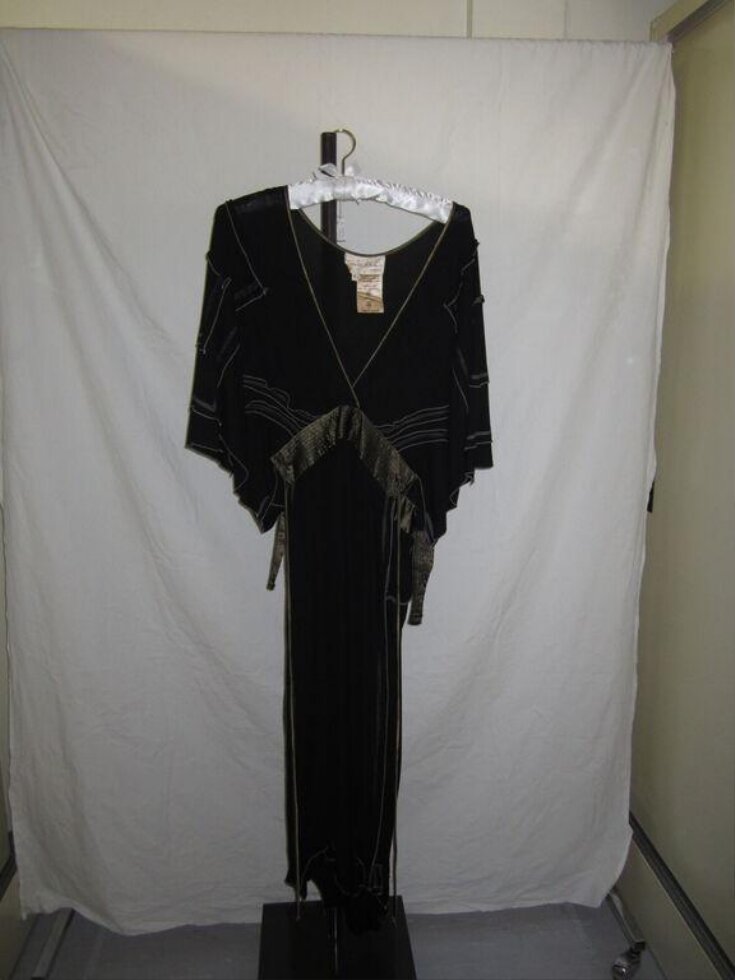
Dress by Rhodes, Zandra, 1973. Victoria and Albert Museum.
From prairie romance to disco sheen: the notable dress forms
If one wants to understand why these garments still matter, the notable examples in the dossier offer the clearest guide. The Ossie Clark for Quorum printed chiffon dress of 1970 fused bias cut with Birtwell’s florals and Art Nouveau-inflected prints, creating one of London fashion’s most recognizable early-1970s forms. At almost the opposite pole stood Gunne Sax by Jessica McClintock, already selling prairie-inspired dresses in 1970 with lace inserts, high necklines, and calico-style prints. Those dresses codified the romantic revival in American ready-to-wear and made nostalgia a mass desire.
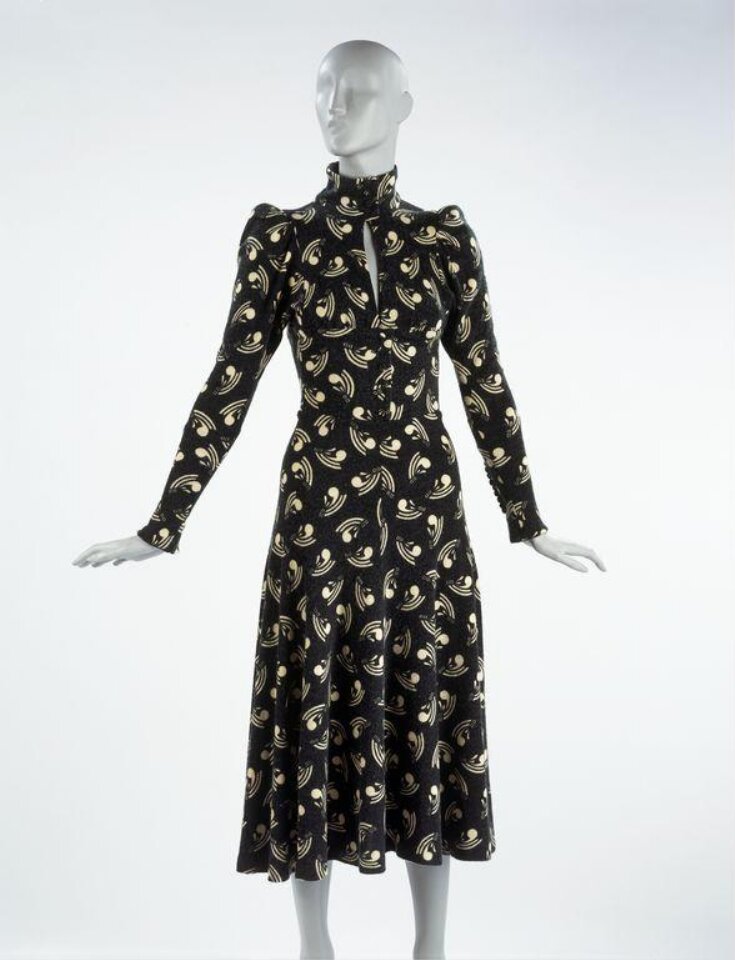
Dress by Biba, 1973. Victoria and Albert Museum.
Laura Ashley widened that appeal through long printed cotton dresses that were widely sold by 1970 and gained broader visibility in 1971 as the revival look spread. Her floral cottons, with high necks and ruffled historical references, made rural-romantic dressing commercially widespread in Britain and export markets. These were not costume, exactly, but everyday fantasy. They also explain why so many people now searching for vintage style dresses are drawn to the decade’s softer and more sentimental side.
Late in the decade, the mood sharpened and brightened. Rhodes’s chiffon evening dresses, especially from 1977 and 1978, introduced hand-screen printing, slashed or raw edges, and beadwork that made evening dress feel artisanal and confrontational at once. By 1979, disco-influenced eveningwear in jersey, lamé, and slinky synthetics coexisted with prairie, wrap, and minimalist forms. The result is a decade where 1970 dresses and 1970 dresses for party can look utterly different and still be perfectly authentic.
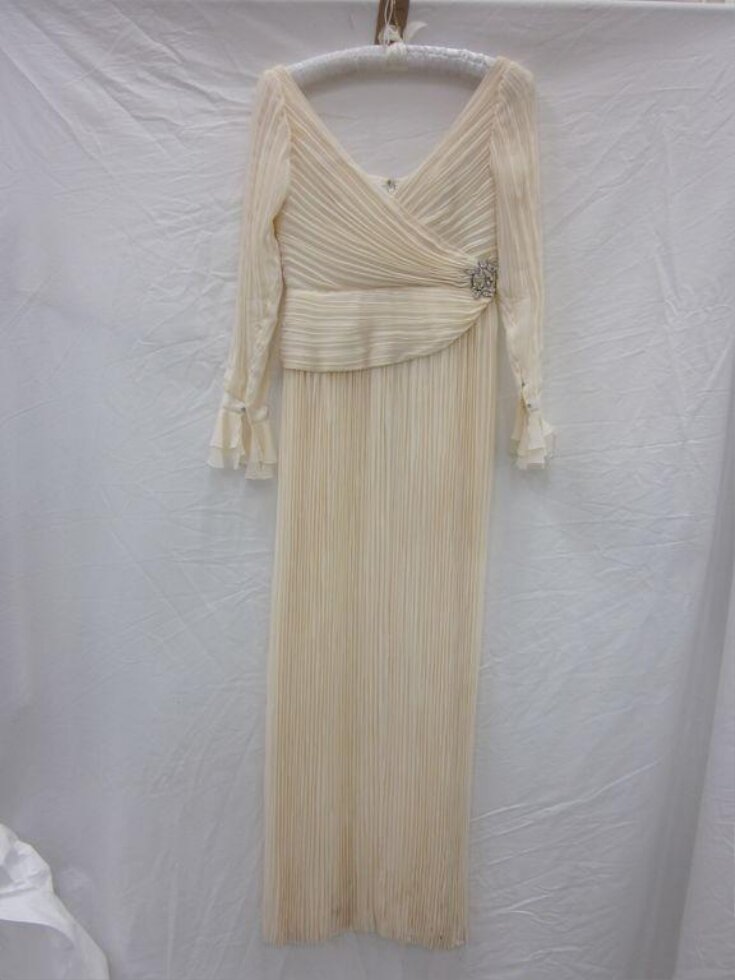
Dress by Ungaro, Emanuel, 1975. Victoria and Albert Museum.
For a museum point of reference, the Victoria and Albert Museum’s 1979 Zandra Rhodes evening dress offers a useful late-decade marker. It sits far from the early-1970s prairie impulse, yet it belongs to the same larger story of expressive dress. The decade rewarded individuality, and its fabrics tell that story as clearly as its silhouettes.
- ◆Bias-cut crepe and chiffon, especially in the manner of Ossie Clark, gave woven dresses fluid movement without heavy internal structure.
- ◆Matte jersey and silk jersey underpinned easy, lightly constructed garments, culminating in Diane von Furstenberg’s 1974 wrap dress.
- ◆Prairie and revival styles used printed cotton, eyelet or insertion lace, pintucks, and ribbon drawstrings to echo nineteenth-century dress details.
- ◆Biba’s hallmark ingredients included rayon crepe, velvet, dark floral prints, high necks, bishop sleeves, and midi hems.
- ◆Late-1970s evening dresses favored lamé, sequins, and lightweight synthetic knits designed for movement under nightclub lighting.
Why collectors still chase these dresses
Collectors value surviving examples for very concrete reasons: label clarity, textile condition, and whether a garment embodies a recognizable current. Strong demand centers on named designer pieces with documented labels and iconic silhouettes, especially early-to-mid-1970s dresses that express a specific trend rather than anonymous mass-market production. That means Ossie Clark with a Celia Birtwell print, early Diane von Furstenberg wraps, Halston Ultrasuede, Gunne Sax prairie styles, Laura Ashley florals, Biba labels, and Thea Porter caftans remain especially compelling. Condition matters enormously, because silk chiffon, printed cotton, velvet, and synthetic knits each age differently.
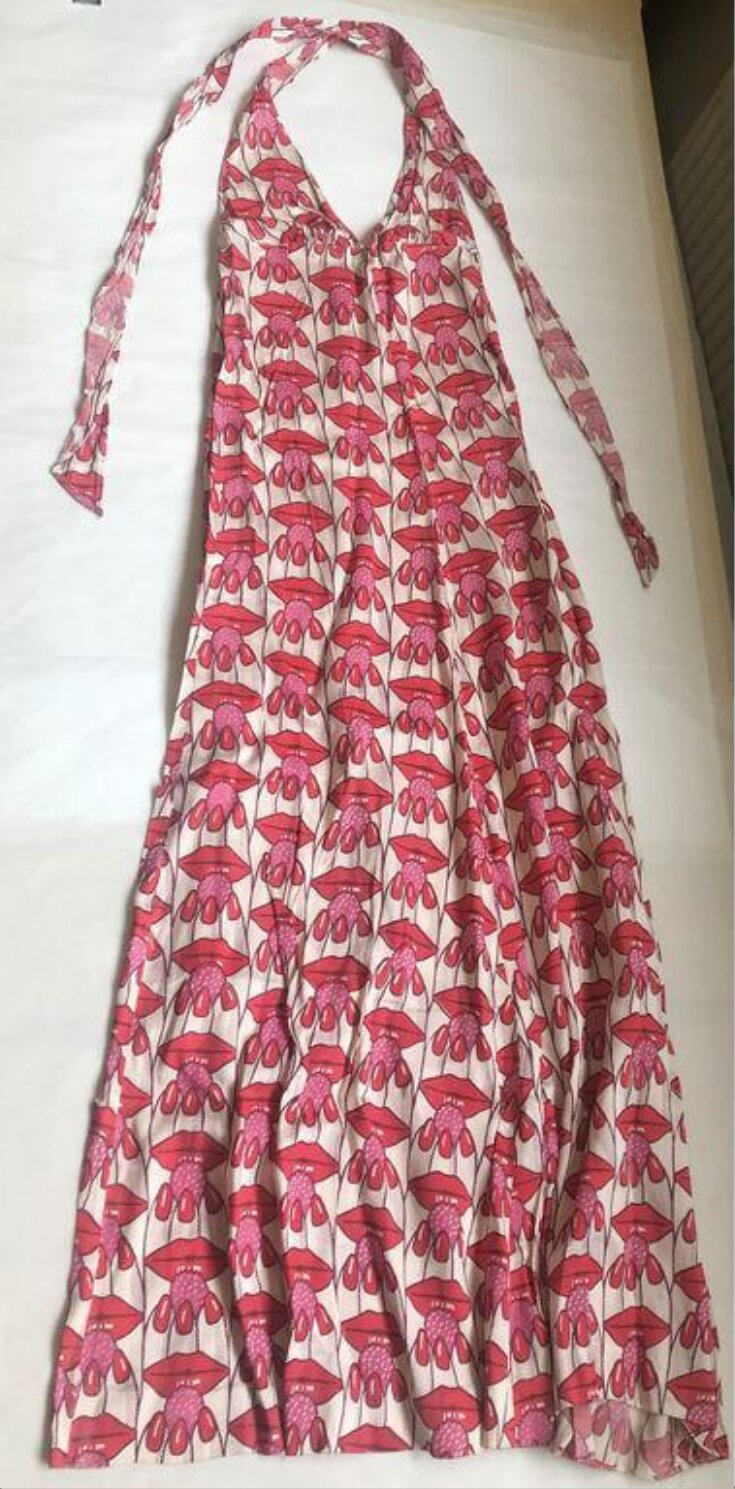
Dress by Wentworth, Jane, 1973. Victoria and Albert Museum.
Moreover, the nine dresses in the image show why collecting the decade is so seductive. A Mary Quant dress from 1973 captures the persistence of youthful brevity; Biba’s 1973 day and evening dresses represent accessible glamour; Rhodes’s 1973 and 1979 pieces illustrate the move from early-decade experimentation to late-decade theatrical eveningwear. Even where the objects are not the dossier’s headline examples, they can be read against its documented currents. Together they prove that 1970 dress style was not a ladder of trends replacing one another but a crowded room of alternatives.
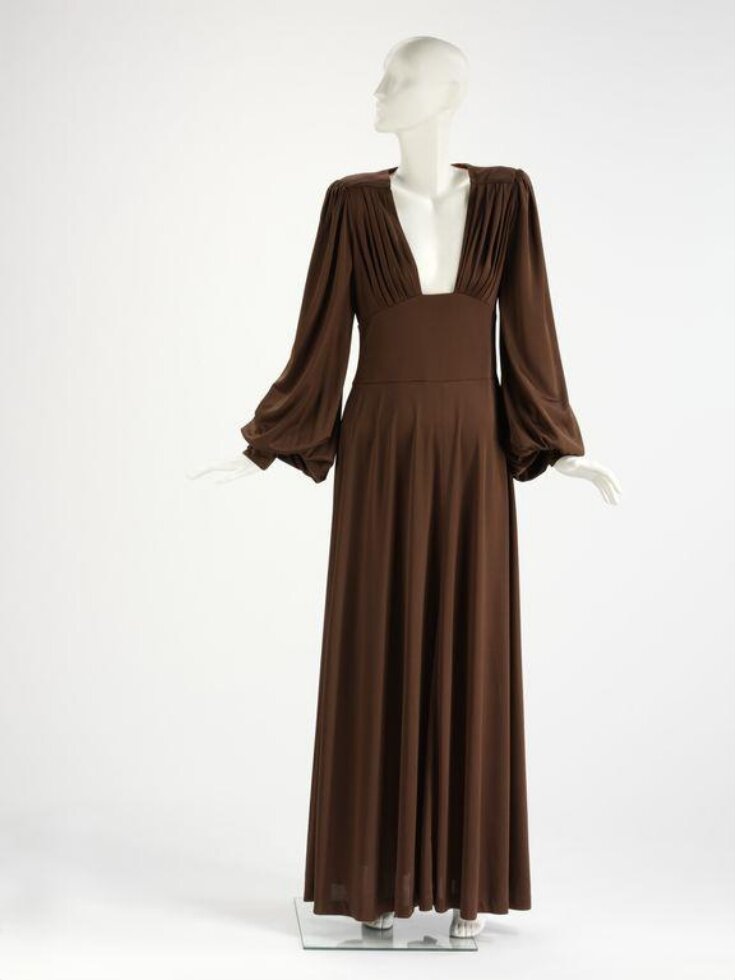
Evening dress by Biba, 1973. Victoria and Albert Museum.
That is why the decade continues to speak so directly to present taste. It offers body-skimming jersey, bias-cut chiffon, nostalgic cotton, velvet midi glamour, caftan ease, and disco shine, each tied to specific designers, dates, and retail worlds. For anyone drawn to vintage style dresses, the attraction lies in that unusual breadth. The best surviving 1970 dresses still feel less like relics than proposals for living: practical, romantic, theatrical, and endlessly open to personal styling.
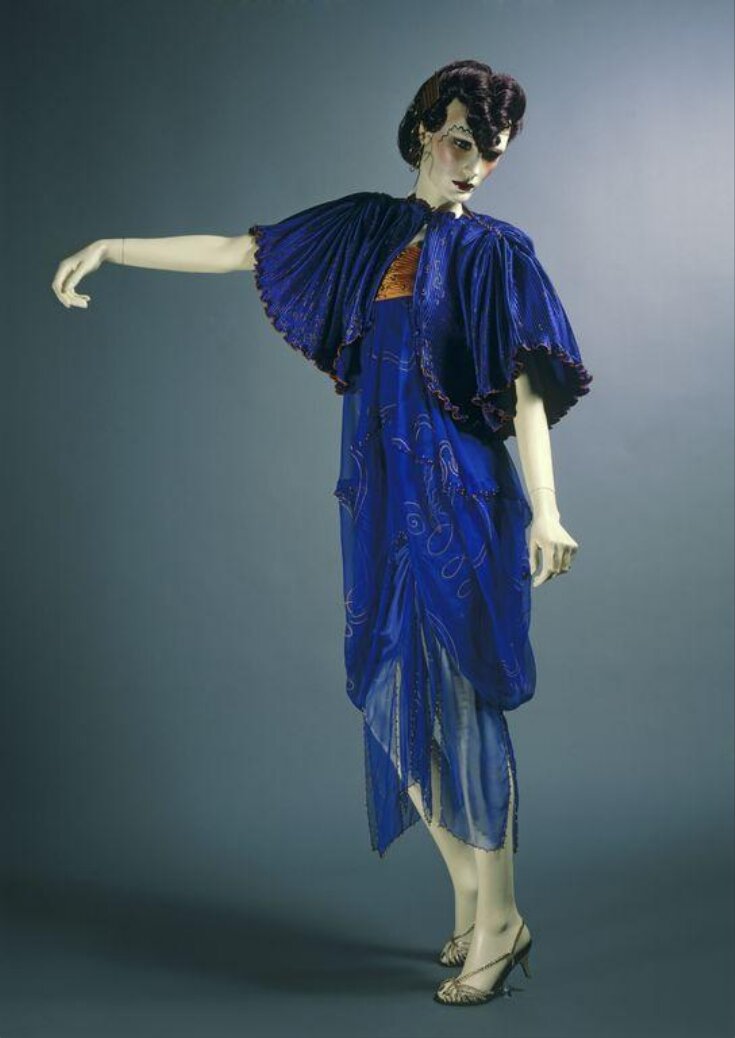
Evening dress by Rhodes, Zandra, 1979. Victoria and Albert Museum.
✦ ✦ ✦
Museum object images are reproduced for editorial and educational purposes. All rights remain with the originating institutions.


Leave a Comment