
n 1943, one Belgian brown leather handbag was bought in Lille during the war, a small act that says much about how women sought useful beauty in constrained times. That story, preserved through a family and now catalogued in Europeana, captures why vintage bags from the 1940s still feel so vivid: they carry rationing, ingenuity, and personal style in the same clasped frame.

Vierkante handtas met schouderriem in bruin leer by onbekend, 1943. Europeana Collections.
Wartime restraint and the changing shape of vintage bags
World War II altered fashion at the level of hardware, handle, and seam. The period brief is clear: less metal, more practical construction, and a turn toward fabric, wood, and plastic when scarcity shaped what could be made. Handbags followed the new rhythm of daily life, serving women who moved between office, factory, queue, and home. Utility mattered, but so did polish.
Because of that pressure, the 1940s favored strong silhouettes over excess trimming. Boxy frame bags, compact top-handle styles, envelope clutches for evening, and small shoulder forms all answered real needs. Neutral tones such as black, brown, navy, and burgundy worked hard with tailored suits and daytime coats. Decoration survived, though often in a disciplined register: reptile embossing, tapestry, neat stitching, and a smart clasp instead of conspicuous branding.
“During the war, many people living near the border went to France because goods such as leather, cosmetics, and other necessities were cheaper there.” — object history attached to the Belgian shoulder bag, 1943
That observation gives the decade its human scale. A bag was not merely an accessory; it was tied to shortages, cross-border shopping, and careful household decisions. Yet women still changed bags for day and evening, and magazines as well as film stars encouraged a glamorous ideal. The 1940s handbag sits precisely at that junction, where necessity met aspiration.

Rechthoekige handtas in bruin leer met beugel in bruin gevlekte plactic by onbekend, 1940. Europeana Collections.
Materials, hardware, and the 1940s eye
The era’s materials tell the story almost as clearly as its silhouettes. Leather remained central, especially for structured day bags, but wartime conditions encouraged substitutes and accents in plastic, wood, rayon, or tapestry. That is why vintage leather bags from the decade often sit beside examples with Bakelite- or Lucite-like details, or with decorative surfaces that enlivened otherwise sober wardrobes. Texture did crucial work.
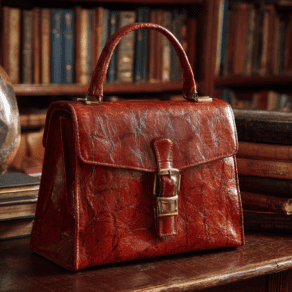
A fine example is the 1940 Belgian rectangular brown leather bag with a mottled brown plastic frame. Its shape is direct and architectural, but the speckled plastic beugel gives it a modern note associated with material experimentation under pressure. A large button closure sits on the frame, while the handle is attached directly to that structure, making the whole design feel compact and engineered. It is an object of utility, though not a dull one.
Another telling piece is the small green crocodile-patterned bag from Belgium, also dated 1940. Whether read as exotic glamour or as a tactile flourish against a strict outfit, its green reptile surface makes it stand out from the decade’s usual dark neutrals. Inside, the lining is in natural leather, a reminder that the pleasure of a bag in this period was often concealed within as much as displayed outside. The appeal of vintage designer bags today often rests on precisely these material contrasts, even when the maker is unknown.

Kleine handtas van groen krokodilleer by onbekend, 1940. Europeana Collections.
Closures that define the decade
If one detail instantly dates a 1940s bag, it is often the closure. Kiss-lock frames, tilting knobs, modest brass fittings, and clasped beugels distinguish the period from today’s zip-heavy or logo-led accessories. Hardware tended to be visible but not loud. It served the hand first, the eye second, and that balance is part of the decade’s enduring elegance.
The black Belgian bag from 1940 shows this beautifully. Small and elongated, with a softly rounded body set on a flat base, it closes with a rectangular gold-tone frame topped by a black rectangular knob held in a gold-colored mount. That knob tilts to open the bag, while the short rounded handles rise from the upper edge. The result is sober, precise, and unmistakably of its time.

Handtas in zwart leer by onbekend, 1940. Europeana Collections.
Day bags, evening bags, and what women carried
The 1940s made a sharper distinction between daytime utility and evening display than many wardrobes do now. Day bags were sturdier, often neutral, and sized for the practical burden of the era: coins, gloves, a handkerchief, lipstick, perhaps ration books or a compact mirror. Evening bags, by contrast, became smaller and more theatrical, often relying on satin, beads, sequins, or metal mesh rather than robust leather. Even under wartime limits, the ritual of changing one’s bag still mattered.
The Belgian brown leather bag from 1940 with a gathered upper section offers an unusually intimate look inside this world. It is rectangular, softly rounded and ruched near the top, and secured by a brass fastening made from four overlapping acorn-shaped knobs with a small decorative tongue. Inside are two compartments lined in ribbed satin, along with a matching wallet in the same fabric, strengthened with leather on one side. Few objects explain the social life of a handbag so clearly: order, modest luxury, and the expectation that contents should be neatly sorted.
Moreover, the natural leather shoulder bag from 1947 points toward the late-decade shift in habits. It has three storage compartments, visible large topstitching used both for construction and ornament, a front flap closed by a small brass lock, and a strap fixed with two brass rings. Those details make it one of the most persuasive vintage shoulder bags in this group, practical enough for postwar movement yet still carefully finished. If the earlier frame bags feel tied to wartime formality, this one suggests a looser, more mobile life.

Handtas in bruin leer by onbekend, 1940. Europeana Collections.
How to buy and read 1940s vintage bags now
Collectors are often told to start with labels, but 1940s bags can speak eloquently even when the maker is unnamed. Shape, lining, stitching, hardware, and wear patterns matter just as much. The Belgian examples here show the era’s signatures in miniature: brass locks instead of overt logos, framed openings, compact proportions, and interiors divided for disciplined use. For anyone learning to date vintage bags, these are more reliable clues than fantasy provenance.
By contrast, the market can blur the line between authentic age and later imitation. Replacement parts, repainted leather, or modern hardware can flatten a bag’s character. A genuine 1940s piece usually wears its history unevenly: softening at the handle, slight tarnish on brass, and interior aging that matches the body rather than fighting it. When in doubt, compare details with documented museum objects such as the 1947 Belgian leather handbag in Europeana.
- ◆Look for period closures such as kiss-lock frames, tilting knobs, and modest brass locks rather than oversized modern fittings.
- ◆Check interior logic: multiple compartments, satin or natural leather linings, and matching accessories like a wallet are strong period signals.
- ◆Study stitching closely; the 1947 Belgian bag uses deliberately large stitches as both structure and decoration.
- ◆Notice proportion and posture: many 1940s bags are compact, upright, and built to sit neatly in the hand or under the arm.
- ◆Value personal histories, such as the 1943 Lille purchase, because documented ownership can illuminate use without exaggerating rarity.
What sets the decade apart, finally, is its mix of severity and charm. A square brown shoulder bag bought across the French border in 1943, a black leather frame bag with a tilting knob, a green crocodile-finish purse with a pale leather interior: each shows how style persisted through limits. Vintage clutch bags and daytime top-handle pieces alike carried the same message. They were small objects asked to do a great deal.

Handtas in naturel leer by onbekend, 1947. Europeana Collections.
Seen together, these 1940s examples remind us that the best vintage designer bags are not always the loudest or the rarest. Sometimes the most compelling piece is the one whose compartments, clasp, and worn handle still describe a woman’s day with exactness. That is why collectors return to the era again and again. These bags do not merely survive history; they keep it in working order.
Vierkante handtas met schouderriem in bruin leer by onbekend, 1943. Europeana Collections.
✦ ✦ ✦
Museum object images are reproduced for editorial and educational purposes. All rights remain with the originating institutions.


Leave a Comment