
ntertainment in the 1950s was shaped by a collision of youth culture, new media, independent record labels, and bold musical experiments. Rock and roll moved from regional radio to national television, doo-wop groups turned street-corner harmony into pop romance, and jazz musicians pushed bebop into cooler, more arranged, and more spacious sounds. At the same time, radio disc jockeys and jukeboxes helped young listeners hear records that older gatekeepers often ignored, including rhythm and blues, country, blues, gospel, and jazz.
The 1950s music scene did not belong to one sound. Elvis Presley brought rockabilly and rock and roll into the national spotlight after early sessions at Sun Records in Memphis and a major move to RCA Victor in 1955. Doo-wop became one of the decade’s signature vocal styles, usually built around a tenor lead singer and background harmonies from a trio or quartet. Jazz moved in several directions at once, with bebop’s speed and harmonic daring still influential while cool jazz emphasized understatement, pastel tone colors, and more relaxed expression.
For anyone studying entertainment in the 1950s, music offers one of the clearest windows into the decade. It shows how teenagers became a commercial force, how Black musical traditions reshaped mainstream pop, how independent labels challenged the major companies, and how technology changed listening habits. The story runs from Memphis studios to Harlem theaters, from New York jazz clubs to diners with glowing jukeboxes, and from local disc jockeys to national television screens.
Why Entertainment in the 1950s Revolved Around Music
Entertainment in the 1950s became more youth-driven than ever before. Teenagers had more cultural visibility after World War II, and recorded music gave them a way to express taste, identity, rebellion, romance, and group belonging. Jukeboxes became closely tied to postwar youth culture because diners and teenage canteens let young people choose rock and roll at loud volumes away from home.
Radio also changed how entertainment in the 1950s reached listeners. Disc jockey programs became economically important to many American radio stations after World War II, and by the 1950s the success of a record could depend heavily on disc jockey preferences. Alan Freed, one of the best-known radio figures of the decade, helped popularize the phrase rock and roll and brought rhythm and blues, blues, swing, and doo-wop to new audiences, especially young white listeners.
Music in the 1950s also reflected racial crossover and tension. Many rock and roll sounds grew from African American rhythm and blues, blues, gospel, and jazz traditions, while white teenagers increasingly bought and listened to these records. Freed’s dance concerts brought Black and white fans together, making the live music space part of a larger social shift.
Elvis Presley and the Rock-and-Roll Explosion
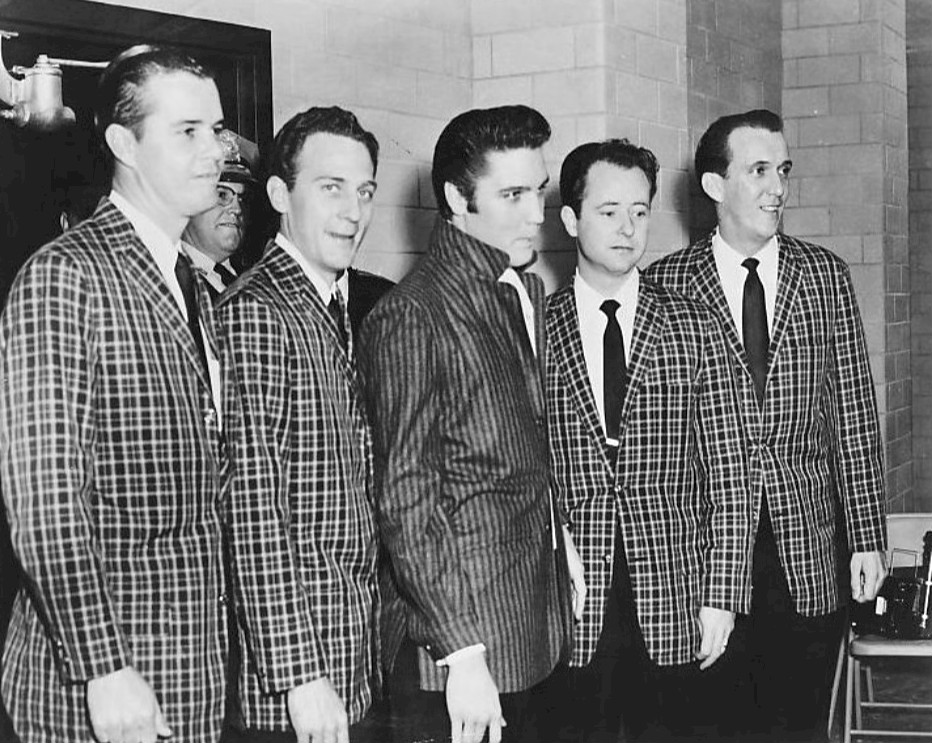
Elvis Presley and the Jordanaires, 1957. Wikimedia Commons.
Elvis Presley was not the only force in 1950s rock and roll, but he became the decade’s most visible symbol of its mainstream breakthrough. Presley is often described as the “King of Rock and Roll” and one of rock music’s dominant performers from the mid-1950s until his death. His rise changed entertainment in the 1950s because he connected regional Southern sounds to national radio, television, records, movies, and teenage fandom.
Presley’s early style came from a mix of blues, country, Tin Pan Alley ballads, and gospel hymns. He absorbed music through radio, church, Black Memphis gospel settings, and the Beale Street blues scene, then turned those influences into a rockabilly style that felt new to many listeners. This blending of traditions helped make him a bridge figure in popular culture, although it also raised questions about race, borrowing, and credit that still shape discussions of 1950s music.
The key turning point came at Sun Records. Producer Sam Phillips first recorded Presley at Sun in Memphis, working with guitarist Scotty Moore and bassist Bill Black. Sun Records launched the label in February 1952 at 706 Union Avenue, recorded gospel, blues, hillbilly, country, boogie, and western swing, and found Presley in 1954.
Presley’s recording of Arthur “Big Boy” Crudup’s “That’s All Right Mama” in July 1954 helped reveal the full shape of his musical personality and rockabilly synthesis. Over the next year, Presley released five singles on Sun and built a strong Southern following through records, roadhouse shows, clubs, and radio appearances on Louisiana Hayride. That regional foundation mattered because entertainment in the 1950s often moved from local scenes to national fame through radio airplay, touring, label promotion, and television.
In 1955, Colonel Tom Parker arranged the sale of Presley’s recording contract to RCA Victor, with Sun receiving $35,000 and Presley receiving $5,000. RCA gave Presley the national promotional machinery that Sun could not match, and his 1956 hits included “Heartbreak Hotel,” “Don’t Be Cruel,” and “Love Me Tender.” The result was not just a new star, but a new model for mass entertainment in the 1950s: records, radio, television, films, merchandising, and youth identity working together.
Presley’s impact was also visual. His performance style, hair, clothes, and stage movement made rock and roll feel physical and controversial. In a decade often remembered for suburban order and social conformity, Presley showed how popular music could turn a singer into a cultural event. He made sound, image, and youth desire inseparable.
The Rise of Doo-Wop Groups

Frankie Lymon and The Teenagers, 1957. Wikimedia Commons.
Doo-wop was one of the most important vocal styles in entertainment in the 1950s. It is defined as a rhythm-and-blues and rock-and-roll vocal style popular in the 1950s and 1960s, usually featuring a tenor lead vocalist with a trio or quartet singing background harmony. The name comes from the nonsense syllables that groups used to create harmonic support behind the lead singer.
The roots of doo-wop reached back to earlier vocal groups such as the Mills Brothers and the Ink Spots. The Mills Brothers turned small-group harmony into an art form by using voices to imitate instrumental sections, and the Ink Spots helped establish the importance of tenor and bass voices in pop vocal ensembles. By the 1950s, those ideas became part of a younger, urban, rhythm-and-blues-based sound.
Doo-wop fit the social world of teenagers because it could be made almost anywhere. Many young singers in cities such as New York, Chicago, and Baltimore had limited access to instruments, so vocal groups became a practical and expressive musical unit. Groups rehearsed in echo-rich spaces such as hallways, school bathrooms, and under bridges so they could hear the blend of their harmonies.
This made doo-wop more than a sound. It was a form of neighborhood entertainment in the 1950s, especially in urban communities where music, friendship, romance, and local pride overlapped. The songs often centered on love, longing, heartbreak, and teenage emotion, which made the style perfect for radio dedications, school dances, and jukebox plays.
Several doo-wop groups became central to 1950s pop. The Platters, the Moonglows, the Coasters, the Flamingos, Frankie Lymon and the Teenagers, and the Orioles all helped define the style for wider audiences. The Platters’ 1956 remake of “My Prayer” is one example of Ink Spots influence, showing how older harmony traditions carried into 1950s vocal pop.
Female vocal groups also mattered. The Chantels, the Shirelles, and Patti LaBelle and the Bluebelles all contributed to female doo-wop, showing that the style was not only a male street-corner tradition. These groups helped prepare the way for the girl-group boom and the polished soul-pop of the early 1960s.
Doo-wop’s success depended heavily on independent labels and local scenes. Small labels could record young vocal groups quickly, test singles through radio and jukeboxes, and sometimes break records before larger companies noticed. This made doo-wop one of the clearest examples of how entertainment in the 1950s grew from neighborhoods into national pop culture.
Bebop, Cool Jazz, and the Changing Sound of Jazz

Charlie Parker, Tommy Potter, Max Roach at Three Deuces, 1947, William P. Gottlieb. Library of Congress.
Jazz in the 1950s was not standing still. Bebop, which had emerged in the 1940s through musicians such as Charlie Parker and Dizzy Gillespie, remained a major influence because of its complex harmonies, fast tempos, and emphasis on advanced improvisation. The postwar scene was one where bebop had taken hold while other musicians began developing new approaches, including cool jazz.
Cool jazz offered a contrast to bebop’s heat and intensity. Cool jazz emerged in the United States during the late 1940s, named by journalists for its understated or subdued feeling. Its tone colors often leaned toward pastels, vibrato was slow or absent, and drummers tended to play more softly than in bop and hard bop.

Dizzy Gillespie on 52nd Street, c. 1946–1948, William P. Gottlieb. Library of Congress.
Miles Davis played a crucial role in the shift toward cool jazz. His nonet, with arrangements by Gil Evans and others, played at the Royal Roost in New York in 1948 and recorded for Capitol Records in 1949, producing tracks that later became central to the development of cool jazz. The Miles Davis Nonet of 1948 to 1950 is considered a direct offspring of the Claude Thornhill sound, with pieces such as “Boplicity,” “Israel,” “Move,” and “Moondreams” among its most significant recordings.
Cool jazz also developed through musicians such as Lee Konitz, Gerry Mulligan, Stan Getz, Art Pepper, and Lennie Tristano. The sound was varied, but it often favored restraint, melodic clarity, lighter textures, and a renewed interest in collective improvisation.
The Modern Jazz Quartet showed another side of cool and chamber jazz. Formed in 1953, the group included John Lewis, Milt Jackson, Percy Heath, and Kenny Clarke, who was soon replaced by Connie Kay. John Lewis brought classical influence and contrapuntal writing into the group’s repertory, making the MJQ a key example of jazz as refined concert music as well as nightlife entertainment.
The jazz story of entertainment in the 1950s also includes hard bop, which reacted against some cool jazz restraint by reconnecting modern jazz with blues, gospel, and more forceful rhythms. Even when the public spotlight moved toward rock and roll, jazz clubs, record labels, festivals, and college audiences kept jazz central to serious music culture. In the same decade, a teenager might dance to Elvis, hear doo-wop on the radio, and discover Miles Davis or Gerry Mulligan through records, clubs, or older siblings.
Key Venues in the 1950s Music Scene
Venues mattered because they gave entertainment in the 1950s a physical home. Radio and records spread the music, but theaters, clubs, ballrooms, arenas, and diners gave fans places to gather.
| Venue or setting | City or region | Why it mattered |
|---|---|---|
| Sun Studio and 706 Union Avenue | Memphis | Sun Records used this Memphis space as an all-purpose studio and recording home for gospel, blues, country, boogie, western swing, and early rockabilly. |
| Louisiana Hayride | Shreveport | Presley built part of his early regional following through radio performances on Louisiana Hayride before national stardom. |
| Cleveland radio and dance halls | Cleveland | Alan Freed’s Cleveland radio work and dance concerts helped bring rhythm and blues and rock and roll to young crossover audiences. |
| Birdland and Royal Roost | New York | Miles Davis’s nonet played at the Royal Roost in 1948 before recording sessions that influenced cool jazz. |
| Urban hallways, bathrooms, and bridges | New York, Chicago, Baltimore, and beyond | Doo-wop groups often rehearsed in echo-rich places that helped singers hear their harmonies clearly. |
| Diners and teenage canteens | United States | Postwar jukeboxes in diners and teenage canteens let young listeners choose rock and roll in social spaces outside the home. |
The most important point is that 1950s venues were not only formal stages. A diner with a jukebox, a school dance, a radio studio, a neighborhood hallway, and a Memphis recording room could all become part of the music network. This made entertainment in the 1950s feel immediate, local, and participatory.
Record Labels That Shaped Entertainment in the 1950s
The 1950s music scene depended on record labels that were willing to record sounds outside the safest mainstream formulas. Major labels had distribution power, but independent labels often found the raw material first.
| Label | Base or identity | 1950s role |
|---|---|---|
| Sun Records | Memphis | Sam Phillips launched Sun in 1952 and recorded gospel, blues, country, hillbilly, boogie, western swing, and early rockabilly, including Elvis Presley in 1954. |
| RCA Victor | Major label | RCA bought Presley’s contract from Sun in 1955 and helped turn him into a national and international star through larger-scale recording and promotion. |
| Chess Records | Chicago | Chess Records was established in 1950 and became central to electric blues, rhythm and blues, and early rock and roll with artists such as Muddy Waters, Howlin’ Wolf, Chuck Berry, Bo Diddley, Etta James, the Dells, and the Flamingos. |
| Atlantic Records | New York | Atlantic Records, founded in 1947, helped move rhythm and blues forward after Jerry Wexler joined Ahmet Ertegun as a partner in 1953. |
| Capitol Records | Major label | Capitol recorded Miles Davis’s nonet sessions in 1949, which later became influential in the development of cool jazz. |
| Blue Note Records | Jazz label | Blue Note’s Miles Davis biography frames Davis as central to major jazz innovations from the mid-1940s onward and describes the nonet’s influence on cool jazz. |
These labels helped define entertainment in the 1950s by turning local sounds into portable culture. A record could begin in a small studio, move to a disc jockey, enter a jukebox, travel through teen word of mouth, and become a national hit. That chain was one reason the decade’s music moved so quickly.
Radio: The Voice That Carried the 1950s Sound

Mutual Broadcasting System — Fulton Lewis Radio, 1940s–1950s commercial. Wikimedia Commons.
Radio was one of the most powerful engines of entertainment in the 1950s. It made music part of daily life in cars, kitchens, bedrooms, shops, and public spaces. Unlike television, which required viewers to sit and watch, radio could follow listeners through the day.
Disc jockeys became taste-makers. By the 1950s, the success of a record could depend on disc jockey preferences, which meant radio personalities had major influence over what became popular. This made radio a bridge between record labels and listeners.
Alan Freed’s importance came from the way he recast rhythm and blues for a wider youth audience. He helped popularize and redefine the phrase rock and roll through his radio show, exposing new listeners to rhythm and blues, blues, swing, and doo-wop, and helping turn Black musical styles into part of the broader teen soundtrack.
Top 40 radio also reflected the influence of the jukebox. The queues of hit-after-hit music on jukeboxes helped inspire the teen-friendly Top 40 format, which replaced older programming approaches that often played several songs by a single artist. This made radio faster, more repetitive, more single-oriented, and more closely aligned with youth taste.
Jukeboxes: Music on Demand Before Streaming
Jukeboxes were one of the most important technologies of entertainment in the 1950s. They let people choose music in public, often for a small coin, long before digital playlists or streaming services existed. Jukeboxes introduced music on demand and helped customers hear songs for less than the cost of buying a record.
In the postwar years, jukeboxes became central to diners and teenage hangouts. Stylish jukebox cabinets in diners let teenagers listen to rock and roll at volumes that were generally impossible or inadvisable at home. This made the jukebox not just a machine, but a social ritual.
Jukeboxes also widened access to music that radio often neglected. Operators used meters inside machines to track which songs were popular in specific locations, then programmed boxes with a mix of national hits and regional selections. Those regional selections included Black and working-class musicians in genres such as country and blues that often received limited radio airplay.
That made the jukebox a democratic force in entertainment in the 1950s. A teenager did not need to own a record player, buy every single, or wait for a station to play a request. The right coin in the right diner could make the new sound public.
How These Sounds Changed American Culture
The 1950s music scene changed American culture because it changed who had power. Teenagers became visible consumers, independent labels became hitmakers, disc jockeys became gatekeepers, and public listening spaces became social stages. Entertainment in the 1950s was no longer just something families consumed together in the living room; it was increasingly something young people chose with friends.
Elvis Presley showed how a performer could combine sound, image, movement, and media into a national phenomenon. Doo-wop groups showed how local vocal culture could become pop music without expensive instruments or elite training. Bebop and cool jazz showed how musicians could keep pushing artistic complexity even as the commercial market turned toward rock and roll.
The decade also made popular music more racially and socially complicated. Rock and roll drew deeply from Black musical traditions, while many white performers received larger mainstream rewards. At the same time, radio, jukeboxes, and dance concerts created spaces where young Black and white listeners could encounter some of the same records, even in a segregated society.
Quick Timeline of Entertainment in the 1950s Music Scene
| Year | Music milestone | Why it mattered |
|---|---|---|
| 1950 | Chess Records established | Chess became a major force in electric blues, R&B, and early rock and roll. |
| 1952 | Sun Records launched | Sam Phillips created a Memphis label that recorded blues, country, gospel, and early rockabilly. |
| 1953 | Modern Jazz Quartet formed | The group helped define chamber jazz and a refined cool-jazz approach. |
| 1954 | Elvis recorded “That’s All Right Mama” | The record helped reveal Presley’s rockabilly synthesis and launched his rise from Memphis. |
| 1955 | Presley moved from Sun to RCA | RCA bought his contract, giving him access to major-label promotion and national scale. |
| 1956 | Presley scored major RCA hits | “Heartbreak Hotel,” “Don’t Be Cruel,” and “Love Me Tender” helped make him a national star. |
| 1950s | Doo-wop reached mass popularity | The style became known for tenor leads, background harmonies, and urban vocal-group culture. |
| 1950s | Jukeboxes became teen culture icons | Diners and teenage canteens helped make jukeboxes symbols of youth listening and music on demand. |
Conclusion: Why 1950s Music Still Matters
Entertainment in the 1950s still matters because the decade created the blueprint for modern popular music culture. A song could be discovered locally, promoted by a label, pushed by a disc jockey, chosen on a jukebox, performed on television, and turned into a youth movement. That pattern still shapes music marketing today, even if the jukebox has become the playlist and the radio request has become the social share.
Elvis Presley, doo-wop groups, bebop players, and cool-jazz innovators were part of the same larger transformation. They showed that entertainment in the 1950s was not a single style, but a network of sounds and spaces. From the raw energy of rock and roll to the smooth harmonies of doo-wop and the refined textures of cool jazz, the decade turned American music into a shared national conversation.
✦ ✦ ✦
Museum object images are reproduced for editorial and educational purposes. All rights remain with the originating institutions.



Leave a Comment