
1950s Designers & Couturiers · No. 2
Cristóbal Balenciaga
The Basque fisherman’s son who learned to sew at his mother’s knee — and grew up to be called, by every couturier of his era, simply the master.
21 January 1895 — 23 March 1972
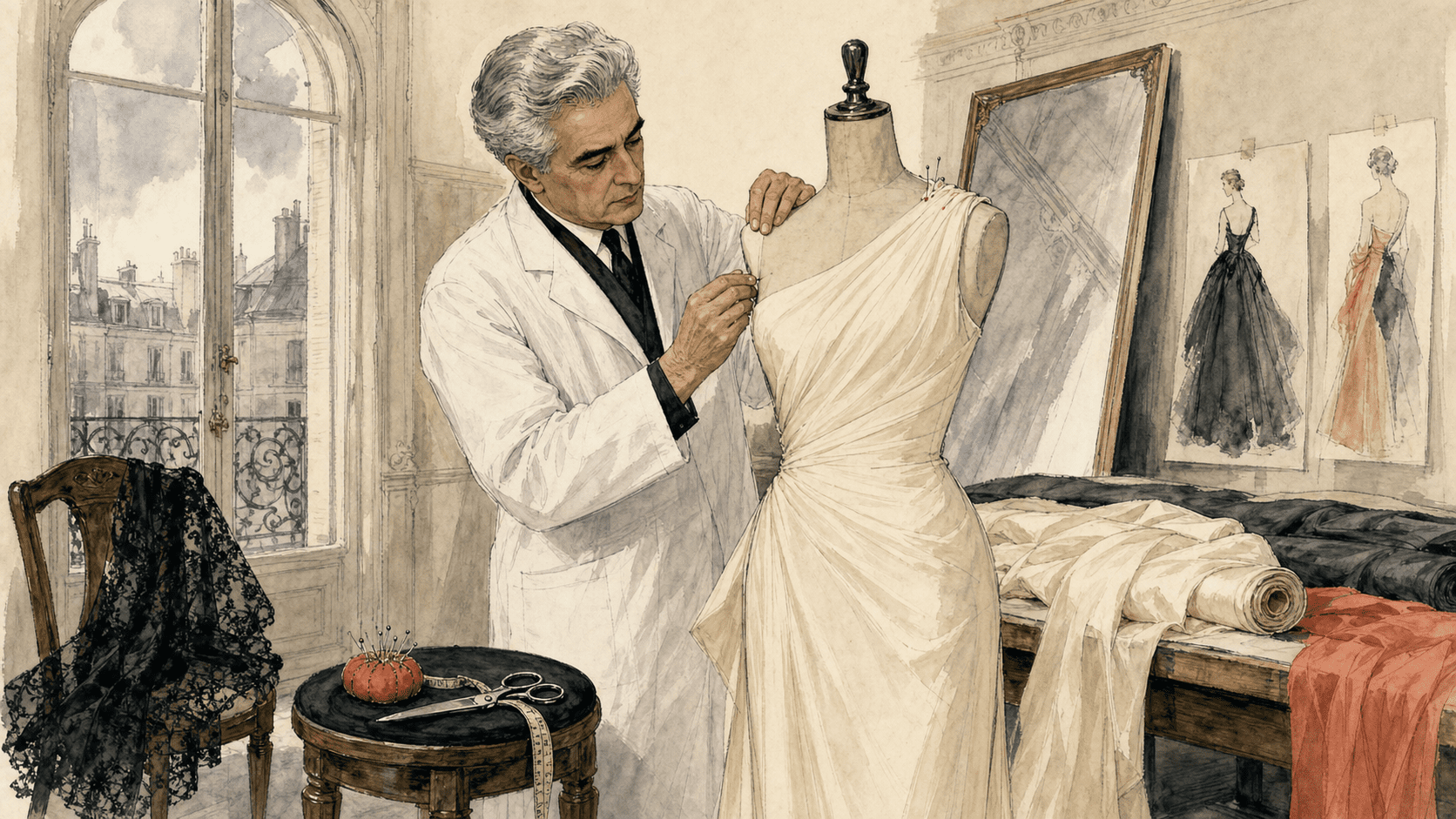
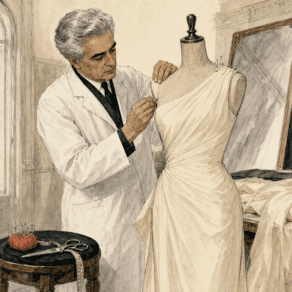
The couturier at the form. Unlike most designers, Balenciaga could personally cut, baste, and finish every garment he showed. He often stood for hours in silent concentration, draping by hand directly on the mannequin.
f Christian Dior was the showman of the 1950s — the one who launched a silhouette with a single February afternoon, who staged collections like Broadway openings, whose face appeared on the cover of Time — then Cristóbal Balenciaga was his opposite. A man so private he refused to attend his own shows. A man who never gave interviews. A man whose face most of his clients never saw. And yet, when other couturiers spoke of him, they used a single word: master.
“Balenciaga is the master of us all,” Christian Dior said. Coco Chanel — who hated almost everyone — agreed: “Balenciaga alone is a couturier in the truest sense of the word. The others are simply fashion designers.” Hubert de Givenchy, who would become Balenciaga’s closest friend and disciple, called meeting him “the most important moment of my life.”
He was a fisherman’s son from a tiny village on the Basque coast. He never went to design school. He could not even draw very well. What he could do — and what no other twentieth-century couturier could match — was take a flat piece of fabric, drape it on a living body, and turn it into architecture.
Part 1The Quiet Boy from Getaria
He was born on 21 January 1895 in Getaria, a fishing village of perhaps two thousand souls clinging to the Bay of Biscay on Spain’s northern Basque coast. His father, José Balenciaga Basurto, was a fisherman and the village mayor. His mother, Martina Eizaguirre Embil, was a seamstress who took in mending for the local aristocracy who summered along the coast.
When Cristóbal was around eleven, his father died. The family — Martina and her three children — fell into hardship. The boy spent hours sitting at his mother’s feet as she worked, watching her hands. He would later say he could not remember a time when he could not sew.
The decisive moment came when he was about twelve. A local noblewoman, the Marquesa de Casa Torres, summered in Getaria with her aristocratic friends. She was an unusually elegant woman with a Paris wardrobe — Worth, Doucet, Paquin. Young Cristóbal worked up the courage to approach her one afternoon and offered, in halting Spanish, to make her a dress.
She asked him why.
“Because,” he said, “I think I can.”
She let him try. He copied one of her Worth tailored suits, by eye, from memory. The work was so accurate that the Marquesa not only let him keep going, she paid for him to apprentice with a tailor in San Sebastián, twenty miles away. She gave him access to her own Paris-couture wardrobe — he was allowed to take her dresses apart, study them seam by seam, and put them back together. She would remain his patroness and protector for the rest of her life. When she died in 1935, her granddaughter would later become a queen — and would wear, for her wedding, a dress made by him.
From San Sebastián to Paris
By 1917, at twenty-two, he had opened his first dressmaking house in San Sebastián. He named it Eisa, after his mother’s family name. By the late 1920s he was the favoured couturier of Queen Victoria Eugenia of Spain. He opened branches in Madrid and Barcelona. He travelled annually to Paris to study collections at Worth, Vionnet, and Chanel — buying patterns, sketching, learning everything.
Then in 1936 the Spanish Civil War broke out. His salons closed. His royal patrons fled. Madrid and Barcelona were unsafe. He went briefly to London and then, in 1937, to Paris — a forty-two-year-old refugee with an excellent reputation in Spain and almost no one in France who knew his name. He opened a maison at 10 Avenue George V, in the 8th arrondissement, two blocks from Dior’s future address.
His first Paris collection, in August 1937, was a quiet sensation. Harper’s Bazaar sent its formidable editor Carmel Snow, who declared the new house extraordinary. By 1939 — only two years in — Balenciaga was already one of the most respected couturiers in Paris. The Second World War, which closed many houses, only deepened his reputation. He stayed open through the Occupation, dressing the few clients who could still afford couture, refusing to make any concession to Nazi taste.
When peace came in 1945, he was ready.
✦ ✦ ✦
Part 2Twelve Things You Probably Didn’t Know
Balenciaga’s life was a fortress of privacy. He gave exactly one press interview in his entire forty-year career — to The Times of London in 1971, the year before his death. He hated photographers and walked out of any room one entered. But behind the silence is a richer and stranger biography than almost anyone realises.
One — He Could Make a Dress Entirely by Himself
Of every great couturier of the twentieth century, Balenciaga was the only one who could personally execute every step — cut, baste, sew, finish — to the standard of his own workrooms. Dior could not. Saint Laurent could not. Chanel could not. When asked late in life what set him apart from his peers, he answered, simply, that he had begun by sewing.
Two — His Birthday Was the Same as Dior’s, Ten Years Apart
Born 21 January 1895. Christian Dior was born exactly ten years later, on 21 January 1905 — the same day of the year. The two greatest names in 1950s couture shared a birthday. Dior died in 1957; Balenciaga survived him by fifteen years, and never publicly mentioned the coincidence.
Three — He Refused to Show His Collections on Schedule
While every other Paris house released collections the day journalists arrived, Balenciaga released his a full month later. He despised the noise of opening day and refused to compete with it. American buyers and editors learned to fly in twice — once for everyone else, and again four weeks later for the master.
Four — He Was Devoutly, Almost Monastically, Catholic
He attended Mass daily for most of his life. His Paris apartment was furnished like a Spanish monk’s cell — plain walls, dark wood, a crucifix, no decoration. When the Second Vatican Council in the 1960s ordered priests out of cassocks and nuns out of habits, he was personally devastated. Many believe this was one of the reasons he closed his house in 1968: if the Church could abandon ritual, fashion was certainly lost.
Five — He Designed for a Queen Whose Grandmother Was His First Patron
In December 1960, Fabiola de Mora y Aragón married King Baudouin of Belgium. Her wedding dress — ivory satin, ermine-trimmed, with a six-metre train — was designed by Balenciaga. Fabiola was the great-granddaughter of the Marquesa de Casa Torres, the noblewoman who had bought him his first apprenticeship in San Sebastián half a century earlier. He made the gown without charge.
Six — He Loved Sleeves Above All Else
“He was genuinely obsessed with sleeves,” said his friend the socialite Gloria Guinness. He invented or perfected almost every modern sleeve treatment: the three-quarter sleeve, the seven-eighths bracelet sleeve, the dolman sleeve, the kimono sleeve, the melon sleeve. His clients said the smallest gesture — lifting a teacup, turning a page — felt different in a Balenciaga because the sleeves were cut at the precise angle to make the wrist look slender and the hand look graceful.
Seven — He Created the “Stand-Away” Neckline
One of his most-imitated innovations, introduced in 1953 and refined through the decade: a jacket or dress neckline set a full finger’s width away from the throat. It made the neck look longer, the jaw look finer, and (as Gloria Guinness put it) “let women and their pearls breathe.” Every modern boatneck and stand-collar is a descendant.
Eight — His Atelier Was Run Like a Silent Religious Order
The seamstresses at 10 Avenue George V worked in near-total quiet. No radio. No chatter. Balenciaga himself often did not speak for hours. When he did, his head seamstresses said, every word was an instruction so precise that nothing more was needed. He fired anyone who chewed gum in the workroom.
Nine — His Clients Were the Most Glamorous Women in the World
Mona von Bismarck — who refused to be photographed by anyone after Balenciaga retired in 1968. Bunny Mellon, whose Virginia closets contained more than three hundred Balenciagas. Pauline de Rothschild. Gloria Guinness, voted best-dressed woman in the world year after year. Marella Agnelli. Hope Portocarrero, the First Lady of Nicaragua. Marlene Dietrich. Queen Fabiola. Jackie Kennedy, who quietly wore Balenciaga in private even after being told that, as First Lady, she must wear American designers in public.
Ten — He Once Fitted a Dress on Mona Bismarck for Three Days
The fitting lasted three full days — eight hours each day. Mona, one of the great American beauties of the century, stood patiently. Balenciaga pinned, removed pins, repinned. When at last he was done, he stepped back, looked at her, and burst into tears. She wore the dress to one ball and gave it back to him because she thought no one else should ever see it.
Eleven — He Closed His Houses in 1968 Without Warning
In May 1968 — during the Paris student uprisings that brought France briefly to a halt — Balenciaga, 73 years old, simply closed. Every salon. Every workroom. Madrid, Barcelona, San Sebastián, Paris. Hundreds of seamstresses found out by reading the morning paper. He gave no reason. To friends he said only that the world he had dressed no longer existed. Mona Bismarck shut herself in her room and reportedly wept for three days.
Twelve — His Last Commission Was Another Wedding Dress
In 1972, Generalísimo Francisco Franco’s granddaughter asked him to come out of retirement to make her wedding gown. He agreed, made it, and saw it worn at the cathedral. A few days later, on a visit to his country house in Jávea on the Spanish coast, he died of a heart attack. He was 77. He is buried in his birthplace, Getaria, on a hillside overlooking the bay where his father once fished.
✦ ✦ ✦
Part 3What Made a Balenciaga, a Balenciaga
While Dior worked in nostalgia — corsets, padded hips, the wasp-waist of 1860 reborn — Balenciaga worked in pure architecture. He believed clothing should not fight the body but reorganise the space around the body. He moved fabric off the skin. He created shapes that floated, hovered, curved away.
A couturier must be an architect for design, a sculptor for shape, a painter for colour, a musician for harmony, and a philosopher for temperance.— Cristóbal Balenciaga
He had three secret weapons:
Fabric. He commissioned a Swiss textile mill — Abraham — to develop a stiff, weighty, silk-and-rayon fabric for him called gazar. It held architectural shapes the way no other cloth could. He used it for sculptural ball gowns that stood up almost on their own.
The body’s geometry. Unlike most couturiers, he did not idealise the body. He worked with what was there. His semi-fit suits — fitted at the front, loose at the back — were designed for the post-thirty woman, whose torso had thickened slightly. He made the imperfect body look better than the perfect one.
His hands. Almost alone among his peers, he draped directly on the mannequin or the client. He did not sketch first. He took a length of fabric, pinned it, cut, repinned. The garment emerged as a piece of three-dimensional sculpture, never as a flat drawing.
✦ ✦ ✦
Part 4The Signature Silhouettes
The 1950s, in Balenciaga’s hands, were a decade-long argument with Christian Dior’s New Look. Where Dior tightened the waist, Balenciaga set it free. Where Dior padded the hips, Balenciaga floated fabric. Where Dior dressed his clients in armour, Balenciaga dressed them in air.
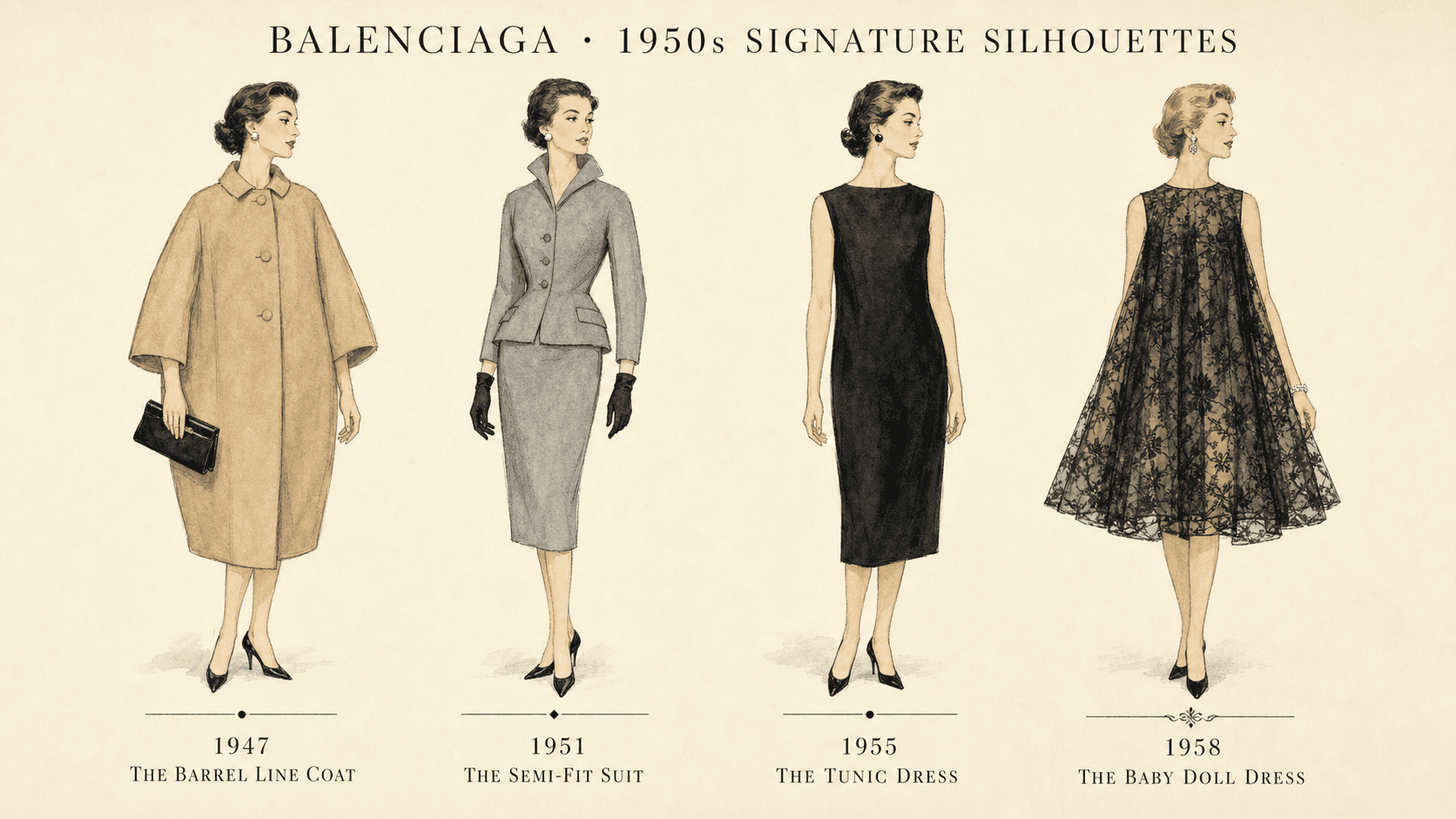
Four silhouettes that changed the geometry of women’s clothing — the Barrel Line coat (1947), the Semi-Fit suit (1951), the Tunic dress (1955), and the Baby Doll dress (1958). Each one moved fabric away from the body — and pulled fashion’s future a step closer.
The Barrel Line Coat — 1947
Released the same year as Dior’s New Look, but in the exact opposite direction. Balenciaga’s barrel coat curved outward in the middle back, leaving room around the body the way a cocoon leaves room around a moth. It was the first hint of what would come.
The Semi-Fit Suit — 1951
His most enduring tailored shape: a jacket fitted closely at the front to the waist with darts, but loose, floating, and voluminous at the back. To the eye, the woman wearing it had a defined waist and the silhouette of a column. To her body, it was as comfortable as a dressing gown. The set-away collar arrived with it. Every modern “relaxed-fit” blazer is a descendant.
The Tunic Dress — 1955
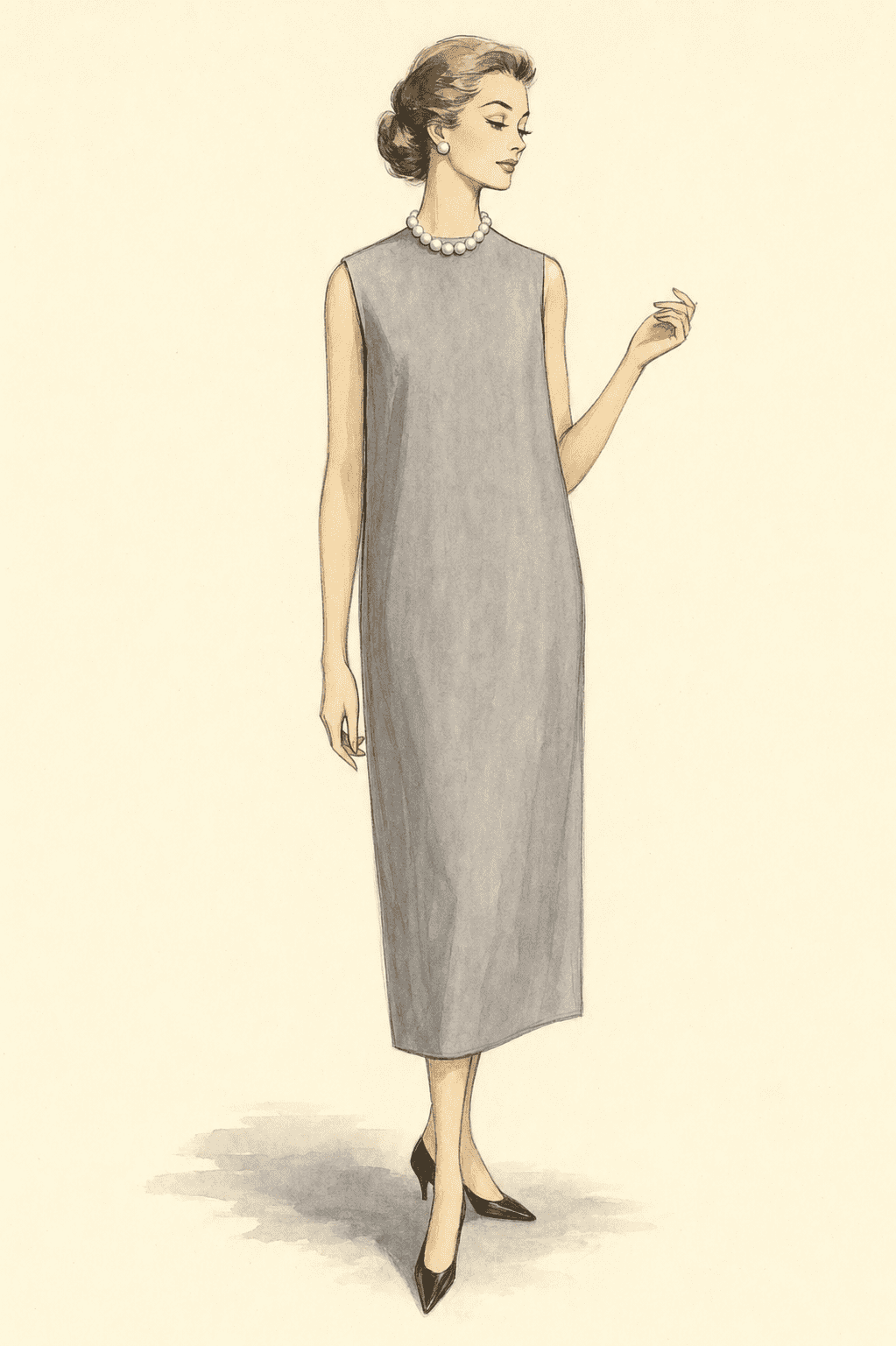
The Tunic dress, 1955. A sleeveless column of dove-grey wool with the famous stand-away neckline — the dress that taught a generation of women they did not need a defined waist to look elegant.
A sleeveless straight column with a high stand-away neckline, narrow shoulders, no waist definition, hem mid-calf. It was widely (and noisily) hated by his clients when it first appeared. Some of his most loyal customers cancelled their fittings. Carmel Snow at Harper’s Bazaar defended it; Vogue hedged. Within five years, the tunic shift was the dominant evening shape in America. By 1965, it had become the day uniform of every well-dressed woman in the Western world. Jackie Kennedy’s 1961 inaugural wardrobe is a Tunic dress in everything but name.
The Sack and the Baby Doll — 1957 and 1958
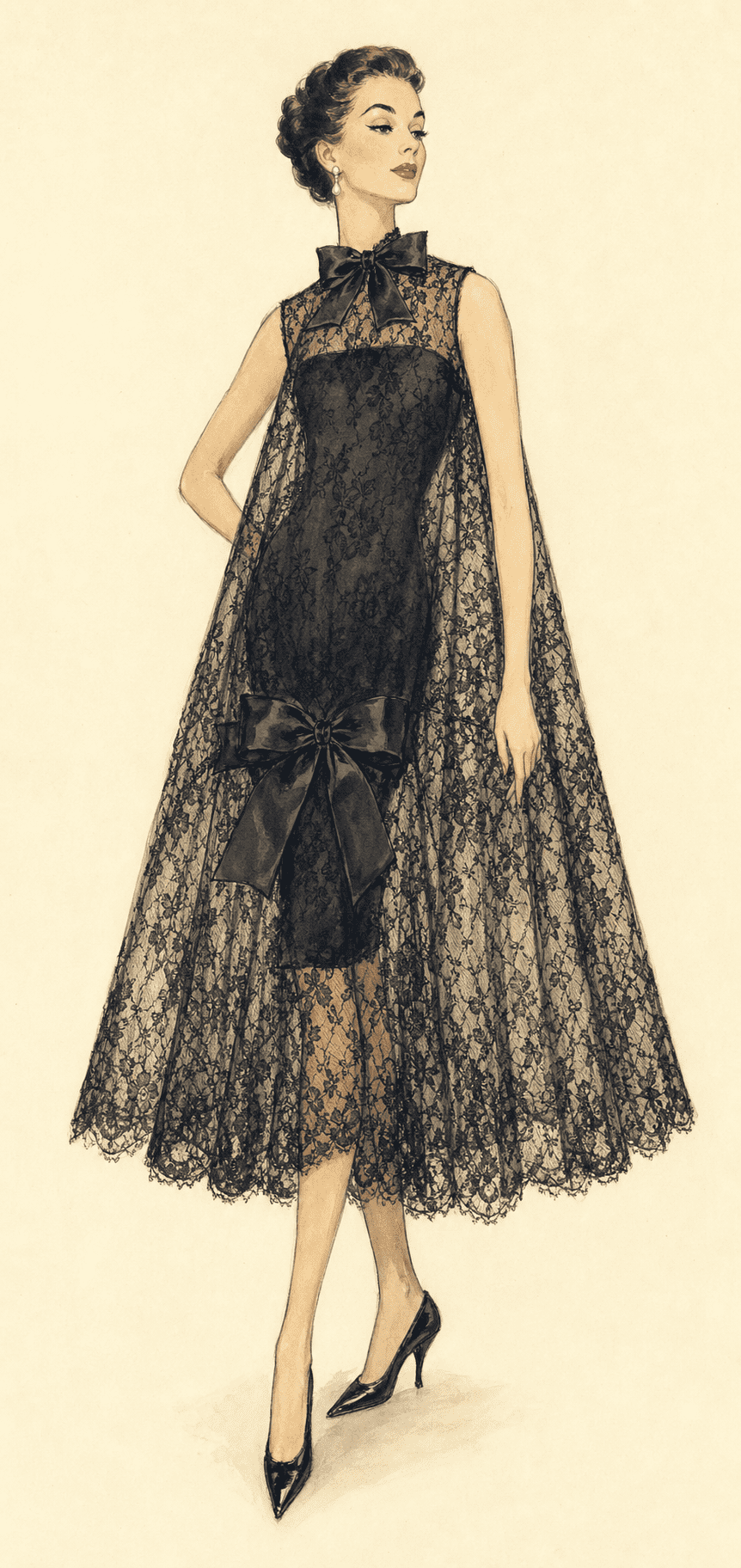
The Baby Doll dress, 1958. Semi-transparent black Chantilly lace over a fitted black slip — childlike in name, scandalous in execution. The shape inspired Saint Laurent’s 1958 Trapeze line and became the visual DNA of the 1960s.
In 1957 Balenciaga showed the sack dress: a chemise of total straightness, no waist, no shape, falling like a paper bag from the shoulder. American women revolted. The “Below the Knee Club” of 1947 had nothing on the howls of 1957: women threw down their Vogues in tears; husbands rejoiced that they would no longer pay for couture. Cartoonists in The New Yorker drew sack-dressed women being mistaken for laundry. A year later, in 1958, Balenciaga refined the idea into the baby doll — a transparent flared lace dress over a fitted slip, with two satin bows. The clients now adored it. The sack was redeemed; the future, in fact, had arrived a year early.
It was Saint Laurent, at Dior, who paid the first tribute. His 1958 Trapeze line — a triangle dress that saved Dior’s house after the master’s death — is openly indebted to the baby doll. Saint Laurent never denied it.
✦ ✦ ✦
Part 5The Atelier as a Cathedral
To understand Balenciaga you must understand how he worked. He arrived at Avenue George V at eight every morning and left at eight every night. He walked the same route from his apartment, alone, in a dark coat. He passed three churches; at one, he stopped for Mass.
Inside the atelier — the windows opaque so no one could see in — eighty seamstresses worked at long tables in absolute silence. He moved among them like an abbot in his monastery. He almost never raised his voice. He almost never gave praise. When he stopped at a table to inspect a hem, the seamstress’s hands would tremble.
He did not sketch. He worked in cloth, on a body, with pins. His head seamstresses learned to read his hands the way a sailor reads weather. A drape held at one angle for two seconds meant “shorter.” A drape lifted and dropped meant “longer.” A drape replaced precisely on the form, untouched, meant “perfect, do not change a thing.”
He invented techniques that have entered every couture house’s vocabulary: the four-seam sleeve, set into the bodice with a single curved insertion at the back. The infanta shoulder — modelled on Velázquez’s seventeenth-century paintings of Spanish princesses. The single-seam wedding dress with a six-metre train, balanced so perfectly on the body that the bride could carry the train herself, with one hand, without strain.
Hubert de Givenchy — who would open his own house in 1952 — became Balenciaga’s closest friend and student. When Givenchy launched, Balenciaga personally taught him for ten years, in private, without payment. Their relationship was the most generous mentorship in twentieth-century fashion, and one of the most famous friendships in Paris.
✦ ✦ ✦
Part 6A Quiet Life Timeline
✦ ✦ ✦
Part 7How Balenciaga Changed the 1950s — and Everything After
If Dior gave women back their femininity, Balenciaga gave them back their freedom.
1. He Set the Body Free
The 1950s opened with the New Look’s wasp waist and ended with Balenciaga’s chemise. The single most important shift in twentieth-century women’s clothing — from sculpted-to-the-body to flowing-around-the-body — was led almost single-handedly by him. The 1960s shift dress, the 1970s caftan, the 1990s slip dress, the 2010s oversized blazer: all descend, directly, from his Tunic and Sack.
2. He Proved Comfort and Glamour Were Not Opposites
Until Balenciaga, “elegant” meant “constructed.” A truly elegant 1950s woman was held in by corsetry, padding, boning, and stay-tape. Balenciaga showed that a sleeveless column of grey wool, properly cut, was more glamorous than any cage. His Tunic dress did not need a girdle. His Semi-Fit suit did not need a longline bra. He liberated the post-war female torso from the architecture beneath the architecture.
3. He Made the Older Woman Visible Again
Most 1950s couturiers chased the twenty-year-old body. Balenciaga’s most devoted clients were in their forties, fifties, sixties — Mona Bismarck, Bunny Mellon, Pauline de Rothschild. The Semi-Fit suit was specifically designed for the woman whose waist was no longer twenty inches. He invented the entire visual language of chic-at-any-age, and that legacy is what made Coco Chanel’s later comeback (and Carolina Herrera’s, and Donna Karan’s, and Phoebe Philo’s) possible.
4. He Created the Template for the Designer-Recluse
Refusing interviews. Walking out at the click of a camera. Letting the work speak. The whole modern archetype of the silent, mysterious, almost monastic designer — Martin Margiela, Phoebe Philo, Helmut Lang — descends from Balenciaga. He proved that mystery, properly tended, sells more than publicity.
5. He Trained the Next Generation, Without Asking for Credit
Hubert de Givenchy. André Courrèges (who worked in his atelier for ten years before launching his own house). Emanuel Ungaro (who learned under Courrèges in Balenciaga’s workroom). Oscar de la Renta (who trained at Eisa in Madrid). Paco Rabanne. The entire generation of 1960s couture, French and American, ran on Balenciaga-trained hands.
6. He Invented the Modern Wedding Dress
The architectural, train-balanced, single-seam wedding gown — sculpted ivory with mathematical precision — is largely his innovation. Queen Fabiola’s 1960 dress was studied by every royal couturier afterward. Princess Diana’s 1981 dress, designed by the Emanuels, owes a clear debt. Kate Middleton’s 2011 Sarah Burton dress for Alexander McQueen quotes the Balenciaga ermine-trimmed shoulder line almost directly.
7. He Made Spanish Couture Matter
Before Balenciaga, Paris was the only city on earth that could be said to have a couture. After him, Spain — and specifically the Basque country — became permanent fixtures in the world’s fashion vocabulary. The Cristóbal Balenciaga Museum opened in Getaria in 2011, in a glass-and-stone building on the bay where his father had fished. It is the only museum in the world dedicated to a single couturier in his birthplace.
✦ ✦ ✦
CodaA Master, in Silence
On 23 March 1972, Cristóbal Balenciaga died of a heart attack at his country house in Jávea, on Spain’s Mediterranean coast. He was seventy-seven. His funeral was small, by his explicit wish. No Paris journalists were invited. Hubert de Givenchy travelled to Spain alone to attend; Mona Bismarck, ill, sent flowers and shut herself away to mourn. Coco Chanel, who had once called him the only true couturier, had died the year before — they did not, in the end, outlive each other by long.
He is buried in the cemetery of Getaria, on a hill above the bay, in a simple grave. From the grave you can see the harbour and the boats, and beyond them, the open Bay of Biscay where his father once fished. It is, perhaps, the only Balenciaga design left without a single embellishment: a man’s name, two dates, and the sea.
And yet his influence is everywhere. Open any wardrobe of any well-dressed woman over forty, in any city on earth, and you will find a Balenciaga in spirit if not in label: a relaxed-fit blazer with a free-moving back. A sleeveless column dress in dove-grey or black. A coat that curves slightly outward at the waist. A neckline set a finger’s width away from the throat so that pearls have room to breathe. A wedding dress with a single curved seam at the shoulder.
He never wanted his name to live forever. He believed clothes should disappear into the life of the woman wearing them. By that measure, he succeeded more completely than any couturier of his century. The master is gone. The shapes remain.
The dressmaker makes dresses. I make fashion. The dressmaker follows the form of the body; I give form to the space around it.— Cristóbal Balenciaga, 1971
✦ ✦ ✦
1950s Designers & Couturiers · Cristóbal Balenciaga · Fashion plates in the manner of a mid-century Vogue sketch · 2026


Leave a Comment