
1950s Designers & Couturiers
Christian Dior
The florist’s son from Normandy who reinvented womanhood — and built, in eleven brief years, the modern fashion house.
21 January 1905 — 24 October 1957
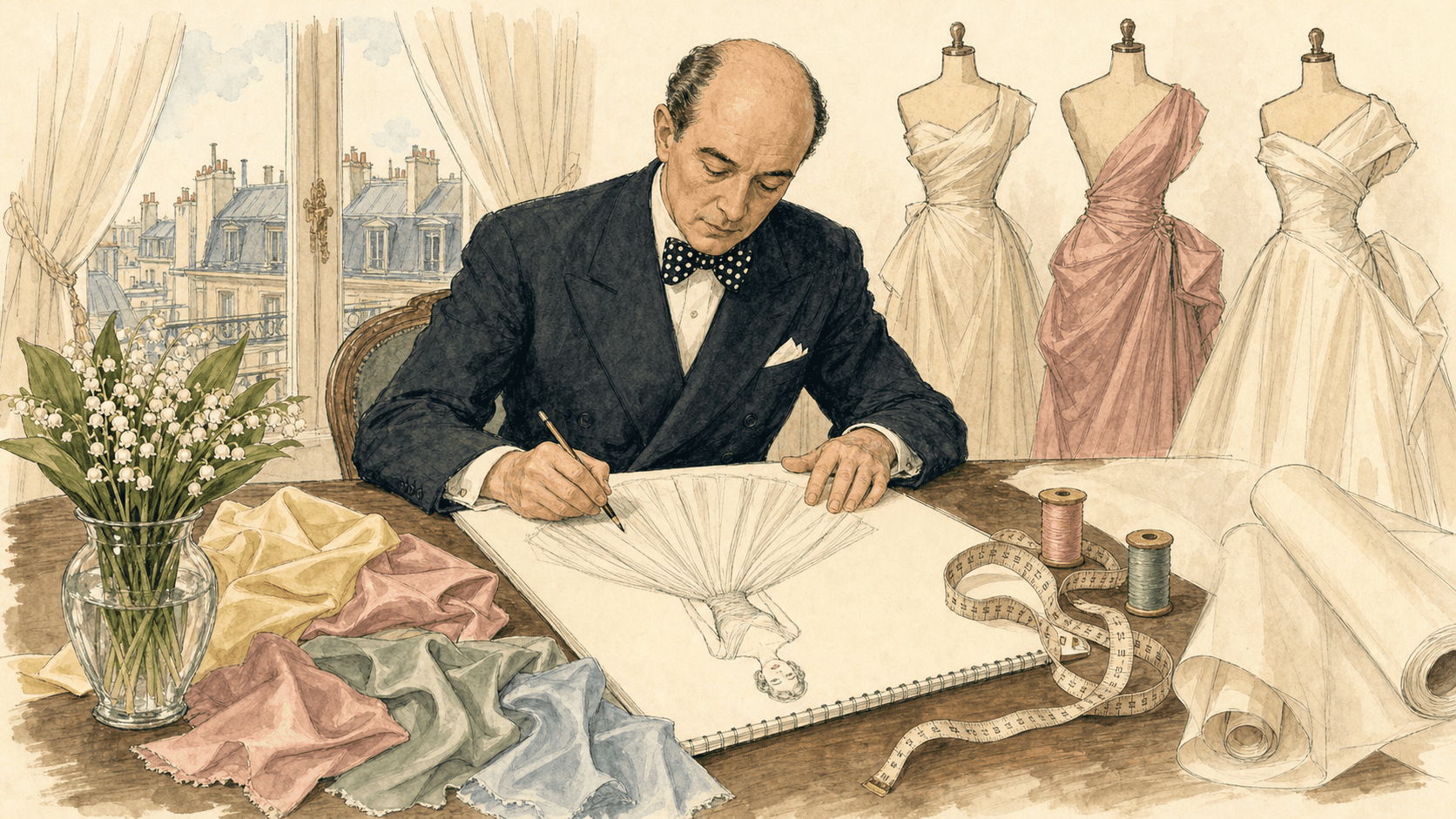
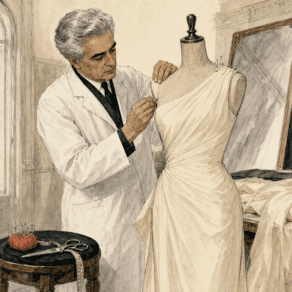
The couturier at work. Dior sketched obsessively, often before dawn, surrounded by silk swatches, a tape measure, and — by his own absolute insistence — a small posy of muguet, lily of the valley, his good-luck flower.
he most influential dress designer of the twentieth century was, by most accounts, a shy, slightly portly, balding French gentleman who would rather have stayed home with his cat. He did not draw on house models in dramatic charcoal flourishes like Yves Saint Laurent. He did not refuse interviews like Balenciaga. He did not seduce his clients like Chanel. He worked quietly, lived modestly, consulted a clairvoyant before every collection, and built — in just over a decade of work — the empire that every modern luxury brand still imitates.
To understand the 1950s in fashion is to understand Christian Dior. To understand Dior, you have to start somewhere quite unexpected: with a boy who wanted to be a diplomat, an art gallery that bankrupted his family, and a sister he loved more than anyone in the world.
✦ ✦ ✦
Part OneThe Man Behind the New Look
Christian Dior was born on 21 January 1905 in Granville, a small port town on the Normandy coast — the second of five children in a comfortable bourgeois family. His father, Maurice Dior, owned a fertilizer-and-chemicals factory founded by Christian’s grandfather in 1832. The family lived in Les Rhumbs, a clifftop pink-and-grey villa overlooking the English Channel, surrounded by the rose garden his mother Madeleine had designed herself. (The villa is now the Musée Christian Dior. The roses are still there.)
Young Christian was the artistic one. He sketched constantly. He read Proust. He befriended a fortune-teller at the local fair when he was fourteen, who took his hand and announced: “You will be ruined. But women will be lucky for you. You will succeed through them, and make a great deal of money from them.” He never forgot it.
His parents wanted something steadier. He was sent to Paris in 1923 to study at the École des Sciences Politiques — to become, they hoped, an ambassador. He was a poor student. He spent his evenings instead in Montparnasse with the surrealists: Jean Cocteau, Christian Bérard, Max Jacob. In 1928, with a small loan from his father, he opened an art gallery on the rue de la Boétie, showing work that almost nobody else in Paris would yet show — Dalí, Picasso, de Chirico, Braque.
Then in three savage blows, his life collapsed. His mother died of septicaemia in 1931. His father’s fertilizer business went bankrupt in the Depression. His older brother was committed to an asylum. The gallery folded. By 1934, at 29, Christian Dior was penniless, homeless, sleeping on the floors of friends’ apartments, and ill with what doctors then politely called “lung trouble.” He survived by selling his fashion sketches door-to-door to Paris couture houses for a few francs each.
The pattern of his life had a particular shape that mattered: ten years of failure, ten years of obscure work as a junior designer (first at Robert Piguet, then at Lucien Lelong, where he worked side-by-side with another struggling junior named Pierre Balmain), the German Occupation, and then — at the age of 41 — a chance meeting with the cotton magnate Marcel Boussac in 1946 that would change everything.
Boussac, France’s wealthiest industrialist, wanted to revive an old couture house. Dior persuaded him, in a series of nervous lunches, to back something entirely new instead. On 16 December 1946, the House of Dior opened at 30 Avenue Montaigne. The first collection went out fourteen months later. By the time it was over, the modern fashion industry existed in a form it had not existed in before.
✦ ✦ ✦
Part TwoThe Secret Dior: Twelve Things Almost Nobody Knows
The Lucky Number Eight
Dior was profoundly superstitious. His lucky number was eight. He chose the address 30 Avenue Montaigne because 3 + 0 = 3, and 3 + 8 (the floor where his salon would be) made his name’s eight letters. His first collection had two themes: Corolle (Flower-Crown) and Huit (Eight). The figure-eight silhouette — wide shoulders, narrow waist, wide hips — appeared in the very name of his manifesto.
The Clairvoyant Who Ran His Career
Dior consulted a fortune-teller named Madame Delahaye before every single one of his eleven collections. She read his cards in her shabby apartment in the rue Saint-Honoré. He paid her handsomely and, when she fell ill, sent her his couture seamstresses to nurse her. The night before launching the New Look in February 1947, he was so paralyzed with terror that he begged her to come to the salon. She came. She read the cards. She told him to go ahead. He did.
The Lily of the Valley in Every Hem
Muguet, lily of the valley, was his good-luck flower. A sprig was sewn discreetly into the hem of every single Dior couture garment, every season, for the rest of his life. The tradition continues at Maison Dior to this day. He also bought lily-of-the-valley dresses for every house model on May 1st (Labour Day in France, traditionally le jour du muguet) and wore a bunch in his buttonhole at every collection presentation.
His Sister Was a Resistance Heroine
Christian’s youngest and most beloved sister, Catherine Dior, was a fighter in the French Resistance. Arrested by the Gestapo on 6 July 1944 in a Paris café, she was tortured for weeks at avenue Henri-Martin without ever giving up a single name from her network. She was deported in one of the last trains from Paris to Ravensbück concentration camp, then to a slave-labour munitions factory. She survived. She came home in May 1945 weighing forty kilograms. The perfume Christian launched in 1947 — the same year as the New Look — he named Miss Dior after her, on the day she returned. After the war, brother and sister grew flowers together for the Paris market at Les Halles. He rose at 4 a.m. to take the roses to market.
He Refused to Show His Face
Despite running the most famous fashion house on Earth, Dior was excruciatingly private. He refused to appear in his own advertisements. He gave only a handful of filmed interviews in his life. He preferred his country house at Milly-la-Forêt, his vegetable garden, his dachshund Bobby, and his close circle of friends to any Paris social life.
His First Collection Had a Riot
On 12 February 1947, when the New Look was unveiled, the salon was so packed that women fainted. One model named Tania, walking in the famous Bar Suit, swept her skirt against a standing ashtray and knocked it across the room. Carmel Snow, editor of Harper’s Bazaar, leaned to her companion and whispered the words that would name a movement: “It’s such a new look.”
And Then Came the Protests
Not everyone was charmed. In Texas, women formed the “Little Below the Knee Club” and picketed Dallas department stores carrying signs that read “DOWN WITH DIOR” and “WE’RE FOR THE FREE AMERICAN LEG”. The club had 1,300 members in 48 cities by April 1947. In Paris, women at the Place du Trocadéro physically tore the long skirt off a model who had emerged from a Dior fitting. The British Board of Trade considered banning the New Look entirely as a violation of postwar fabric rationing — one Dior dress used more cloth than a working woman’s annual coupon allowance. Stafford Cripps, Britain’s Chancellor of the Exchequer, called it “utterly stupid and irresponsible.”
The Lunch That Killed Him
Christian Dior died at the spa town of Montecatini, Italy, on 24 October 1957, just shy of his 53rd birthday. He had been on holiday with his close friend Raymonde Zehnacker. Three rival versions of his death survive. The official one: a heart attack at the card table. The second: he choked on a fish bone at lunch. The third (Coco Chanel’s catty version, told for years afterwards in her own salon): an over-exertion with a young man. What is certain is that he had visited Madame Delahaye one final time three weeks before, and that she had told him not to take the trip.
The Cat, the Dog, the Driver
Dior adored animals. His Siamese cat, Mitsou, slept on his bed. His dachshund, Bobby, attended fittings. His chauffeur, Marcel, drove him everywhere because he was terrified of driving himself. He once said that the perfect day involved being driven slowly through the Bois de Boulogne with Bobby on his lap, a sketchbook open, and nowhere particular to be.
The Garden That Made the Dresses
Dior said over and over: “After women, flowers are the most divine creation.” Almost every collection name comes from gardens or botany — Corolle (the petals of a flower), Tulipe, Muguet, Profilée. His Junon and Venus gowns of 1949 are constructed from layers of petal-shaped panels. His mother’s rose garden at Granville was, in his own words, “the only school of design I ever needed.”
The Boy Who Trained Three Future Emperors
Three of Dior’s young assistants would go on to become couturiers in their own right and reshape fashion’s next thirty years. Pierre Cardin joined the house at 24 — legend says it was Cardin himself who was sent to buy the cotton wadding that padded the Bar Suit’s hips. Yves Saint Laurent arrived as Dior’s chosen successor at 19 and was put in charge of the house at 21 after Dior’s death. Marc Bohan took over after Saint Laurent and ran Dior for nearly thirty years. (Hubert de Givenchy, often miscounted in this group, never worked at Dior — but he was Dior’s close friend and protégé.)
He Wrote a Book About His Own Job
In 1954, Dior published a little book called The Little Dictionary of Fashion, written for the young woman starting her wardrobe from nothing. It is funny, exact, and almost shockingly modest. Entry for “Elegance”: “Elegance must be the right combination of distinction, naturalness, care, and simplicity. Outside this, believe me, there is no elegance. Only pretension.”
✦ ✦ ✦
Part ThreeThe Bar Suit, and Why It Mattered
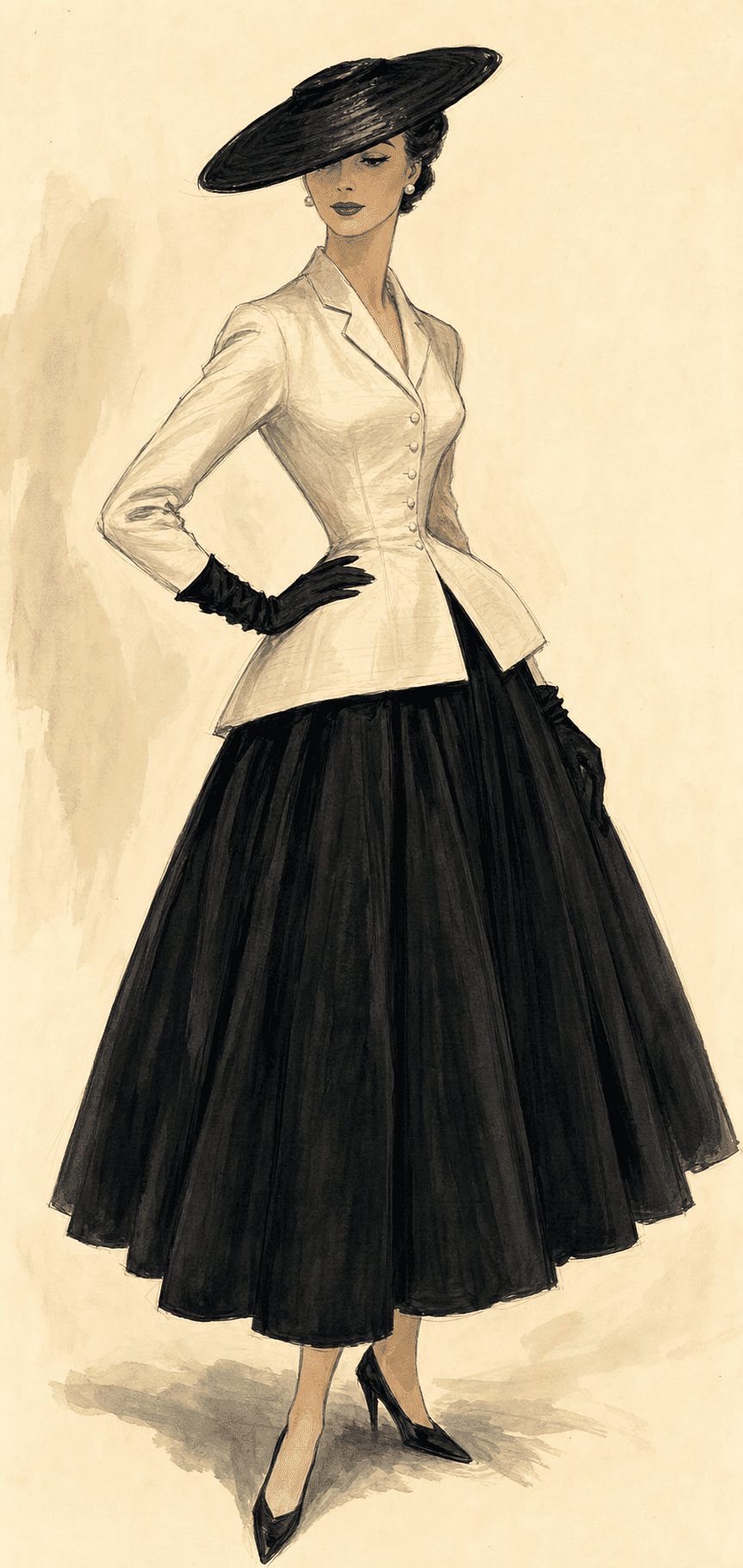
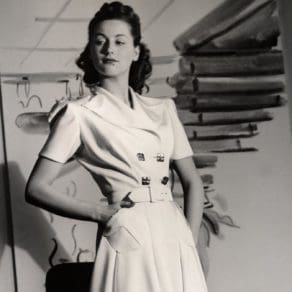
The Bar Suit, 12 February 1947. The single most copied garment of the twentieth century. Ivory silk shantung jacket, padded at the hip with cotton wadding (legend says Pierre Cardin was sent out to buy the padding), over almost four metres of pleated black wool. A waist so tight it required its own corset.
To understand why one dress could reset an entire industry, you have to remember what women had been wearing the week before.
For six years of war and two years of postwar rationing, women had been dressed by the state. The British Utility scheme (1941) and the American L-85 regulations (1942) had restricted every garment in the Allied world: no more than two pockets, no more than three buttons, no patch pockets, no leg-of-mutton sleeves, no skirt longer than just below the knee. Shoulders were square. Waists were unmarked. Skirts were straight and economical. A woman in 1946 looked, by deliberate government design, vaguely like a slimmer version of her husband in his demobilisation suit.
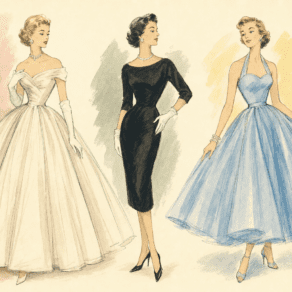
Then on the morning of 12 February 1947, in a Paris salon decorated with grey satin and white lilies, Dior sent out 95 looks across two themes — Corolle and Huit — and demolished the entire visual language of wartime in less than ninety minutes. The shoulders were soft and natural. The waist was nipped to roughly twenty-two inches, often with a built-in corselet sewn into the dress itself. The hips were padded outward with cotton wadding. The skirt — and this was the scandal — was three to four metres of pleated wool falling to just below the knee, in defiance of every fabric-rationing regulation still in force across half of Europe.
“I designed flower women — soft shoulders, generous busts, waists slim as vine tendrils, and skirts as wide as petals.”— Christian Dior
The Bar Suit was the masthead of the collection: an ivory shantung silk jacket, peplum hem padded outward at the hip, paired with that vast black wool skirt. The combination weighed roughly four kilograms. The waist was 53 centimetres. To wear it, you needed a built-in waspie corset, a properly fitted brassiere, gloves, a hat, stockings, and a particular kind of confidence. To watch it walk down a salon in 1947 was to watch the war end in fabric.
Within three months, every magazine in the Western world had covered it. Within a year, knock-offs hung in department stores from Selfridges to Sears. Within five years, the entire global silhouette of female dressing had reformed itself around the New Look. Princess Margaret wore it. Rita Hayworth wore it on her honeymoon. Eva Perón had thirty Dior outfits made for her European tour in 1947. Every prom dress and wedding dress for the next sixty years would derive, ultimately, from this single afternoon in Paris.
✦ ✦ ✦
Part FourThe Eight Silhouettes
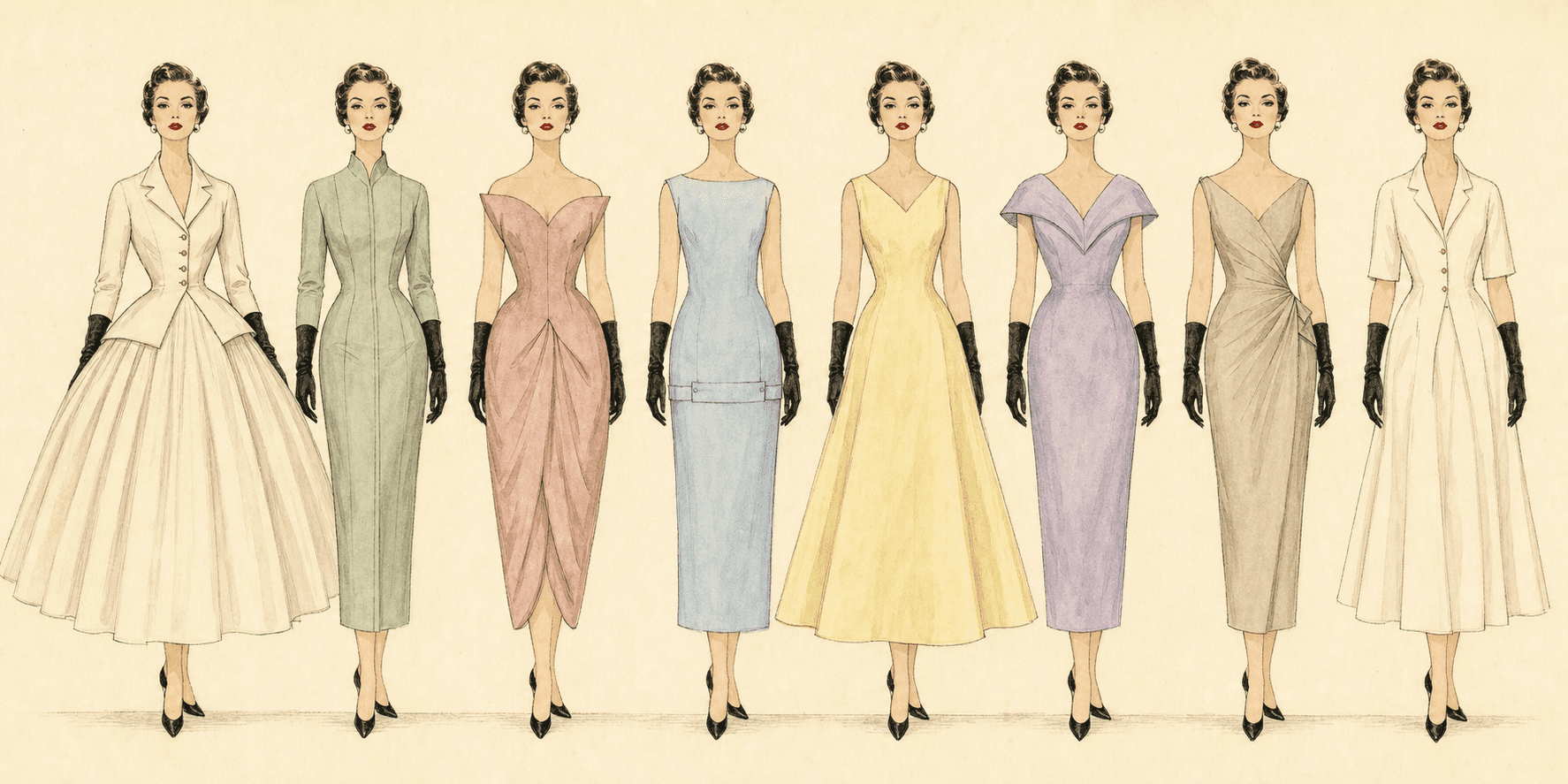
Ten years, eleven collections, eight silhouettes. Dior reinvented the line of his own clothes almost every season — Corolle, Verticale, Oblique, Naturelle, Tulipe, Vivante, H, A, Y, Flèche, Libre. Each one was front-page news.
What separated Dior from every couturier before him was that he did not stop with one revolution. He had a new silhouette ready almost every six months — and each one was launched with the press hysteria of a head of state’s visit. Department buyers from New York booked Paris hotel rooms eighteen months in advance just to see the next one.
Feb
Aug
Spring
Autumn
✦ ✦ ✦
Part FiveThe Junon, and Dior’s Other Religion
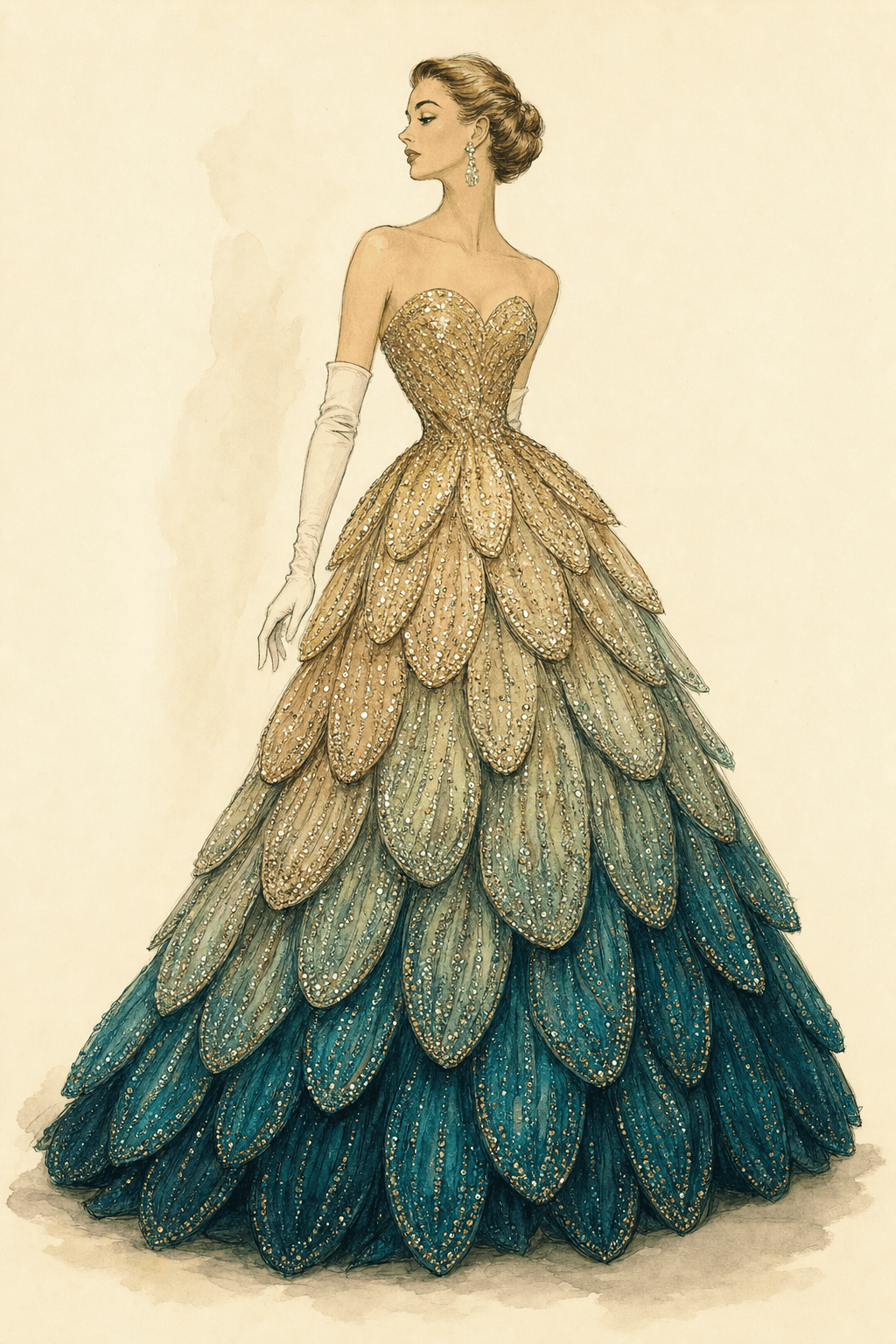
The Junon, autumn 1949. Named after the Roman goddess Juno. The gown is built from layered curved panels shaped like peacock feathers — gold at the bodice, deepening through bronze, sage and peacock blue to a teal so dark it reads almost black at the hem. Some 4,000 sequins were applied by hand. The original is in the Metropolitan Museum of Art.
If the Bar Suit was Dior’s manifesto, the Junon ball gown of 1949 was his prayer. It is one of two sister gowns from his Milieu du Siècle (“Mid-Century”) collection — the other, named Vénus, was built from overlapping ivory-and-silver petals like a sea-shell rising from foam. Both were intended as offerings to the gods of femininity. Both took the Paris atelier nearly three hundred hours each to construct.
The Junon’s skirt is made not from one continuous fabric but from layered curved panels — between forty and fifty of them, depending on the size — each one hand-cut, hand-sewn, and then individually embroidered with sequins in graduating peacock-feather colours. Gold at the waist. Champagne below that. Bronze. Sage green. Peacock blue. Deepest teal at the floor. From across a ballroom, the wearer appeared to be standing inside a closed peacock fan. When she moved, the fan opened.
Both gowns were originally bought by an American socialite, Mrs. Byron C. Foy, daughter of Walter Chrysler. She wore them once each, then donated them in 1953 to the Costume Institute of the Metropolitan Museum of Art, where they live now — too fragile ever to be worn again, but still occasionally displayed under glass.
For Dior, the Junon was the answer to the question that had haunted him since 1947: could couture be art? By the standards of the previous fifty years, the answer was supposed to be yes — Worth, Poiret, Vionnet, all had argued so. But the New Look had also made Dior something else: a brand, a business, a global empire. The Junon was his proof that the empire had not eaten the artist.
✦ ✦ ✦
Part SixThe Business: How One Man Invented the Modern Fashion House
Here is the part of Dior’s story that historians find harder to romanticise, and that matters more to the way we live now than any single dress.
When Dior opened in December 1946, French couture was a dying industry. The war had nearly killed it. Wartime restrictions on textiles, on travel, on foreign currency, on advertising — all had strangled the great houses. Of the 106 couture houses in Paris before 1939, fewer than fifty survived to 1946. Most were running at a loss, subsidised by their backers or sustained by family fortunes evaporating in the postwar inflation.
Dior, with Marcel Boussac’s money behind him, did something nobody had done. He built the couture house as a brand portfolio.
- ✦1947 — Miss Dior, the perfume, launched the same week as the New Look. Within five years it would outsell the entire couture collection by revenue.
- ✦1948 — Christian Dior, Inc. opened in New York City — the first French couturier to open a wholly-owned American subsidiary. The Fifth Avenue boutique sold scaled-down ready-to-wear adaptations of the couture, at a fraction of the price.
- ✦1948 — Christian Dior Furs, the first of dozens of licensed product lines.
- ✦1949 — Stockings, ties, and gloves licensing deals.
- ✦1953 — Christian Dior Shoes (with Roger Vivier).
- ✦By 1955 — half of all French fashion exports came from a single building on Avenue Montaigne. The House of Dior employed over a thousand people in Paris alone, including five hundred seamstresses across eight ateliers.
This was not just commercial expansion. It was the invention of an entirely new industrial model. Before Dior, a couture house sold gowns to a few hundred extremely rich women each year, plus the rights to reproduce its patterns to a small list of approved foreign department stores. After Dior, a couture house sold gowns to a few hundred extremely rich women — and perfume, stockings, ties, shoes, gloves, lipstick, scarves, handbags, sunglasses, lingerie, and the right to imagine being a Dior woman to anyone with five dollars to spend.
Every luxury house operating today — Chanel, Louis Vuitton, Gucci, Prada, Hermès, Saint Laurent — operates on the model Christian Dior invented between 1947 and 1957. Bernard Arnault, who acquired the Dior business in 1984 and built LVMH around it, is in some real sense the executor of an estate Dior himself drafted.
“In a machine age, dressmaking is one of the last refuges of the human, the personal, the inimitable.”
— Christian Dior, 1954
✦ ✦ ✦
Part SevenHow Dior Changed the World
Eleven collections, ten years, three padded hips and one cinched waist. What did it all do?
1. He gave women permission to be feminine again.
After fifteen years of androgynous tailoring designed around scarcity, war, and labour, Dior made it socially acceptable — even celebrated — for women to dress in clothes that openly declared themselves female. For some women this was a relief; for others, a regression. Both reactions were sincere. The argument has not ended.
2. He invented the Below the Knee Club and the first feminist fashion protest.
The New Look’s most lasting cultural side-effect may have been the protests against it. The American “Little Below the Knee Club,” with its 1,300 members in 48 cities, was the first organised feminist response to a fashion movement in U.S. history. Women picketing in trousers, carrying signs reading “BURN YOUR GIRDLES”, would not look out of place at a 1968 rally. Dior did not invent this. But he forced it into the open.
3. He made Paris the capital of fashion again.
In 1939, Paris was the undisputed centre of world fashion. By 1945, that was no longer obvious — wartime Paris had been cut off, Hollywood had risen, and American sportswear (Claire McCardell, Norman Norell, Bonnie Cashin) was claiming the future. Dior, single-handed, reversed this. By 1950, every American buyer was back in the Avenue Montaigne salon, and Paris had its crown again — a crown it has not since lost.
4. He created the wedding dress as we know it.
The strapless or off-shoulder ball gown with a fitted bodice, tiny waist, and vast tulle skirt — the silhouette of essentially every wedding dress sold in the Western world from 1948 until at least the mid-2010s — is direct, identifiable Dior. Princess Margaret’s 21st-birthday gown (1951) is Dior. Grace Kelly’s 1956 wedding gown is Dior-influenced. Catherine Middleton’s 2011 wedding gown is, designer Sarah Burton openly admitted, a tribute to Grace Kelly’s, which means it is a tribute to the New Look.
5. He trained the next half-century of designers.
Saint Laurent, Cardin, Bohan, and dozens of less famous others passed through his ateliers and absorbed not just his techniques but his understanding of what a fashion house could be. Saint Laurent’s Trapeze line of 1958 was a direct response to (and rebellion against) Dior. Cardin’s geometric futurism of the 1960s was a rebellion against Dior. Vivienne Westwood’s punk corsets of the 1970s were a rebellion against Dior. To rebel against him, every interesting designer of the next forty years first had to learn from him.
6. He invented the modern fashion brand.
If you have ever bought a perfume because of the bottle, a pair of sunglasses because of the case, or a handbag with a designer’s initials on it, you live inside a system Dior built. The “lifestyle brand” — the idea that a single design vision could legitimately extend from a £30,000 couture gown to a £30 lipstick — is his invention.
7. He made fashion personal.
Strangely, despite his shyness and his refusal to appear in his own advertising, Dior was the first couturier to be a household name in the way a film star is. Before 1947, designers were known to readers of Vogue. After 1947, “Dior” was a word ordinary women used in ordinary conversation, in ordinary languages, all over the world. The cult of the celebrity designer — Tom Ford, Marc Jacobs, Karl Lagerfeld, Virgil Abloh — descends, again, directly from him.
✦ ✦ ✦
CodaA Quiet Goodbye in Autumn
Christian Dior died on the evening of 24 October 1957 in Montecatini Terme, Italy. He was 52. His body was returned to Paris on the night train and laid in state at the family villa at Callian in the south of France. Crowds of women — strangers, customers, seamstresses from the Avenue Montaigne ateliers, women who had never owned a Dior dress but who knew what one looked like — gathered at the gates.
At the funeral on 29 October, more than 2,500 people attended, including most of the Paris couture establishment. Coco Chanel, his rival and sometimes-tormentor, sent flowers — though, characteristically, she also told a friend the same week that he had “dressed women like armchairs.” Cristóbal Balenciaga, the only couturier Dior had ever publicly called his master, attended silently and left without speaking to anyone.
Yves Saint Laurent, just 21 years old, was named head of the House of Dior three days after the funeral. He had been Dior’s chosen successor since 1955. He kept his mentor’s lily of the valley in every hem.
The House of Dior is, as of this writing, owned by LVMH, the world’s largest luxury conglomerate, and worth somewhere north of one hundred billion dollars. It still presents two couture collections every year in Paris. Its current designer, Maria Grazia Chiuri, signs each one with the same Avenue Montaigne address, the same lily of the valley sprig sewn into every hem, the same eight-letter name in white capitals on the door.
Eleven collections. Ten years. One pair of padded hips and one tightened waist. A florist’s son from Granville, who wanted to be a diplomat, who lost everything, who finally became — by his own confession, late in life and only once — exactly what the fortune-teller had told him he would be at the age of fourteen.
“My dream is to save women from nature.”
— Christian Dior, 1955
✦ ✦ ✦
1950s Designers & Couturiers · Christian Dior


Leave a Comment