
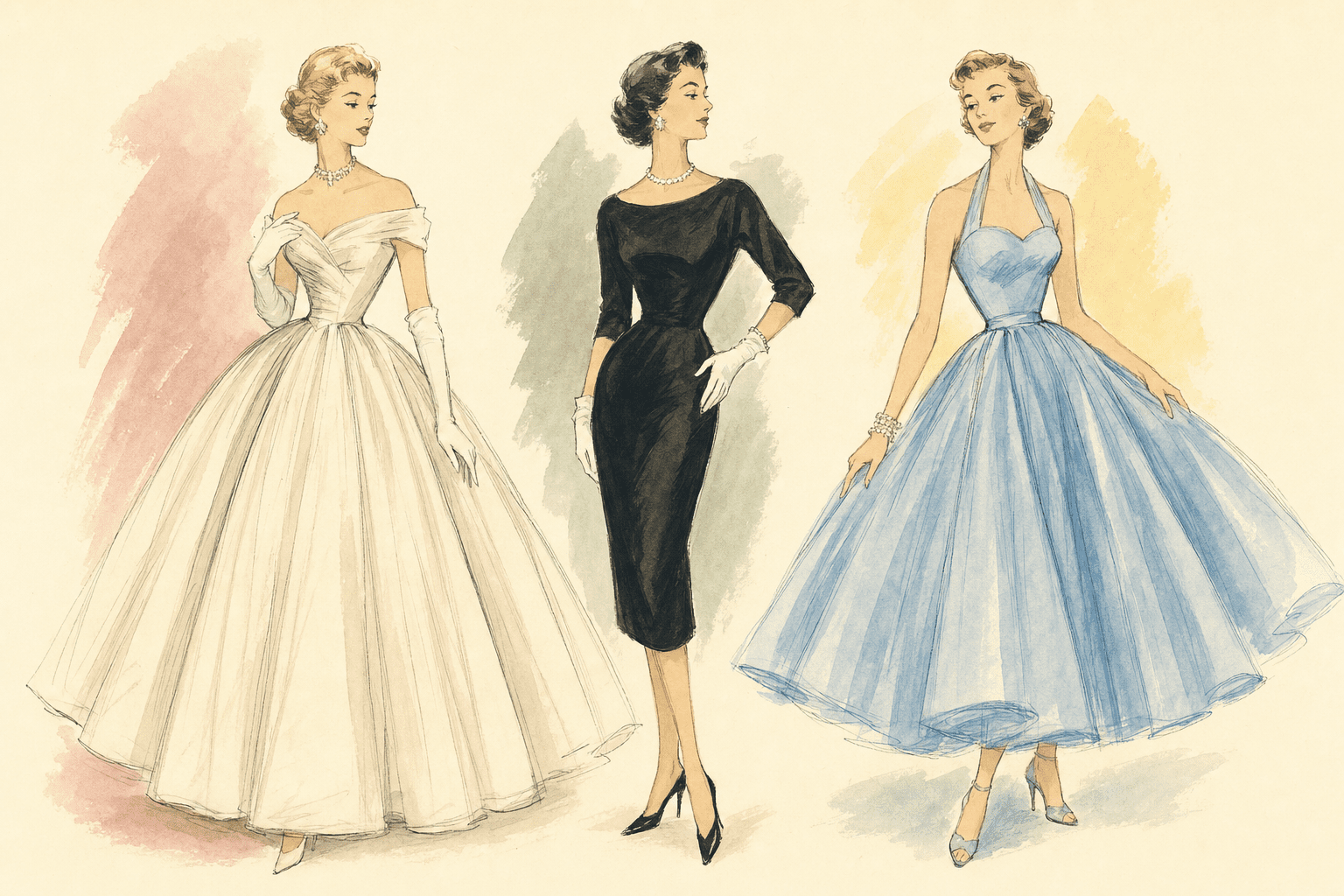
The three pillars of the decade — the New Look ball gown, the wiggle dress, and the halter sundress — illustrated in the manner of a mid-century Vogue fashion plate.
o decade in fashion has been more endlessly mythologised than the 1950s. After fifteen years of depression, rationing, parachute-silk wedding gowns and utility cloth, women were finally allowed to be extravagantly, unapologetically feminine again — and the dressmakers of Paris, New York and Hollywood went to work with a fervour that still defines what we mean by “vintage glamour” today.
The 1950s gave us the cinched waist and the cone bra. The crinoline petticoat and the wiggle hemline. The shirtwaist housewife dress and the strapless debutante gown. It gave us Audrey, Marilyn, Grace, Liz and Brigitte — five silhouettes as much as five women. And it gave us a vocabulary of shapes — Bar, Corolle, En 8, A-line, Trapeze, Sack, Sheath — that designers still cite, season after season.
This guide walks through every major dress silhouette of the decade: what it looked like, who wore it, where, and why it mattered. Each is illustrated in the manner of a 1950s fashion plate — the soft, washy, ink-line magazine sketches that taught a generation of women how to dress.
✦ ✦ ✦
Part OneThe Revolution: How Dior Reinvented Womanhood
To understand the ’50s, you have to start in February 1947, in a salon at 30 Avenue Montaigne. Christian Dior — 42, balding, almost unknown — sent out a collection he called simply Corolle (Flower-Crown) and En Huit (Figure-Eight). The American editor of Harper’s Bazaar, Carmel Snow, took one look and gasped: “It’s such a new look!” The name stuck.
What Dior had done was radical only in retrospect. He took the body wartime had flattened — square shoulders, utility-skirt waists, knee-length hems to save fabric — and re-sculpted it into something almost Edwardian. Soft rounded shoulders. A waist nipped tighter than nature intended (corsets returned in the form of the guêpière). Padded hips. And a skirt so vast — up to thirteen metres of black wool crêpe in the famous Bar Suit — that British factory girls protested in the streets, calling it a scandal at a time when fabric was still rationed.
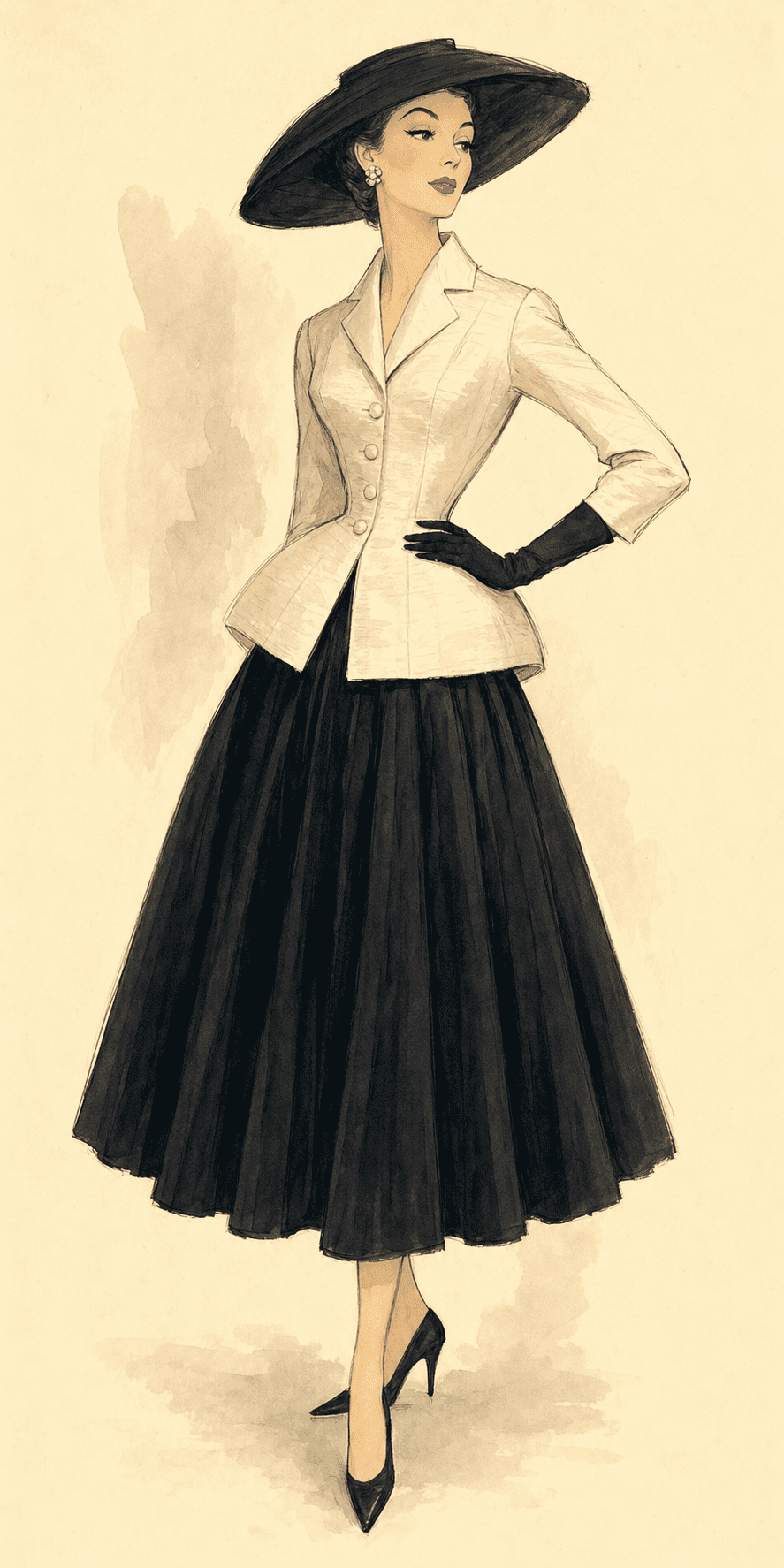
The Bar Suit, 1947. An ivory shantung silk jacket, padded at the hip with cotton wadding (legend says the young Pierre Cardin, then a Dior assistant, was sent to buy the padding). Worn over almost four metres of pleated black wool. The most copied garment of the twentieth century.
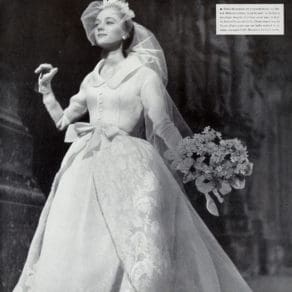
The Bar Suit named not a single style but an entire grammar. From it descended every full-skirted dress of the next twelve years: the ball gowns of Charles James, the prom dresses of suburban America, Elizabeth Taylor’s tulle in A Place in the Sun, Grace Kelly’s wedding gown, the dress your grandmother kept in tissue paper.
“I designed flower women — soft shoulders, generous busts, waists slim as vine tendrils, and skirts as wide as petals.”— Christian Dior, 1947
But Dior was not alone, and the New Look was not the whole story. Across town, Cristóbal Balenciaga — the only couturier Dior himself called the Master — was already pulling fashion in the opposite direction: away from the corseted hourglass, toward architecture, ease, and a body the dress did not need to remake. By the late ’50s, his sack dress, his cocoon coat, and his chemise would loosen women’s clothes again and prepare the ground for the 1960s.
Between these two poles — Dior’s hourglass and Balenciaga’s column — the entire decade played out.
✦ ✦ ✦
Part TwoThe Eight Great Silhouettes
Below, the eight defining dress shapes of the decade, illustrated and decoded. For each: what it is, what fabrics built it, what occasion it belonged to, who wore it best, and which film immortalised it.
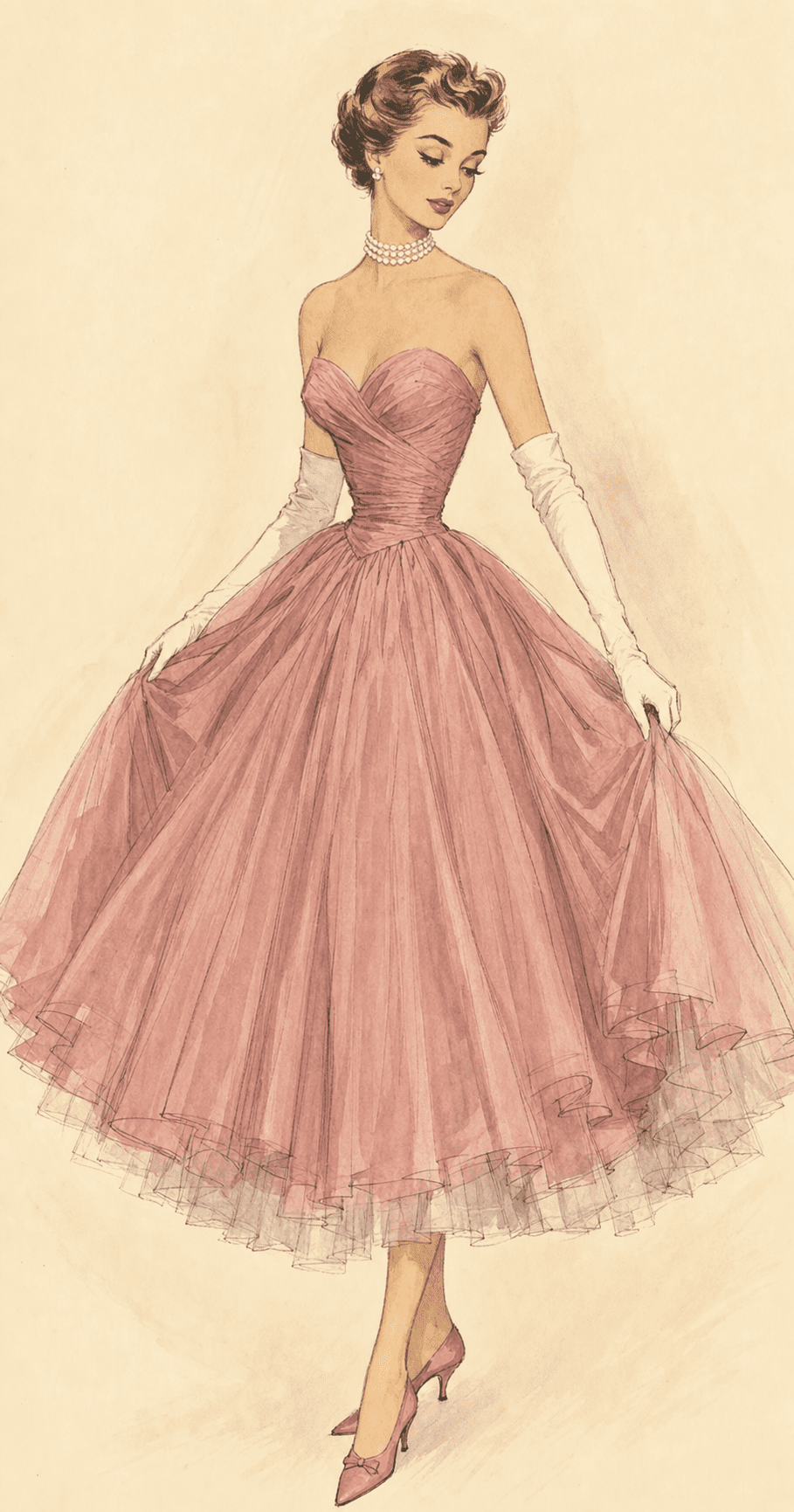
1. The Full-Skirt (New Look)The dress that defined the decade
A fitted, often strapless bodice meets a vast circle skirt held aloft by layers of net or tulle petticoat. The waist is impossibly small — sometimes achieved with a built-in waspie corset — and the skirt swings out a full 180 degrees when its wearer spins.
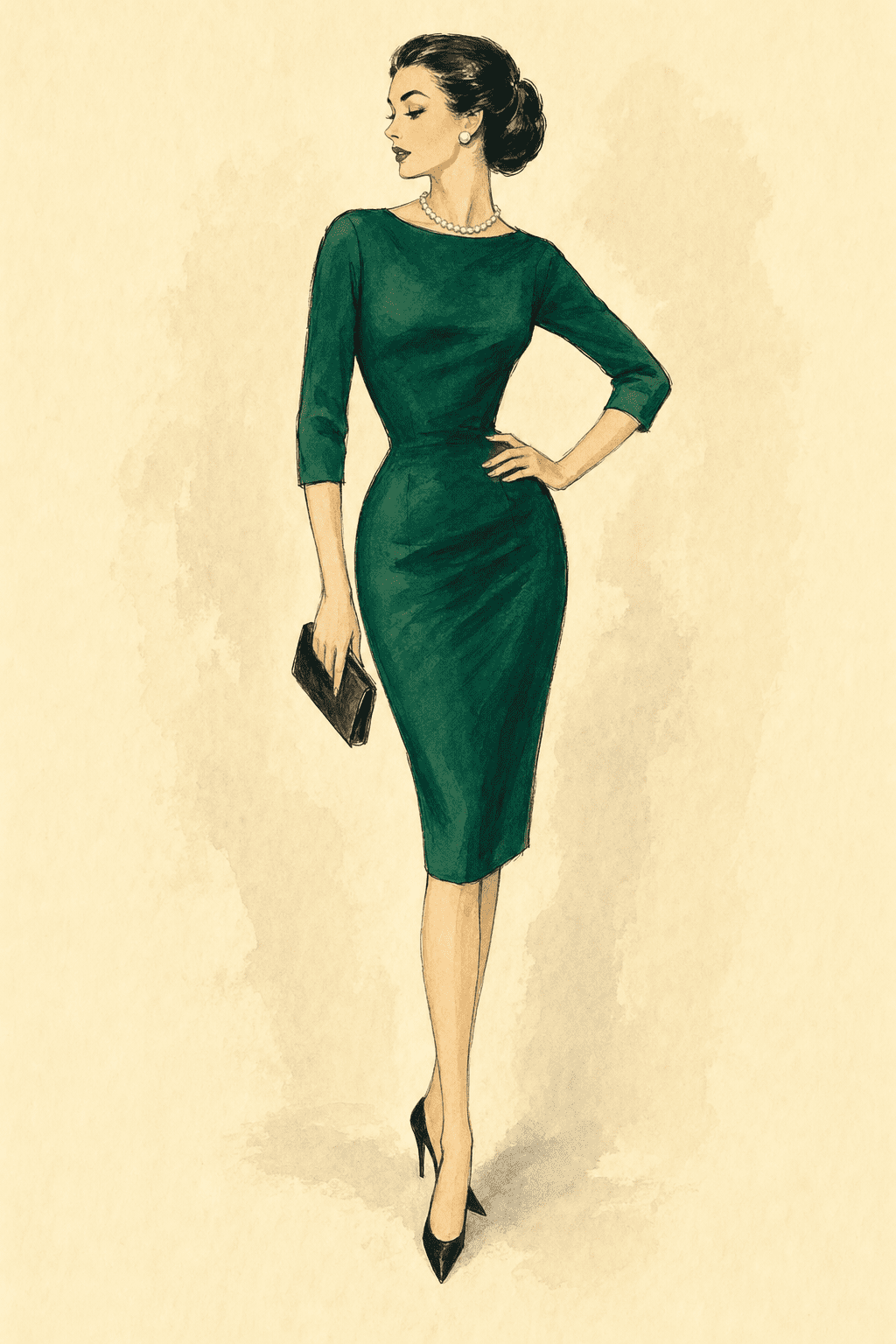
2. The Wiggle (Pencil) DressThe dress that taught a woman how to walk
If the New Look was Sunday-best, the wiggle was Monday-morning. A sleek tubular sheath, fitted from shoulder to just below the knee, narrower at the hem than at the hips — so narrow, in fact, that the wearer literally had to wiggle. Often in jersey or wool crêpe, it traded the romance of the full skirt for pure sex appeal.
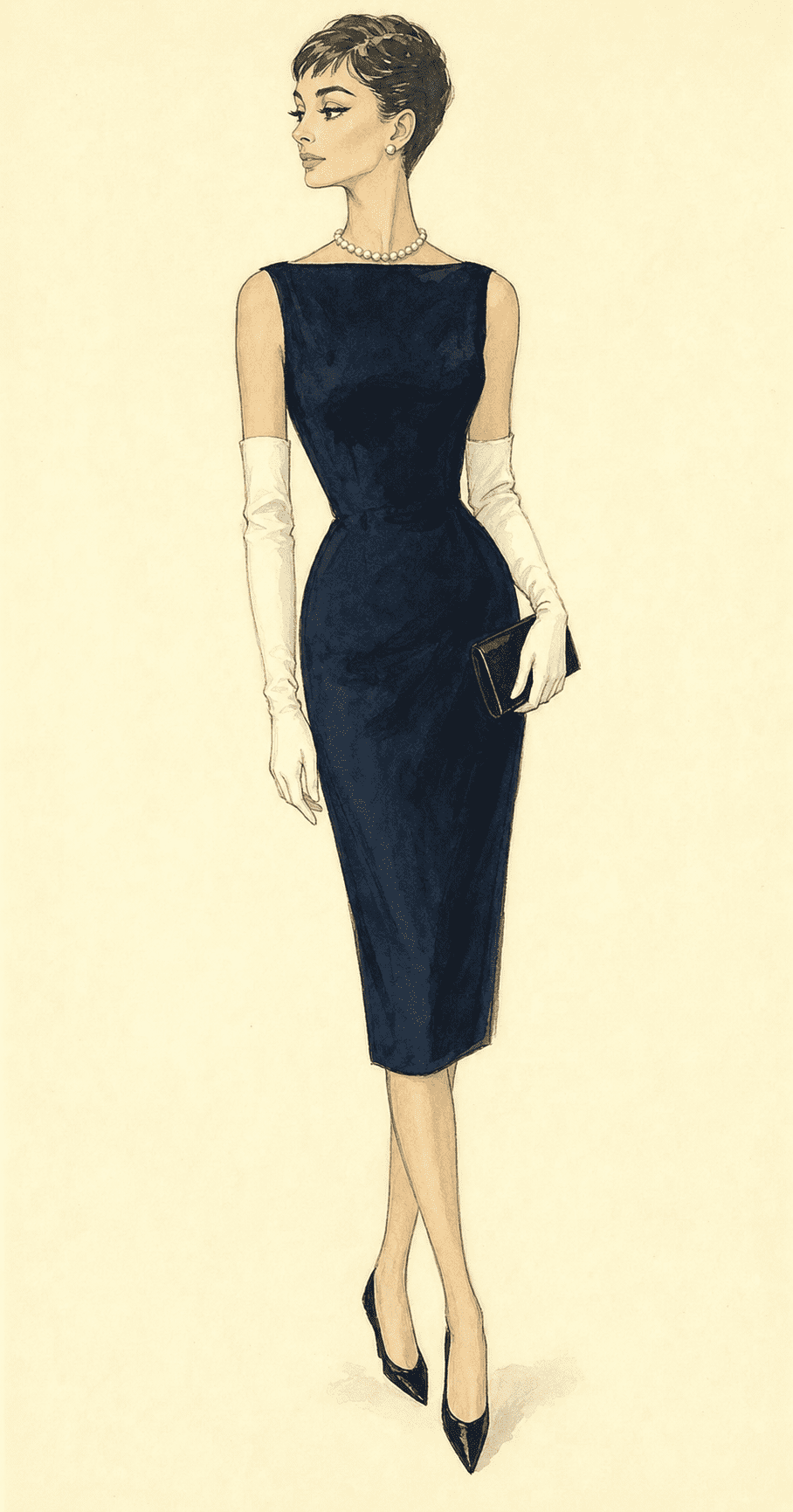
3. The SheathThe Sabrina neckline · the proto little black dress
Cousin to the wiggle but more refined: a column dress, sleeveless or short-sleeved, with a clean bateau (boat) neckline that became known as the Sabrina neckline after Hubert de Givenchy used it for Audrey Hepburn in 1954. Less curvy than the wiggle, more architectural — and the direct ancestor of the LBD Hepburn would wear in Breakfast at Tiffany’s.
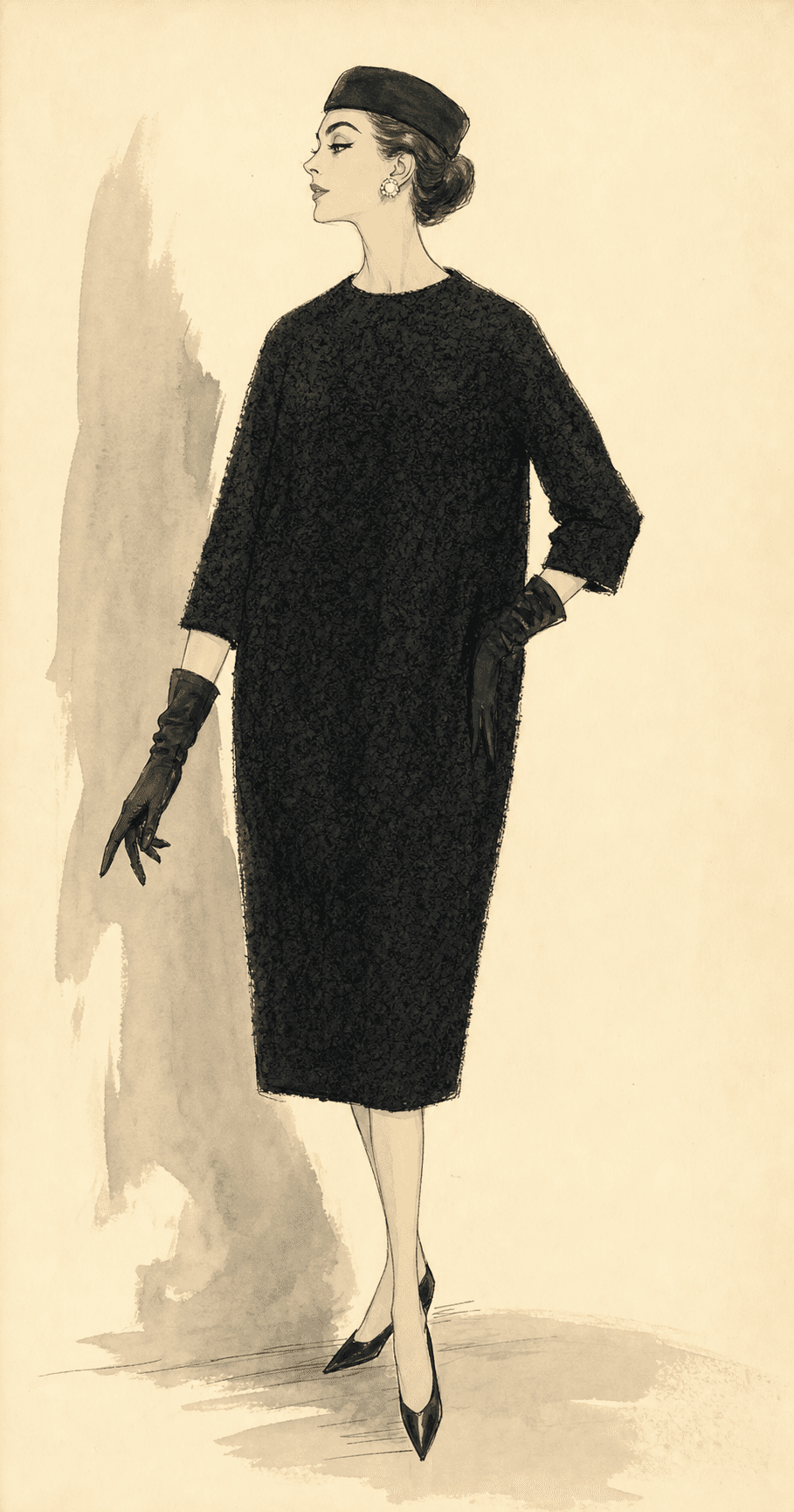
4. The Sack / ChemiseBalenciaga’s rebellion, 1957
The most scandalous dress of the decade — because it had no waist at all. Balenciaga’s sac (and Givenchy’s complementary chemise) hung straight from the shoulders to just below the knee, freeing the body entirely from the corset. Newspapers howled. Husbands disapproved. By 1958 it was everywhere.
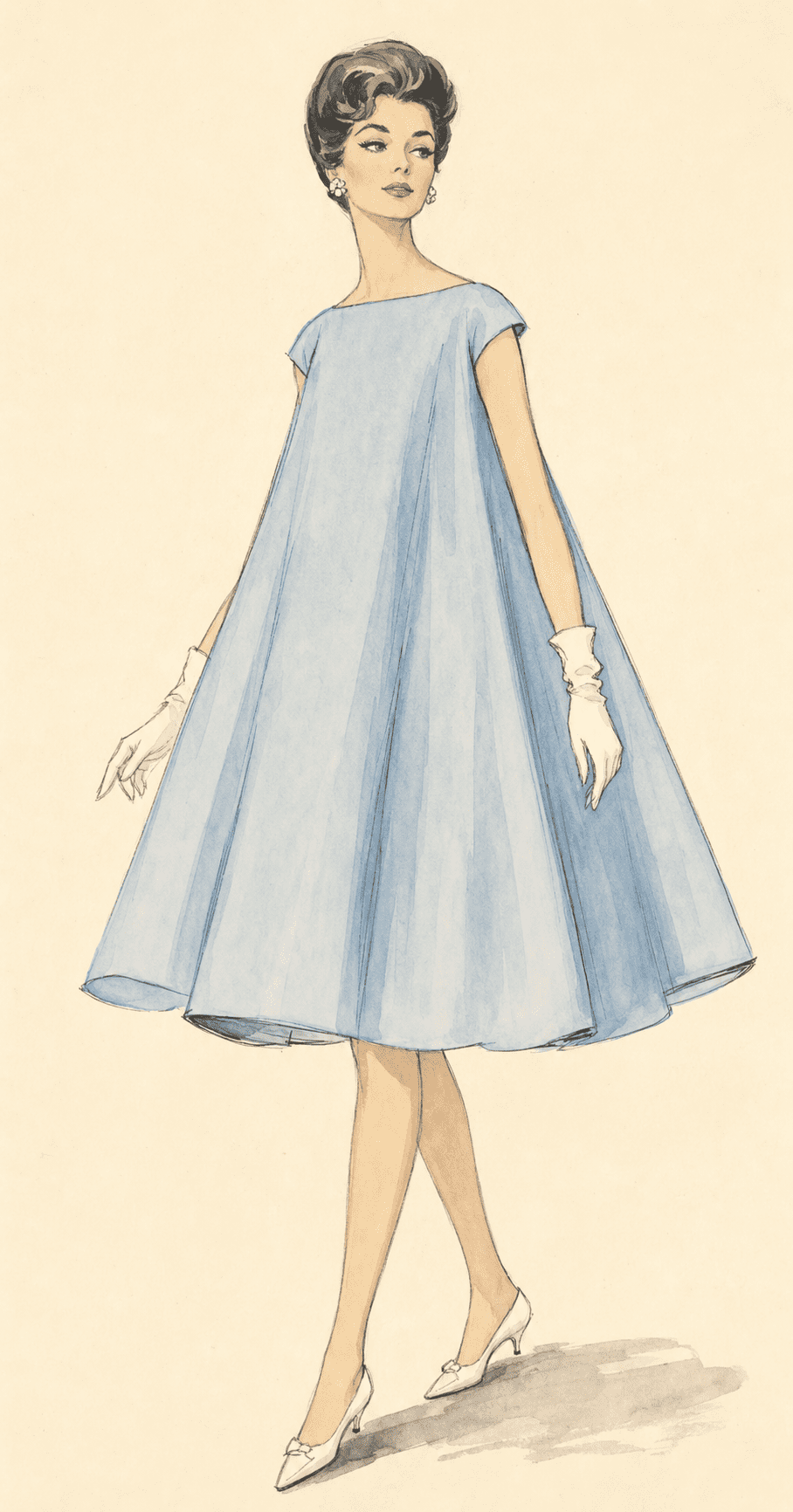
5. The TrapezeYves Saint Laurent’s debut, January 1958
When Christian Dior died suddenly in October 1957, his 21-year-old assistant Yves Saint Laurent was thrust into the role of creative director. His first collection, in January 1958, gave the world the Trapeze line: an A-shape that began narrow at the shoulders and flared dramatically outward to the hem. It was the Sack made joyful. It also, briefly, made Saint Laurent the most famous young man in Paris.
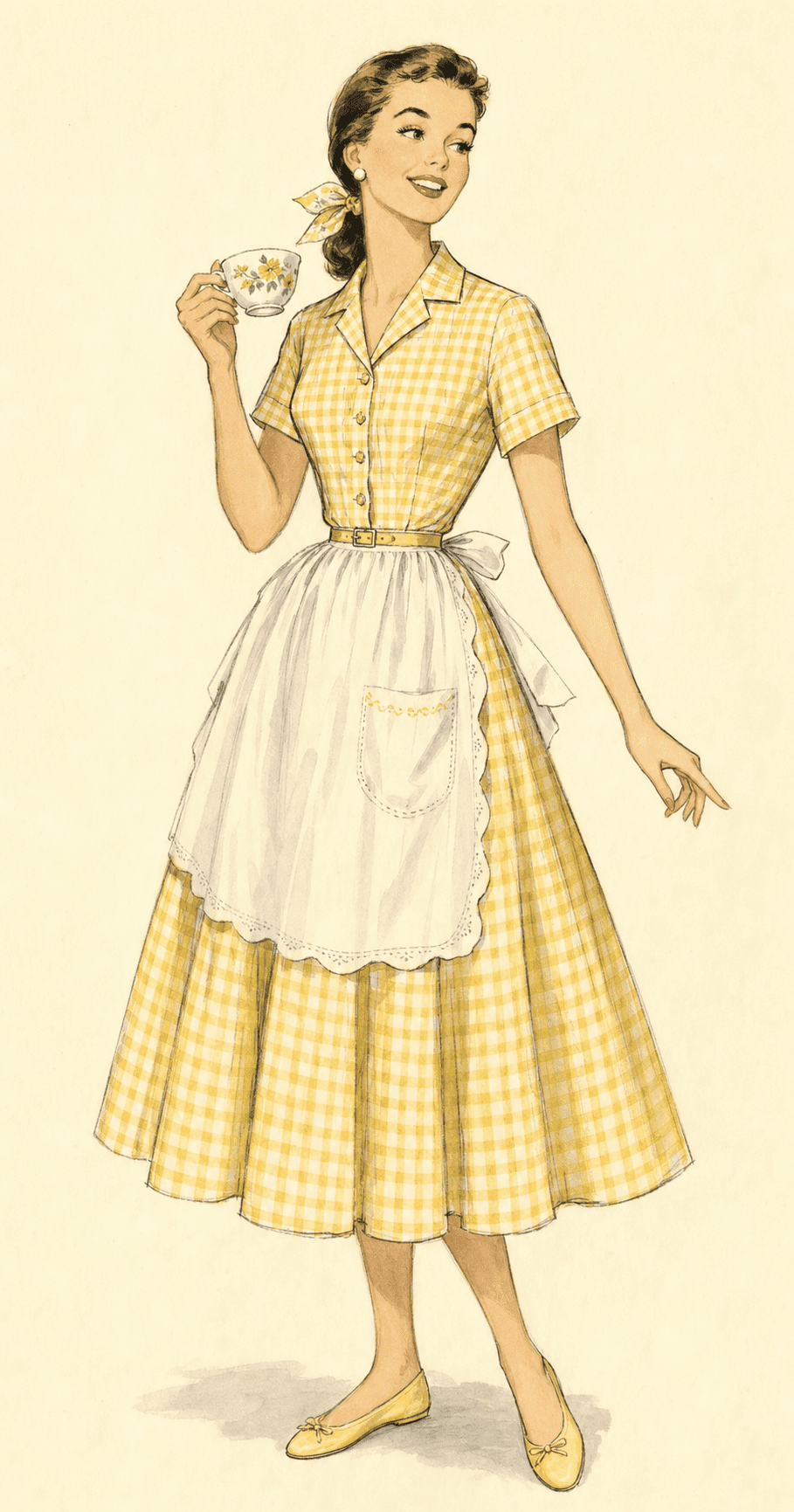
6. The ShirtwaistThe American everyday dress
If New York couture was Charles James and Paris was Dior, suburban America was the shirtwaist. Buttoned bodice with a small collar (cribbed from a man’s shirt), short or three-quarter sleeves, a tidy belt at the natural waist, and a full or A-line skirt to mid-calf. It was modest, washable, made in a thousand prints, and worn by every TV mother in America.
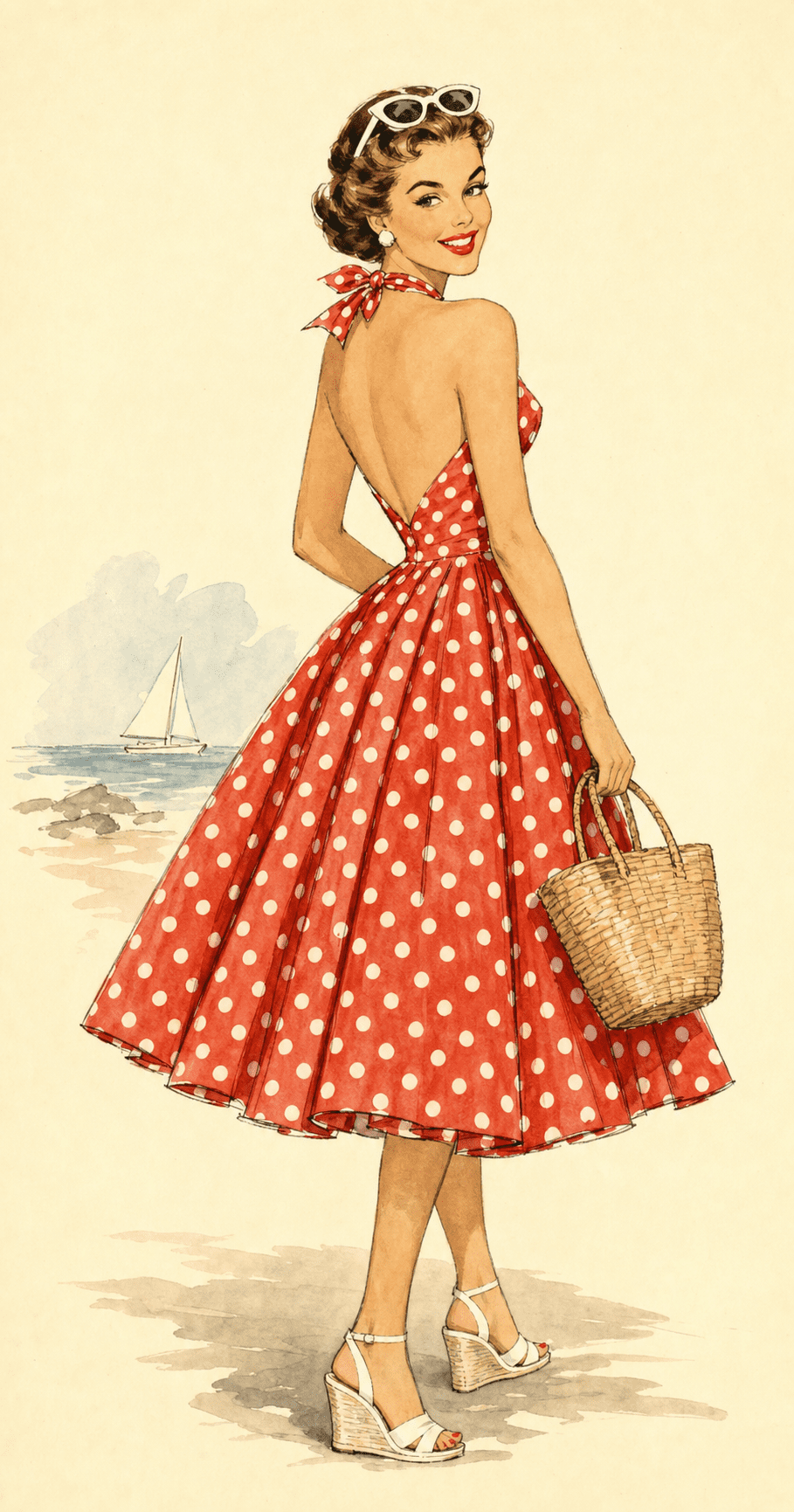
7. The Halter SundressThe dress that built the bombshell
Backless, tied at the nape, with a fitted bodice and a full circle skirt — the halter sundress was the decade’s contribution to summer dressing and the costume of choice for the pin-up. It revealed shoulders and back without showing too much else, which made it both decent and devastating.
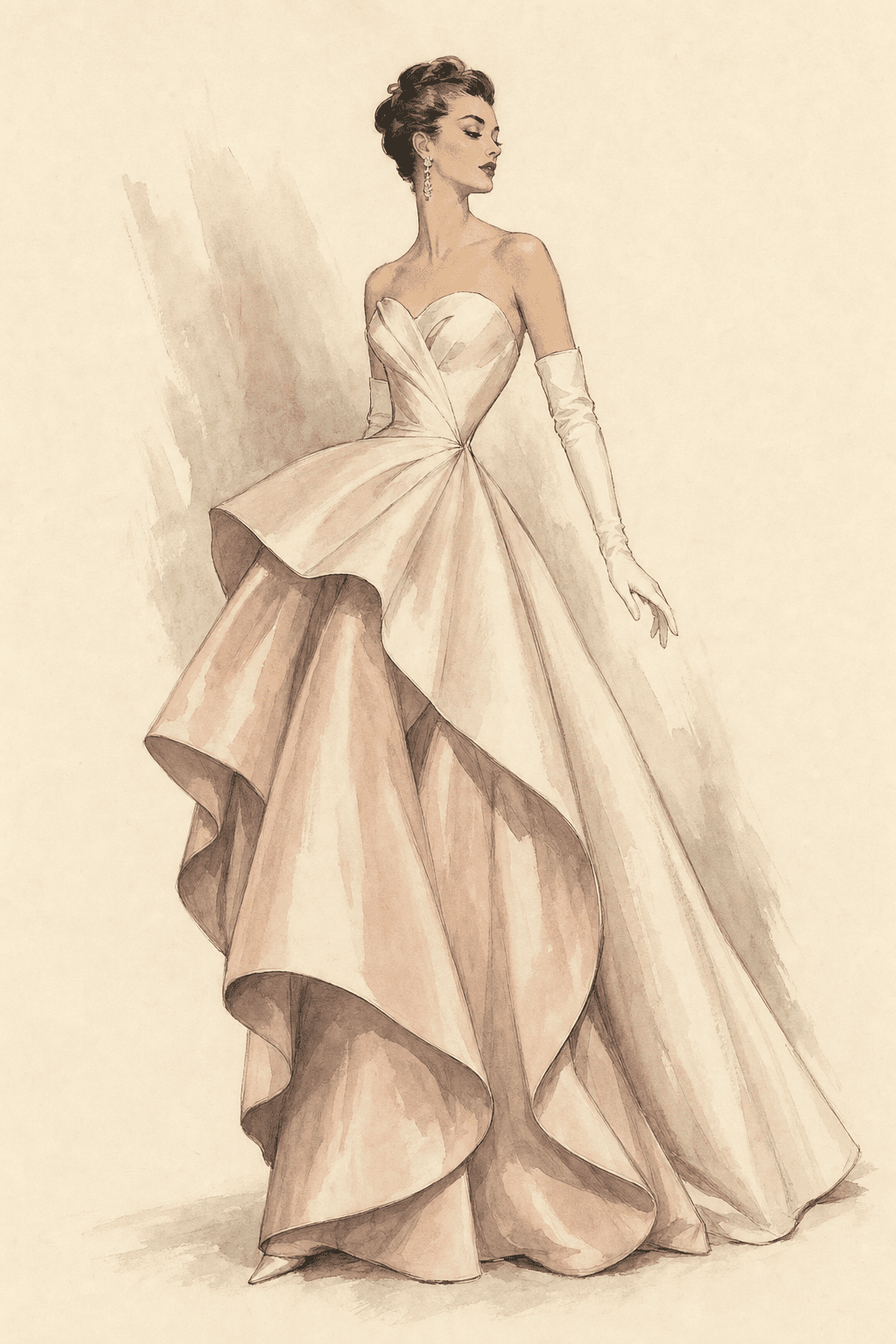
8. The Sculptural Ball GownCharles James and the American couture moment
The decade’s grand finale, and the one piece in any woman’s wardrobe that couldn’t be washed at home. Charles James — the Anglo-American couturier Dior himself called the greatest talent of my generation — built ball gowns the way an engineer builds bridges. His Clover Leaf (1953), Tree and Swan gowns weighed up to ten kilos and required their wearers to be quite literally lifted into them.
✦ ✦ ✦
Part ThreeA Quick Word on Lengths
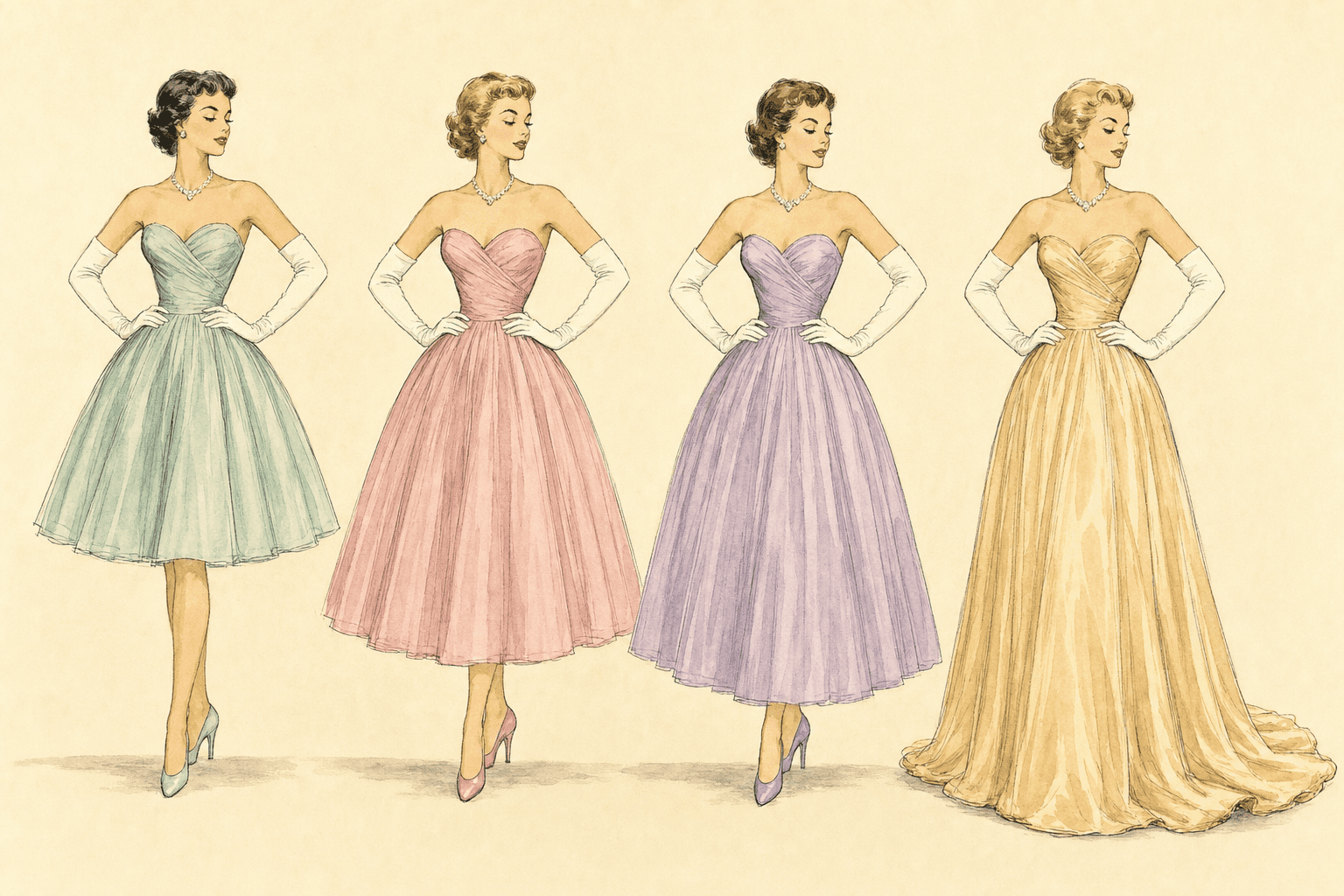
The four main lengths of the decade. From left: cocktail (just above the knee — rare in the early ’50s, increasingly common after 1957), ballet (mid-calf, named after dancers’ tutus), tea (between calf and ankle, the polite afternoon length), and the full evening gown.
One of the most useful things to know about ’50s dressing is that length signalled occasion with absolute clarity. A woman didn’t choose her hem because she liked it — she chose it because of where she was going and what time of day it was.
- ✦Cocktail length (above the knee): A late-’50s arrival, popularised by Givenchy and Saint Laurent. For evening drinks, not yet for the office.
- ✦Ballet length (mid-calf): The most common dress length of the decade. Worn for everything from work to weddings.
- ✦Tea length (between calf and ankle): Named after the afternoon “tea dances” of the 1920s. Polite, restrained, slightly more formal than ballet.
- ✦Floor-length: Strictly after six p.m. Strictly for grand occasions. Strictly with gloves.
“After six o’clock, a lady simply does not show her ankles.”
— Edith Head, costume designer to the stars
✦ ✦ ✦
Part FourThe Five Style Tribes
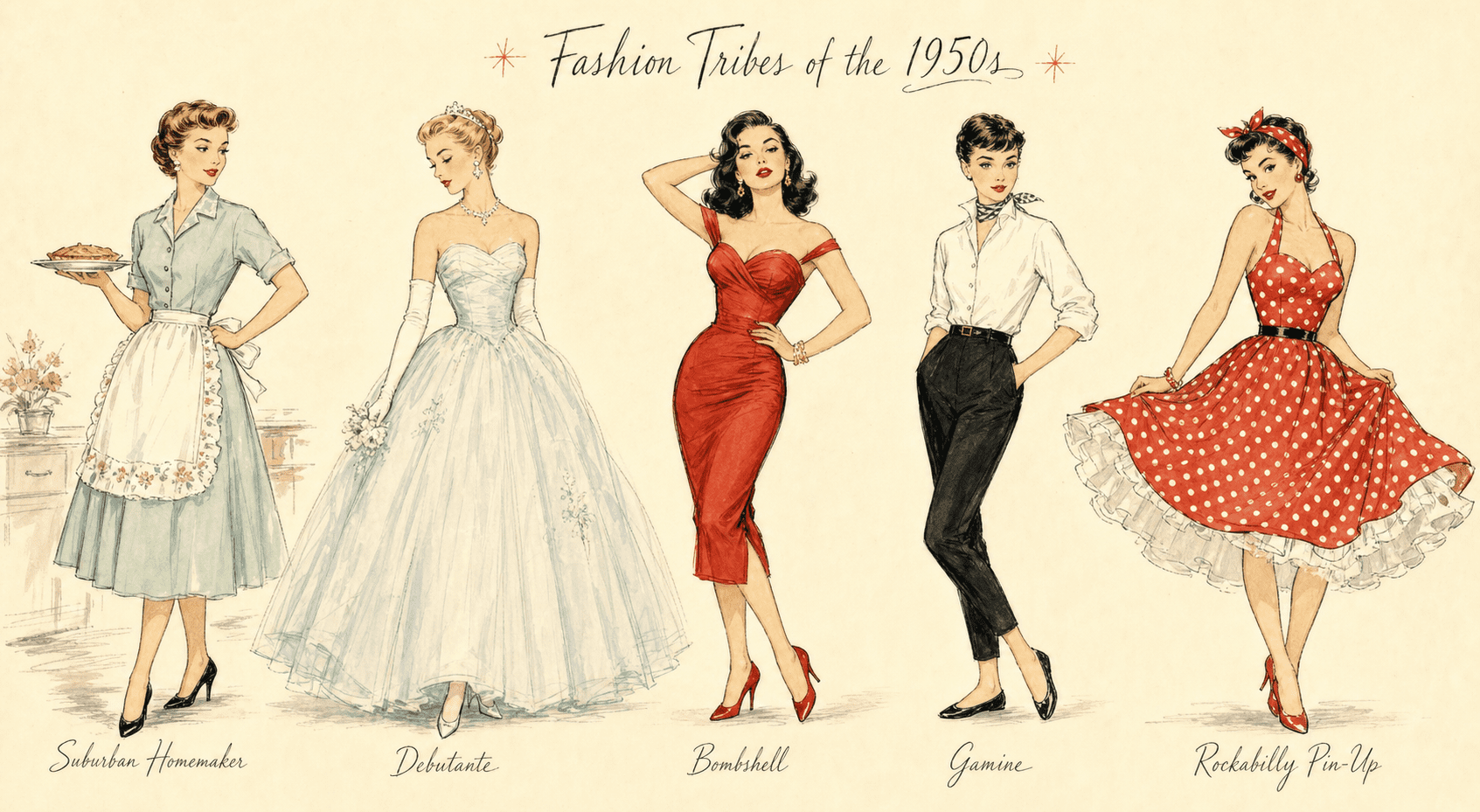
The five women of the 1950s wardrobe, drawn in fashion-plate form.
The ’50s woman was not one woman. She was at least five — each with her own dress, her own designer, her own movie star, and her own attitude toward what it meant to be feminine in a postwar world.
1. The Suburban Homemaker
Uniform: shirtwaist dress, pinafore apron, pearls (always), ballet flats, perfectly set hair.
Designer: Claire McCardell, who invented American sportswear and put women in denim, ballet flats and wrap dresses decades before they had names.
Patron saints: Donna Reed, Lucille Ball, Doris Day, June Cleaver.
2. The Debutante
Uniform: strapless full-skirted gown, long white gloves, single string of pearls, modest amount of décolletage, a great deal of tulle.
Designer: Christian Dior, Charles James, Norman Hartnell.
Patron saints: Elizabeth Taylor (aged 17, in A Place in the Sun), Princess Margaret, the young Jacqueline Bouvier.
3. The Bombshell
Uniform: wiggle dress, sweetheart or halter neckline, peep-toe heels, a single beauty mark, platinum or jet-black hair.
Designer: William Travilla (who dressed Monroe for eight films, including the pink Diamonds gown and the white halter).
Patron saints: Marilyn Monroe, Jane Russell, Jayne Mansfield, Mamie Van Doren, Diana Dors, Sabrina, Bettie Page.
4. The Gamine
Uniform: sheath dress with Sabrina neckline, or slim black cigarette pants and a crisp white shirt with ballet flats. Pixie crop. No fuss.
Designer: Hubert de Givenchy, Coco Chanel (returned from her wartime exile in 1954 with the cardigan suit), Yves Saint Laurent.
Patron saints: Audrey Hepburn, Leslie Caron, Jean Seberg, Françoise Sagan.
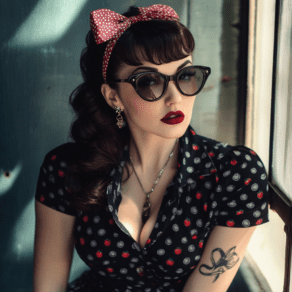
5. The Rockabilly Pin-Up
Uniform: halter swing dress with crinoline petticoat, polka dots or cherries, bandana headscarf, red lipstick, wedge sandals.
Designer: No house dressed her — she was largely a phenomenon of pattern catalogues, drive-ins, and pin-up calendars.
Patron saints: Bettie Page, Wanda Jackson, the early Patsy Cline, the women on the calendars in mid-century garages.
+ The European Variant
A sixth tribe deserves a mention: the Mediterranean ingnue. Brigitte Bardot in her gingham wedding dress (1959). Sophia Loren in a peasant blouse and full skirt. Gina Lollobrigida. Anita Ekberg in the Trevi Fountain. They wore the same shapes as everyone else — but with bare feet, sun-darkened skin, and an attitude that horrified Parisian couture and changed beach dressing forever.
✦ ✦ ✦
Part FiveThe Icons — A Deeper Catalogue
Every dress shape above attached itself to a face. Here, expanded considerably, is who wore what — and why we still remember.
The Screen Sirens
Marilyn Monroe — three dresses defined her: the shocking pink strapless in Gentlemen Prefer Blondes (1953, by William Travilla), the white pleated halter in The Seven Year Itch (1955, also Travilla), and the gold-lamé pleated gown in The River of No Return screen tests. Travilla designed eight of her films; she once wrote on a sketch he’d given her: “Billy dear, please dress me forever. I love you, Marilyn.”
Jane Russell sang opposite Monroe in Gentlemen Prefer Blondes and gave the wiggle dress its sweetheart neckline. Jayne Mansfield took the wiggle to its extreme. Mamie Van Doren brought it to rockabilly. Kim Novak wore Edith Head’s grey suit and emerald-green dress in Vertigo (1958). Ava Gardner floated through The Barefoot Contessa (1954) in Fontana sisters gowns. Rita Hayworth wore Jean Louis sheaths in Affair in Trinidad and Pal Joey. Lana Turner survived from the ’40s into the ’50s in Helen Rose gowns.
The Aristocrats and the Aristocratic-in-Spirit
Audrey Hepburn changed fashion the moment she walked into Givenchy’s atelier in 1953 (Givenchy thought he was meeting Katharine Hepburn and was visibly disappointed; he then dressed Audrey for the rest of her life). Sabrina (1954) gave us the Sabrina neckline. Funny Face (1957) gave us the pink Givenchy and Avedon’s pink-rose photographs. Roman Holiday (1953) gave us the white blouse and full skirt that every European tourist now copies. The little black Givenchy in Breakfast at Tiffany’s was designed in 1959, released in 1961.
Grace Kelly wore Edith Head in every Hitchcock film: the mint suit and chiffon black-and-white gown in Rear Window (1954), the strapless aqua-blue gown and pleated white halter in To Catch a Thief (1955). Her wedding gown to Prince Rainier (Helen Rose, MGM, 1956) used 25 yards of silk taffeta and 100 yards of silk net, and inspired Catherine Middleton’s gown 55 years later. Princess Margaret wore Dior on her 21st birthday in 1951 — the most famous Dior dress ever sold to private royalty. Queen Elizabeth II was crowned in 1953 in a Norman Hartnell gown embroidered with the floral emblems of the Commonwealth — eight months of work, twelve seamstresses.
And in New York, Truman Capote’s swans — Babe Paley, C.Z. Guest, Slim Keith, Marella Agnelli, Gloria Guinness — dressed in Charles James and Mainbocher and defined what American grown-up elegance looked like.
The Europeans
Brigitte Bardot married Jacques Charrier in June 1959 in a pink gingham dress with broderie anglaise trim that she designed herself; the dress sold so many copies that gingham briefly outpaced silk in French fabric sales. Sophia Loren and Gina Lollobrigida made the peasant blouse and tight skirt the unofficial uniform of Italian neorealism. Anita Ekberg stepped into the Trevi Fountain in a strapless black Fontana gown in La Dolce Vita (filmed 1959, released 1960). Leslie Caron wore Cecil Beaton in Gigi (1958) and won the Oscar costume designers’ adoration forever.
Wholesome America and the Television Revolution
Lucille Ball made the shirtwaist and capri-pant combination the look of working motherhood. Doris Day made pastel shirtwaists feel modern in Pillow Talk. Donna Reed dressed for the cameras in shirtwaist and pearls. Debbie Reynolds sang her way through Singin’ in the Rain (technically 1952) and Tammy. Natalie Wood, just sixteen, redefined teenage rebellion in Rebel Without a Cause (1955). Mary Tyler Moore, in the late ’50s, fought CBS for the right to wear capri pants instead of skirts on The Dick Van Dyke Show — and won.
The Singers and Performers
Patsy Cline moved country music from cowgirl fringe to cocktail glamour, often in sequinned wiggle gowns. Wanda Jackson wore rhinestone-trimmed sweetheart dresses and invented rockabilly stagewear. Eartha Kitt slunk through cabarets in custom black sheaths. Lena Horne — the first Black performer signed to a long-term Hollywood contract — wore Travis Banton and Adrian gowns. Dorothy Dandridge became the first Black woman nominated for the Best Actress Oscar (for Carmen Jones, 1954), in a red wrap skirt and black top that became iconic. Diahann Carroll, Connie Francis, and Rosemary Clooney rounded out the decade’s musical fashion plates.
The Pin-Up Underground
And underneath all the couture, a parallel world. Bettie Page, the Tennessee girl with the black fringe, was photographed in halters and lingerie that became the visual blueprint of rockabilly. Sabrina (Norma Sykes) was Britain’s homegrown wiggle-dress bombshell. Diana Dors was sold as “the English Marilyn.” None of them wore couture. All of them shaped how vintage clothing looks today.
Part SixThe Designers Behind the Decade
- ✦Christian Dior (Paris) — The New Look, 1947. Died suddenly in October 1957, leaving the house to his 21-year-old assistant.
- ✦Cristóbal Balenciaga (Paris, born Spain) — Dior’s only acknowledged superior. Gave the world the tunic dress (1955), the chemise/sack (1957), and the cocoon coat. Refused to give interviews for almost his entire career.
- ✦Hubert de Givenchy (Paris) — Audrey’s couturier. Invented the Sabrina neckline. First couturier to release ready-to-wear (1954).
- ✦Coco Chanel (Paris) — Returned from wartime exile in 1954 (at 71) with the cardigan suit. Initially ignored by the French press; adopted instantly by Americans.
- ✦Yves Saint Laurent (Paris) — Inherited Dior at 21. Trapeze line, 1958. Drafted into the French army in 1960 and dismissed from Dior while still hospitalised.
- ✦Pierre Balmain (Paris) — Dressed Queen Sirikit of Thailand, Marlene Dietrich, Brigitte Bardot. Specialised in jolie madame elegance.
- ✦Jacques Fath (Paris) — Died at 42 in 1954. While alive, the third great Paris couturier after Dior and Balenciaga.
- ✦Charles James (New York, born England) — The sculptor of American couture. Made fewer than a thousand pieces in his life; the Met still mounts retrospectives.
- ✦Claire McCardell (New York) — The mother of American sportswear. Invented the wrap dress, the ballet flat (with Capezio), the popover house dress. Died of cancer in 1958 at 52, just as she was about to be recognised globally.
- ✦Norman Norell (New York) — The American couturier in residence. Mermaid sequin gowns. The first American designer treated as Paris’s equal.
- ✦Edith Head (Hollywood) — Eight Oscars for costume design. Dressed Hepburn, Kelly, Taylor, Stanwyck, Lamarr. The first costume designer to become a household name.
- ✦Helen Rose (MGM) — Designed Grace Kelly’s wedding gown and Elizabeth Taylor’s white slip in Cat on a Hot Tin Roof.
- ✦William Travilla (Fox) — Marilyn Monroe’s personal couturier in everything but name.
✦ ✦ ✦
Part SevenThe Films That Taught the World How to Dress
To study the silhouette is, in the end, to study the films. Costume design was the single greatest engine of mass fashion in the 1950s — a Travilla dress on Monroe sold ten thousand pattern copies by Christmas.
| Film | Year | The Dress · The Designer |
|---|---|---|
| All About Eve | 1950 | Bette Davis’s brown cocktail and Marilyn Monroe’s bias-cut white. Edith Head & Charles LeMaire. |
| A Place in the Sun | 1951 | Elizabeth Taylor’s white tulle debutante gown — the most copied dress of the decade. Edith Head (Oscar winner). |
| Singin’ in the Rain | 1952 | Debbie Reynolds in candy-pink shirtwaists. Walter Plunkett. |
| Gentlemen Prefer Blondes | 1953 | Marilyn’s shocking pink strapless (“Diamonds Are a Girl’s Best Friend”). William Travilla. |
| How to Marry a Millionaire | 1953 | Monroe, Bacall and Grable as the wiggle, the sheath and the sundress trinity. Travilla. |
| Roman Holiday | 1953 | Audrey Hepburn’s white blouse and full skirt — the original European tourist outfit. Edith Head. |
| Sabrina | 1954 | The Sabrina neckline; the black cocktail dress with bows at the shoulders. Hubert de Givenchy (uncredited) & Edith Head. |
| Rear Window | 1954 | Grace Kelly’s mint suit, the black-and-white floral chiffon dinner gown, the chiffon negligée. Edith Head. |
| Carmen Jones | 1954 | Dorothy Dandridge’s red wrap skirt and black top — Hollywood’s first Black Best Actress nominee. Mary Ann Nyberg. |
| The Seven Year Itch | 1955 | The ivory pleated halter over the subway grate. William Travilla. |
| Rebel Without a Cause | 1955 | Natalie Wood in jeans and white socks — teenage rebellion in costume form. Moss Mabry. |
| To Catch a Thief | 1955 | Grace Kelly’s aqua chiffon gown on the Riviera. Edith Head. |
| High Society | 1956 | Kelly’s farewell film. Helen Rose evening gowns; the platinum-gold engagement-party gown. Helen Rose. |
| Bus Stop | 1956 | Monroe in fringed saloon-girl green. Travilla. |
| Funny Face | 1957 | Hepburn + Givenchy + Avedon. The pink ball gown; the wedding-dress finale. Givenchy & Edith Head. |
| An Affair to Remember | 1957 | Deborah Kerr’s chiffon. Charles LeMaire. |
| Vertigo | 1958 | Kim Novak’s grey suit and emerald-green wrap dress — possibly the most analysed costume in cinema. Edith Head. |
| Gigi | 1958 | Leslie Caron in Belle Époque revival. Cecil Beaton (Oscar winner). |
| Some Like It Hot | 1959 | Set in 1929, costumed for 1959. Monroe’s beaded chiffon backless gown. Orry-Kelly (Oscar winner). |
| La Dolce Vita | 1960 | Anita Ekberg’s strapless black gown in the Trevi Fountain. Piero Gherardi (Oscar winner). |
✦ ✦ ✦
Part EightThe Decade’s Subculture: Rockabilly and the Pin-Up
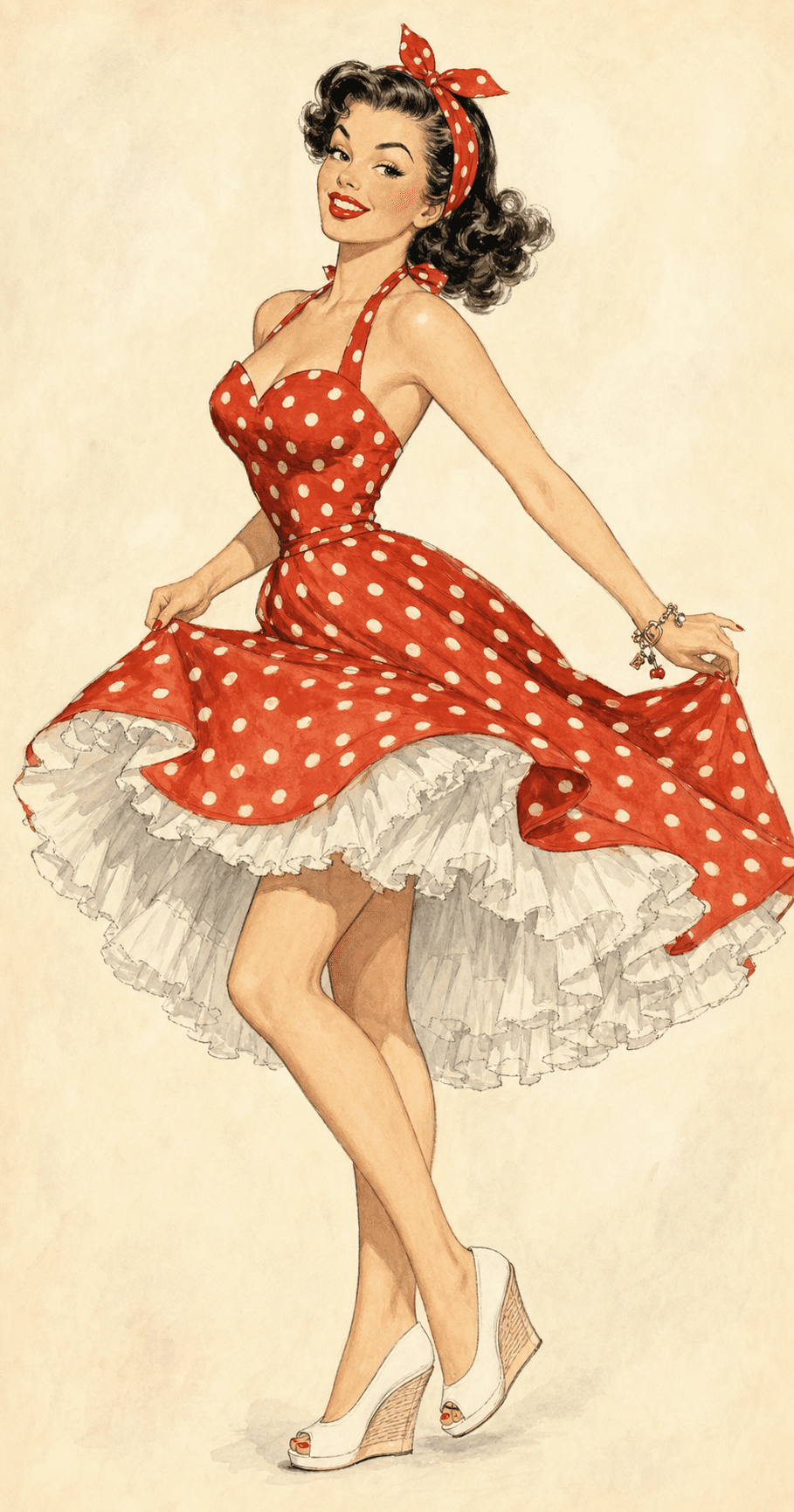
The rockabilly pin-up — born in roadside diners and pattern catalogues, not couture salons.
While Dior and Balenciaga argued in Paris, an entirely separate fashion universe grew up in American garages, jukebox joints, and the pages of Yank magazine. The rockabilly woman bought her dresses from Sears Roebuck or sewed them from Simplicity patterns. She wore halter swing dresses with cherry-or-polka-dot prints, full circle skirts puffed out by net petticoats dyed pink in the bathtub, wedge sandals or saddle shoes, and a bandana tied in a top-knot bow.
The look was descended from wartime pin-up calendars (Alberto Vargas, Gil Elvgren) and powered by the new music — Elvis, Wanda Jackson, Chuck Berry. It barely existed in fashion magazines at the time. It exists everywhere now: in every vintage fair, every burlesque revival, every rockabilly festival from Las Vegas to Sweden. Without it, there would be no Dita Von Teese, no Lana Del Rey, no Amy Winehouse.
✦ ✦ ✦
Part NineHow to Spot an Authentic 1950s Silhouette Today
If you’re shopping vintage — or just want to tell ’50s from ’60s from a clever modern reproduction — here are the giveaways.
- ✦The waist seam. Almost every ’50s dress has one, and it’s exactly at the natural waist. Drop-waists and empire lines mean another decade.
- ✦The metal zipper. Side-seam, never centre-back, almost always metal (nylon coil zippers existed but were rare in dressmaking until the 1960s).
- ✦The hem. Always hand-finished. A machine-finished hem on a “1950s” dress is almost certainly a reproduction.
- ✦The label. Look for union labels (ILGWU — International Ladies’ Garment Workers’ Union — used coloured labels in known sequences that can date a garment within a year or two), care labels without fibre content (mandatory in the U.S. only after 1960), and stiff woven labels rather than printed.
- ✦The structure. A real ’50s bodice has built-in boning, often a built-in waspie, and weight. It is constructed like architecture, not draped like a T-shirt.
- ✦The petticoat. Original petticoats are nylon net, sometimes horsehair-stiffened. Modern repros use polyester organza — softer, lighter, less rustly.
✦ ✦ ✦
EpilogueWhy It Still Matters
It would be easy to dismiss the 1950s silhouette as a step backwards — and many feminist fashion historians have. The corsets returned. The waists were impossible. The dresses required either staff or extraordinary self-discipline to put on. Dior himself said his designs were for women who “had nothing to do but be beautiful.”
But that’s only half the story. The same decade also gave us Claire McCardell’s wrap dress and ballet flat — clothes for women who worked, drove, travelled, picked up children. It gave us Balenciaga’s sack, which freed the body entirely. It gave us Chanel’s cardigan suit and Saint Laurent’s trapeze. And it gave us, in the very same wardrobes, both the strictest dress code of the twentieth century and the seeds of every revolution that came after.
That contradiction — between the polished hourglass and the chemise, the housewife and the gamine, Dior and Balenciaga, Marilyn and Audrey — is exactly what makes the 1950s silhouette inexhaustibly interesting. There has never been a decade with more shapes, more rules, more icons, or more beautiful exceptions to its own rules.
The 1950s did not give us one silhouette. It gave us all of them — and quietly, almost without noticing, taught the rest of the century how to dress.
✦ ✦ ✦
An illustrated guide to the 1950s dress silhouette. Original fashion-plate illustrations created for editorial and cultural reference purposes. © 2026


Leave a Comment