
etween 1940 and 1990, the average home was transformed more completely than in any comparable fifty-year period in human history. Not by architecture or fashion or even technology in the abstract — but by appliances. The refrigerator replaced the ice box. The automatic washing machine replaced two hours of physical labour. The microwave replaced the patient wait. The television replaced the radio as the centrepiece of family life. And through all of it, an entire industry competed furiously to make these machines as beautiful, as colourful, and as desirable as possible — because in post-war America, what you owned said something profound about who you were.
This is the story of the machines that built the modern home: decade by decade, brand by brand, colour by extraordinary colour. The chrome toasters and pastel refrigerators of the 1950s. The avocado green everything of the 1970s. The harvest gold nightmare — and triumph — of the 1980s. And the moment the microwave arrived on every kitchen counter and changed the way a civilisation ate dinner.
It is also the story of things built to last. A 1952 Frigidaire refrigerator was engineered to run for thirty years. A 1960s Sunbeam Mixmaster is still whipping cream in thousands of kitchens today. The irony is that as appliances became more sophisticated, they became less durable. The 1950s toaster may outlast everything currently in your kitchen. Whether that says more about mid-century manufacturing or modern planned obsolescence is left as an exercise for the reader.
✦ ✦ ✦
The 1940s: War, Rationing & the Promise of Tomorrow
The 1940s begins with a paradox: it is simultaneously the decade in which domestic technology advanced the least and the decade that created the conditions for the most explosive growth in appliance history. The reason is simple. From 1941 to 1945, American manufacturing was entirely redirected to the war effort. The same factories that made refrigerators began making military equipment. Steel was rationed. Rubber was rationed. Copper was rationed. If you wanted a new washing machine during the war, you waited — and the machine you were waiting to buy didn’t actually exist yet.
What this meant for the 1940s household was a reliance on whatever you already owned. Ice boxes — literal wooden or metal cabinets cooled by a block of ice delivered weekly — were still common in the early years of the decade. Washing machines existed but required physical involvement: you loaded them, watched them, wrung the clothes through a manual mangle, and hung everything to dry. There were no automatic dryers available to ordinary homes until after the war. The small appliances that did exist — irons, toasters, stand mixers, waffle irons — were solid, heavy, made of steel and bakelite, and designed to survive indefinitely.
“The war didn’t slow down domestic technology — it delayed it, compressed it, and then released it all at once.”
And then, in 1945, the war ended. The factories pivoted back to consumer goods with astonishing speed. Returning soldiers needed homes. The government wanted them to buy homes. The GI Bill made mortgages cheap and available. Suburban development exploded. And every one of those new suburban homes needed to be fitted with appliances — which meant that the appliance industry went from virtually zero production to manufacturing millions of units almost overnight. The post-war boom was not just economic. It was domestic.
The Sunbeam Mixmaster — the stand mixer introduced in 1930 — came into its own in the late 1940s. More people have owned a Mixmaster than any other single appliance in American history, and it is the only kitchen appliance ever featured on a US postage stamp. The chrome-bodied, Art Deco-styled machine sat on kitchen counters like a sculpture. In 1947, the world’s first commercial microwave oven shipped: the Raytheon Radarange. It stood nearly six feet tall, weighed 750 lbs, and cost $5,000. Only restaurants and military canteens could use it. But it pointed the way.
Ice Box
Various
Still common early in the decade. A wooden or metal cabinet cooled by a block of ice delivered by the “ice man” weekly. Replaced almost entirely by electric refrigerators by 1950.
Sunbeam Mixmaster
Sunbeam
The Art Deco chrome stand mixer. Introduced 1930, perfected in the 1940s. So popular it was featured on a US postage stamp. Many still run perfectly today.
Pop-Up Toaster
Toastmaster · Sunbeam · GE
The automatic pop-up mechanism — no watching, no burning — became a kitchen standard by the late 1940s. Chrome-bodied, built from heavy-gauge steel, hand-polished.
Wringer Washer
Maytag · GE · Thor
Still required manual intervention — you loaded the drum, supervised the wash, then fed wet clothes through a mangle by hand. But it beat doing it in a tub.
Window Air Conditioner
Carrier · Westinghouse
The compact window unit was invented in the 1940s. By 1947, 43,000 had been sold. The decade that invented it ended with the promise that everyone would have one.
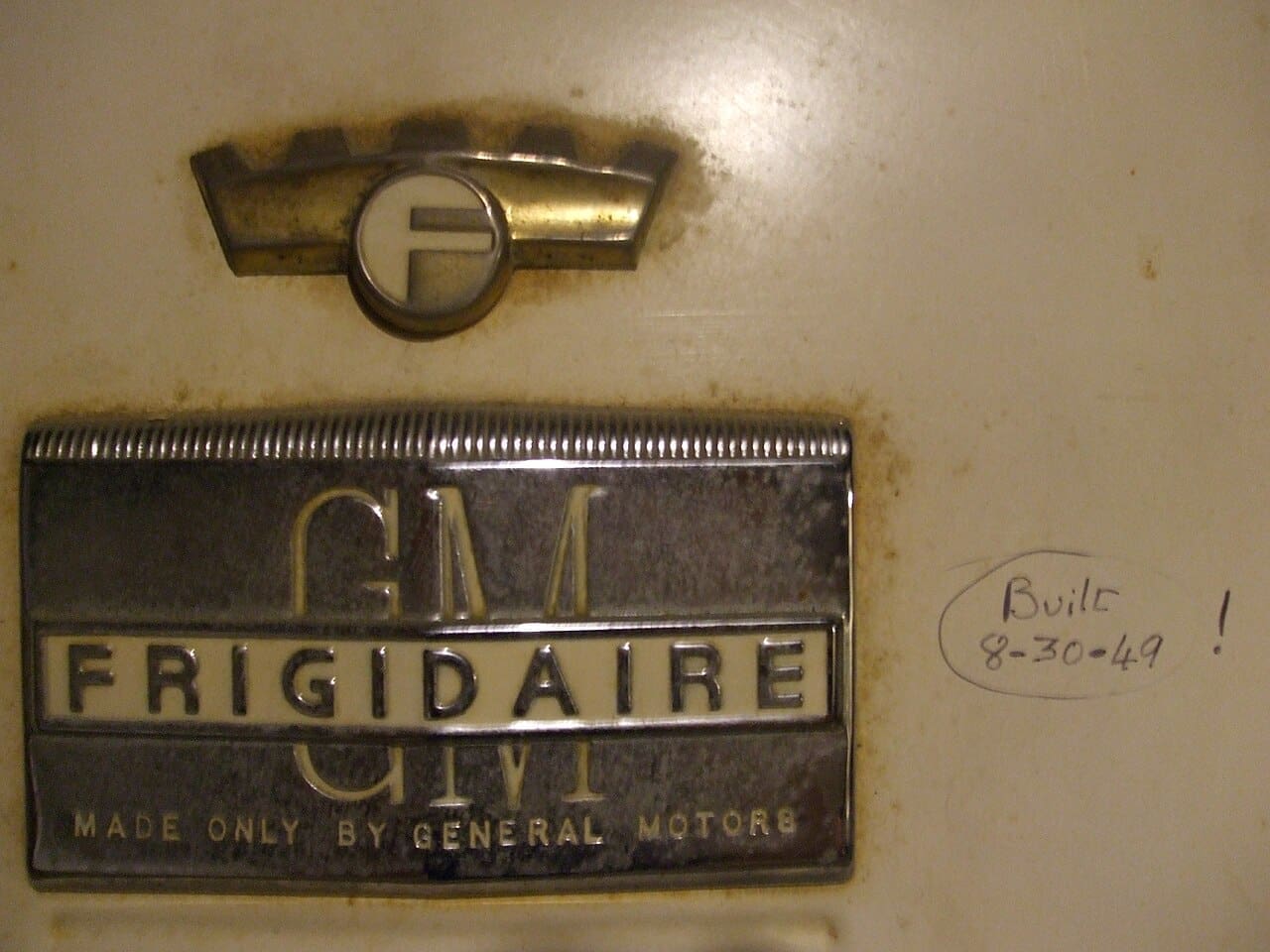
A 1949 Frigidaire refrigerator, photographed in Bethesda, Maryland in 2013 — still running. They were engineered to last 30 years. Modern refrigerators last an average of 8–10. — Wikimedia Commons / CC BY-SA
✦ ✦ ✦
The 1950s: The Golden Age Turns Pink
If the 1940s was about survival and recovery, the 1950s was about display. The post-war economic boom had put money in people’s pockets and new suburban homes under their feet, and the appliance industry competed furiously for that spending. For the first time, owning the right appliances was a statement of aspiration, modernity, and social standing. Advertisements of the era show beaming housewives in pearls and heels showing off their new refrigerators with the pride of someone unveiling a sports car.
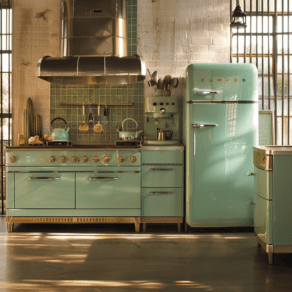
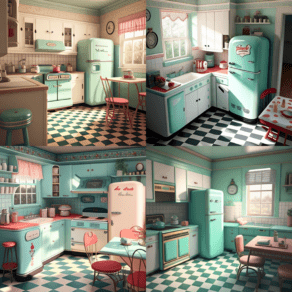
The defining visual shift of the 1950s kitchen was colour. In 1949, an Indiana stove factory introduced ranges in red, yellow, black, and blue — and consumers went absolutely wild for it. By 1954, Frigidaire became the first company to offer a full matched line of coloured large appliances. Pink, turquoise, sunny yellow, robin’s egg blue — a 1950s kitchen could look like an Easter basket in the best possible way.
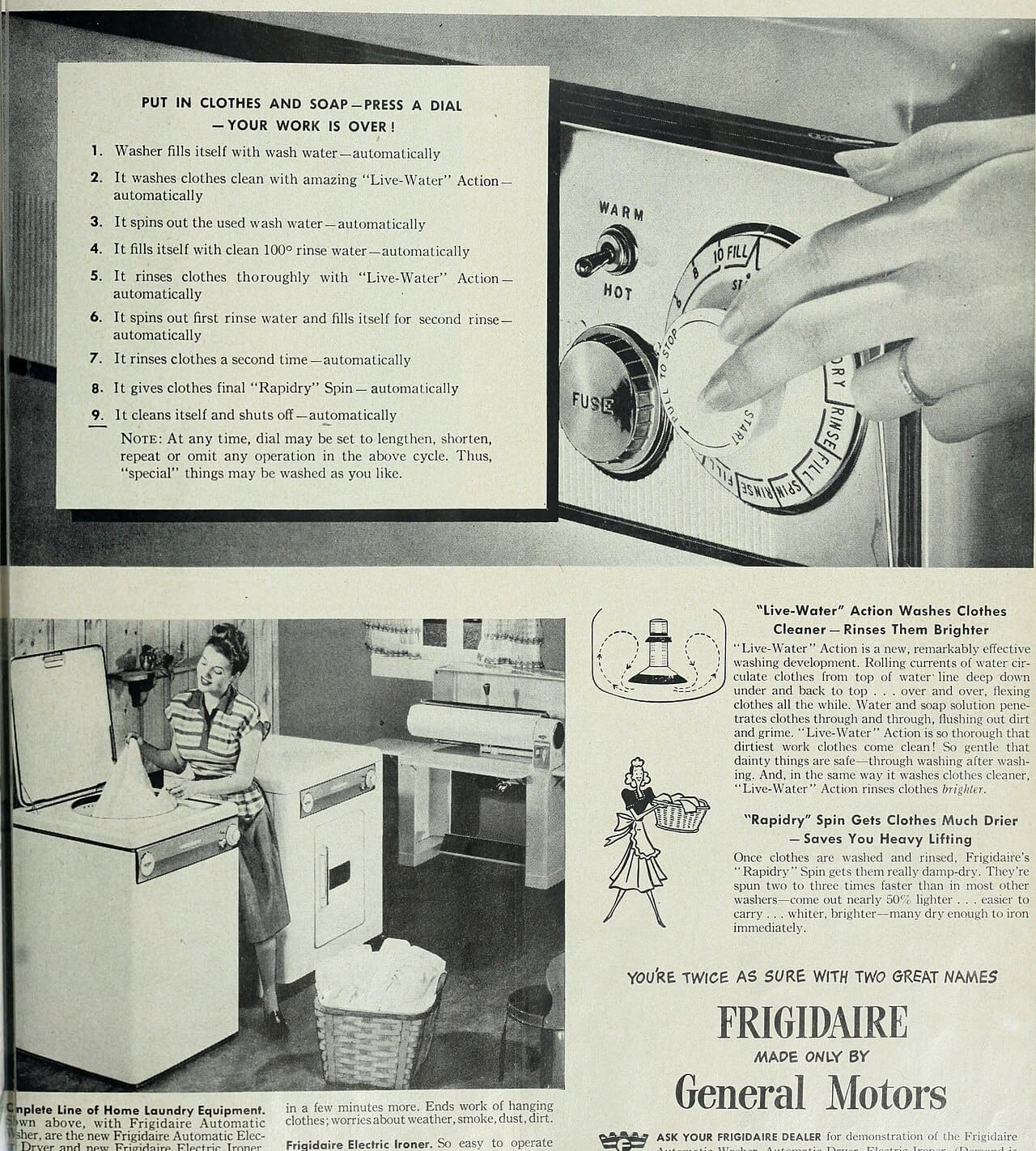
Ladies’ Home Journal, 1948: the magazine that told American women what they should want — and the appliance industry listened very carefully. Post-war advertising turned the refrigerator into a status object. — Wikimedia Commons / Public Domain
The refrigerator became the decade’s defining appliance. By 1955, 80 percent of American homes owned a refrigerator — a figure that had been essentially zero in 1940. Frigidaire introduced automatic ice-makers and auto-defrost in 1952. The Kelvinator Foodarama, introduced in the mid-1950s, was the first side-by-side refrigerator ever produced and was dubbed “the Rolls-Royce of appliances” — it featured a breakfast bar with built-in egg holders, removable juice containers, a tilt-out crisper bin, a butter keeper, and chrome exterior handles. These were not appliances. They were status objects.
Television transformed from a novelty to a cultural institution with a speed that has never been matched before or since. At the start of the 1950s, there were roughly 1 million TVs in American homes. By the end of the decade, there were 88 million, representing approximately 97 percent of all households. The television was no longer a luxury item — it was the centrepiece of family life, and it arrived in a wooden cabinet the size of a sideboard because the technology that made a small screen possible didn’t exist yet.
“In some areas, the use of electricity tripled between the mid-1940s and 1960. America wasn’t just buying appliances — it was buying a vision of the future.”
Coloured Refrigerator
Frigidaire · Kelvinator · GE
The decade’s defining appliance. Auto-defrost (1952), ice-maker, side-by-side designs. Came in pink, turquoise, yellow, canary, robin’s egg blue. The Kelvinator Foodarama: the Rolls-Royce of fridges.
Television
RCA · Zenith · Philco
1M sets in 1950; 88M by 1960. First in wooden console cabinets, then smaller table-top units. Black and white through most of the decade — colour TV was a luxury until the 1960s.
Automatic Washer
Maytag · Whirlpool · GE
Fully automated top-loaders arrive. No more watching, no more wringing. The mangle was finally dead.
Clothes Dryer
Whirlpool · GE · Maytag
Front-loading electric dryers become available to ordinary homes for the first time. The backyard clothesline immediately began its long decline.
Dishwasher
Westinghouse · KitchenAid
A luxury item becoming attainable. Often built into the redesigned open kitchen layout. The Colston dishwasher of the mid-1950s was barely bigger than a breadbox.
Hoover Constellation
Hoover
A spherical canister that floated on its own airflow — introduced in the 1950s and looked like something from a science fiction film. It actually worked better for it.
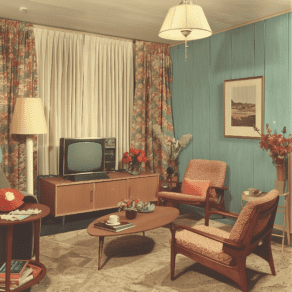
The 1950s Palette — Pastels Rule the Kitchen
The Big Names of the 1950s
✦ ✦ ✦
The 1960s: Space Age Kitchens & the Birth of Avocado
The 1960s kitchen took its design cues from the space programme. Streamlined shapes, push-button controls, and the language of “modern science” appeared in appliance advertisements alongside astronauts and rockets. Westinghouse ran ads depicting their appliances in the kitchens of the future. GE introduced the self-cleaning oven in 1963 — a pyrolytic system that heated to 900°F and burned everything clean — and housewives across America were electrified.
The decade’s most consequential event was not the Moon landing. It was the introduction of Avocado Green as an appliance colour by General Electric in 1966. Within a year, every other major manufacturer had followed. The 1970s kitchen — the most visually distinctive interior decade in American history — was born two years early, in a GE boardroom in the mid-1960s. It was joined in 1968 by Harvest Gold, and in 1964 by the transitional earth tone Coppertone. The pastel 1950s was definitively over.
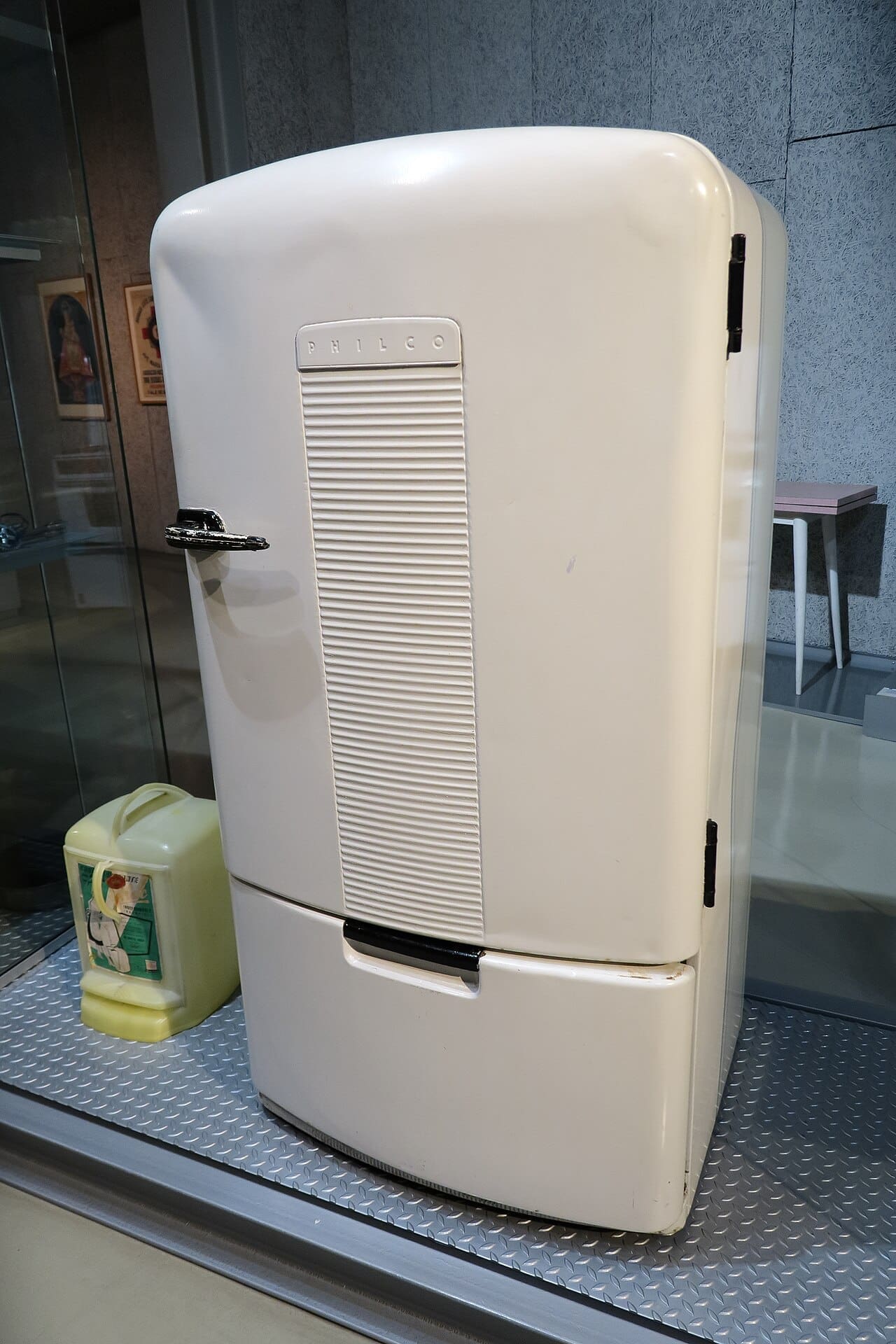
A 1950 Philco refrigerator, preserved in the Museo del Pueblo de Asturias, Spain — the rounded, chrome form that defined early post-war kitchen design, before avocado green changed everything. — Wikimedia Commons / CC BY-SA
The decade was also remarkable for the flourishing of audio equipment. Stereo hi-fi systems — turntable, amplifier, and speakers in a furniture-grade wooden cabinet — became the centrepiece of the living room. Japanese manufacturers Sony, Pioneer, and Marantz arrived and began their methodical conquest of the American audio market. The transistor radio went everywhere. The television added colour — NBC and CBS began full colour broadcasting, and the black-and-white set in the living room started its long retirement to the bedroom.
“GE introduced Avocado Green as an appliance colour in 1966. The 1970s has officially begun two years early.”
The 1960s Palette — The Pastels Retreat, the Earth Tones Arrive
The 1960s Roster
✦ ✦ ✦
The 1970s: Avocado, Gold & the Microwave Arrives
The 1970s kitchen had a colour palette and it was not asking for your opinion. Avocado Green, introduced by GE in 1966, had taken complete hold. Harvest Gold, launched in 1968, was everywhere by 1972. Refrigerators, ranges, dishwashers, washing machines, range hoods, mixing bowls, spatulas, and Tupperware — all of it, in a unified chromatic statement that declared: this is a modern home, and modern homes are earthy and warm and absolutely not white.
What is fascinating about the avocado moment, with the benefit of retrospect, is that it made complete cultural sense at the time. The pastel colours of the 1950s — pink, pale blue, mint green — were associated with the conservative suburban aesthetic of your parents. By the late 1960s, that aesthetic was culturally toxic. The counterculture, the hippie movement, the back-to-nature ethos — all of it pointed toward earth tones. Avocado didn’t look ugly to a 1970s household. It looked natural. It looked au naturel. It looked like straw and soil and the rejection of post-war conformity. And then it looked extremely dated for forty years, and now it looks interesting again. Fashion is a circle.
But the 1970s story isn’t just about colour. It is also about the microwave oven, which arrived in homes in 1967 and spent the entire following decade becoming more affordable, more compact, and more essential. The Amana Radarange countertop model, introduced in 1967 at $495, was the first home microwave most people had ever seen. By 1975, microwave ovens were outselling traditional gas ranges. The microwave didn’t just change how people cooked — it changed how people thought about time.
“Having a microwave meant your kitchen was ahead of the curve. For many families, it became the ultimate sign of a modern household.”
Microwave Oven
Amana · Tappan · Litton · Sharp
The Amana Radarange (1967, $495) brings microwave cooking home. Through the 1970s, prices fall, sizes shrink. By 1975 they outsell gas ranges. The most transformative appliance of the decade.
Avocado Green Everything
GE · Frigidaire · Whirlpool · Maytag
Fridge, range, dishwasher, washer, dryer — all in Avocado Green. By 1972 it was unavoidable. Kohler made avocado bathtubs and sinks. It was everywhere.
Crock-Pot
Rival
The Rival Crock-Pot, introduced in 1971, sold to working women who needed dinner ready when they got home. Set it and forget it. Still essentially unchanged fifty years later.
Food Processor
Cuisinart · Robot Coupe
Carl Sontheimer introduces the Cuisinart food processor to the US in 1973 after seeing the Robot Coupe at a French trade show. The French chef goes from essential to immortal.
Electric Fondue Set
Oster · Cuisinart · Rival
The height of 1970s entertaining. An electric heating element kept the cheese or chocolate melted while guests used long forks to dip bread or fruit.
The 1970s Palette — Earth Tones at Maximum Intensity
✦ ✦ ✦
The 1980s: The VCR, the Microwave & the End of Avocado
The 1980s is the decade where the home appliance story becomes genuinely complicated, because for the first time, two entirely different types of appliance are competing for space, money, and cultural significance. In the kitchen: the microwave’s complete takeover and the slow death of the earth-tone colour era. In the living room: the Video Cassette Recorder, the Sony Walkman, and the beginning of the personal computer as a domestic object.
The microwave went from aspirational to standard in this decade with extraordinary speed. By 1986, 25 percent of American households owned one. By 1997, that figure was 90 percent. Prices collapsed through the 1980s as Japanese manufacturers — Sharp, Panasonic, Sanyo — entered the market and drove costs down. The frozen meal industry restructured around the microwave. Brands like Swanson and Lean Cuisine expanded dramatically because a microwave made eating a frozen dinner in three minutes a viable choice for dinner.
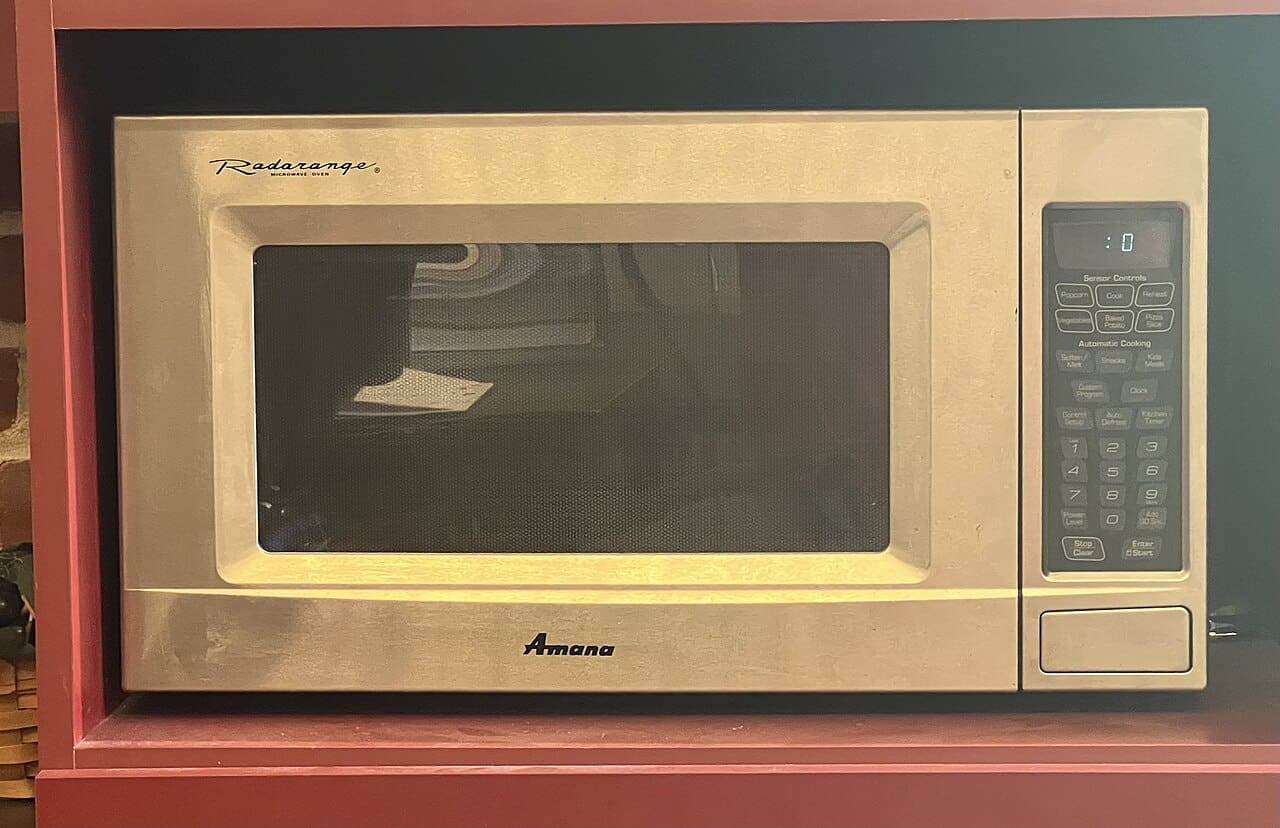
The Amana Radarange — the microwave that changed dinner forever. First home model, 1967, $495. By 1975 it outsold gas ranges. By 1986, one in four American homes had one. By 1997, nine in ten. — Wikimedia Commons / CC BY-SA
The VCR arrived and was initially a format war — Betamax vs VHS, a battle so perfectly documented that “Betamax” became a business school shorthand for having the superior product and losing anyway. VHS won not because it was better but because it could hold a longer tape, which mattered for recording sports events. By the mid-1980s, the VCR was in millions of American homes, rental stores were opening on every high street, and the film industry had discovered that home video could make more money than cinema release.
The colour story of the 1980s is one of gradual retreat. Harvest Gold, which had seemed so warm and inviting in the 1970s, began to look dated by the early 1980s — and once it looked dated, it looked immediately and irredeemably embarrassing. White made a comeback. Almond and Bisque became transitional colours. By the late 1980s, stainless steel was beginning its long ascent to total dominance. The colourful kitchen era, which had lasted from roughly 1949 to 1985, came to a quiet and unannounced end.
“By the late 1980s, stainless steel and white were replacing Harvest Gold. Avocado was already a punchline. The colourful kitchen era was over, and nobody quite agreed on why.”
The 1980s Palette — The Great Retreat
✦ ✦ ✦
Legacy: Why They Built Them Better Then
There is a question that haunts any honest history of home appliances: why don’t they last anymore? A 1952 Frigidaire refrigerator ran for thirty years. A 1960s Sunbeam Mixmaster is whipping cream in someone’s kitchen right now. A 1968 Hoover Constellation vacuum is still floating on its own airflow in a house somewhere in Ohio. Modern refrigerators last an average of 8–10 years. Modern washing machines, perhaps 11.
The answer is not simply that manufacturing quality declined, though it did. It is also that the incentive structure of the industry changed completely. In the 1950s and 1960s, a company’s reputation was built on how long their products lasted — durability was the primary selling point, and word of mouth travelled through the neighbourhood. By the 1980s and 1990s, as global consolidation reduced the number of actual manufacturers, durability became a liability rather than an asset. A washing machine that never breaks is a washing machine that never gets replaced.
The great consolidation of the appliance industry — Electrolux buying Frigidaire, Whirlpool absorbing everything, Korean manufacturers entering with Samsung and LG — compressed dozens of independent manufacturers into a handful of corporations. The era of Frigidaire and Westinghouse and Kelvinator competing to build the most indestructible refrigerator came to an end. What replaced it was an era of planned cycles, feature updates, and the annual model change — borrowed, not coincidentally, from the automobile industry.
“The 1950s toaster may outlast everything currently in your kitchen. This is either inspiring or depressing, depending on your relationship with your appliances.”
What this means practically is that the vintage appliance market is not merely nostalgic — it is functional. Collectors and restorers operate a genuine secondary market in working 1950s and 1960s appliances, and the demand is real. A fully restored 1955 Frigidaire refrigerator, rewired and resealed, can outperform and outlast its modern replacement. The chrome toaster on a contemporary kitchen counter is not merely a design statement. It is a declaration that the person who put it there knows something about how things used to be made.
✦ ✦ ✦
Historical images sourced from Wikimedia Commons under public domain or CC BY-SA licence. Research sourced from Frigidaire Co. archives, Smithsonian Magazine, Britannica, Whirlpool Corporation, and contemporaneous print advertisements.



Leave a Comment