
1950s Icons of Style & Cinema · No. 5
Brigitte Bardot
A Parisian ballet student turned Saint-Tropez sun goddess — who invented “effortless French chic” by accident, walked away from cinema at thirty-nine, and spent the next half-century saving animals instead of starring in films.
28 September 1934 — 28 December 2025
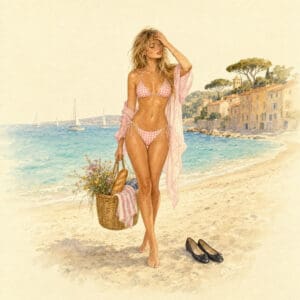
Saint-Tropez, 1956. The look that started “Bardolatry”: gingham bikini, gold ankle chain, wicker basket, ballet flats kicked off at the water’s edge. Within five years every American teenager wanted to live in this photograph.
Part OneThe Ballerina Who Wouldn’t Stand Still
She was raised in the 16th arrondissement on Bach and barre exercises. By twenty-two she was banned by the Vatican, declared an “atomic threat” by André Maurois, and credited by Simone de Beauvoir with the invention of modern femininity.
rigitte Anne-Marie Bardot was born on 28 September 1934 in Paris, into the kind of upper-bourgeois family that summered in Brittany and dressed for dinner. Her father, Louis “Pilou” Bardot, ran an industrial liquid-air business inherited from his own father. Her mother, Anne-Marie “Toty” Mucel, was a former Parisian beauty queen who had wanted to be a dancer and could not — and was determined her daughters would. Brigitte was enrolled at the Conservatoire de Paris at age seven. She studied under Boris Knyazev, the émigré Russian who taught half a generation of French ballerinas, and at thirteen was good enough to audition for the company. The audition went well. Her mother took her out anyway. “She is too pretty for the corps,” Toty told the director. “She will be soloist or nothing.”
She was neither — yet. At fifteen she was photographed in a tartan-checked headscarf by a friend of her mother’s, who showed the picture to Hélène Lazareff, the editor of Elle. Lazareff put her on the cover on 8 May 1950. The cover came with a caption — “Mademoiselle B.B.” — because Toty Bardot refused to let her daughter’s name be published. The initials stuck. They became, eventually, a brand worth more than most studios.
The Elle cover was seen by a 22-year-old assistant director at Marc Allégret’s studio named Roger Vadim Plemiannikov. He showed it to Allégret, who summoned the girl for a screen test. The test went badly. The girl was painfully shy, mumbled her lines, and cried in the dressing room afterwards. Allégret passed. Vadim did not. He began turning up at the Bardots’ Paris apartment uninvited. Pilou Bardot threw him out. He came back. Pilou threw him out again. Vadim moved into the building across the street, where his bedroom window looked directly into Brigitte’s. After three years of this — three years during which she was forbidden to see him, three years during which she lost forty pounds in protest and was twice hospitalised — Pilou relented. Brigitte and Vadim married on 21 December 1952 at the mairie of the 16th. She was eighteen. He was twenty-four.
Four years later, on 28 November 1956, Vadim’s first film as a director opened in Paris. It was called Et Dieu… créa la femme. The world’s idea of what a woman could be in a movie — and what she could wear in one, and what she could do barefoot in the sand at the end of one — was never quite the same again.
Bardot is a locomotive of women’s history.— Simone de Beauvoir, Esquire, 1959
✦ ✦ ✦
Part TwoTwelve Things You Didn’t Know About Brigitte
A trained ballerina who choreographed her own dance scenes; a paparazzi-creating bombshell who hated being photographed; a sex symbol who quit cinema for cats.
She failed her first screen test.
She mumbled, fidgeted, cried in the bathroom, and the casting director told Roger Vadim she had “no future whatsoever.” Vadim married her three years later anyway.
She made Saint-Tropez famous.
In 1957, when she bought La Madrague, the fishing village had 1,200 residents and one bakery. By 1965 it had 20 nightclubs, 30 boutiques and a paparazzi colony. Today it has roughly the same tourist economy as Monaco — and it is hers.
Her ballet flats are the best-selling French shoe of all time.
She asked Rose Repetto in 1956 to adapt a stage ballet shoe for street wear. The result — the Cendrillon — has sold more than 2 million pairs worldwide and is still made by hand in Saint-Médard d’Excideuil.
Her wedding dress was a pink-checked mini.
For her second wedding, to Jacques Charrier in 1959, she rang the unknown designer Jacques Esterel six days before and asked for “something short, pink, and in gingham.” He delivered. Gingham went from peasant fabric to high fashion overnight.
She married four times.
Vadim (1952–57), Charrier (1959–62), the German playboy-industrialist Gunter Sachs (1966–69), and the right-wing politician Bernard d’Ormale (1992 onwards). She also gave birth, exactly once, to a son she never bonded with — Nicolas-Jacques Charrier, born 11 January 1960. He was raised by his paternal grandparents.
She recorded 24 studio albums.
Her duet with Serge Gainsbourg, “Bonnie and Clyde” (1968), was a French No. 1. The original recording of “Je t’aime… moi non plus” — featuring Brigitte, not Jane Birkin — was made for her in 1967 but never released at her request: Gunter Sachs threatened to leave her if she put it out.
She turned down 47 American film offers.
Hollywood courted her for every role Marilyn Monroe ever played. She said no to all of them — including Sue Lyon’s role in Lolita, Suzanne Pleshette’s in The Birds, and Cyd Charisse’s in Brigadoon. She did not want to leave France.
She tried to kill herself on her 26th birthday.
On 28 September 1960, exhausted by paparazzi siege and the breakdown of her marriage to Charrier, she swallowed sleeping pills and slashed her wrists at her farmhouse. A gardener found her. She survived. She never publicly discussed it until her 1996 memoir.
She quit cinema at thirty-nine.
Her last film, L’Histoire très bonne et très joyeuse de Colinot trousse-chemise, was released on 26 September 1973. She gave a press conference the next day, said “Je veux finir avec ça” — “I want to be finished with that” — walked out, and never made another film. She was at the peak of her box-office power.
She has saved more animals than any actress alive.
The Fondation Brigitte Bardot, established in 1986 with $1 million from selling her jewellery, now operates in 80 countries, has rescued 70,000 animals, and lobbies for the EU’s strictest animal-welfare regulations. She funded it personally for thirty years.
She was painted by Picasso, Warhol and Lichtenstein.
Andy Warhol’s Brigitte Bardot (1974) sold for $4.9 million at Christie’s in 2024. Roy Lichtenstein’s 1965 lithograph hangs in MoMA. Picasso made twelve sketches of her in 1956 — she sat for him in Cannes — though she never owned any of them.
She refused the Légion d’honneur three times.
Mitterrand offered it in 1985, Chirac in 1995, Sarkozy in 2008. She said no to all three on the grounds that “France gives medals to people who shoot the bulls and ignores the people who save them.”
✦ ✦ ✦
Part ThreeThe Three Looks That Built “French Girl”
She never had a couturier on retainer. She walked into shops, sat on the floor — she famously detested chairs — and pointed at things. The things she pointed at became, by the end of the decade, the entire wardrobe of Western femininity.
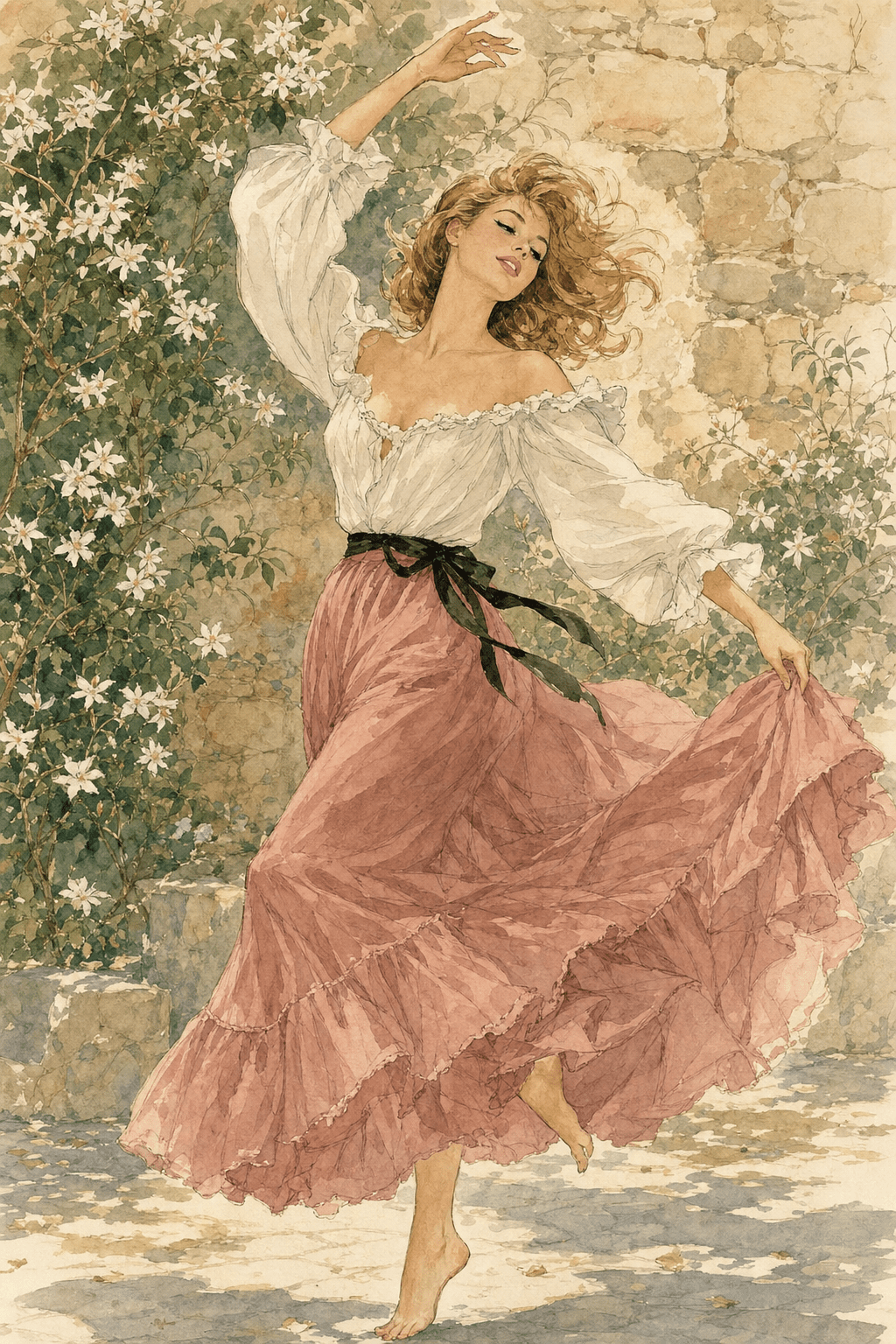
The Bardot Neckline, 1956. The white off-the-shoulder peasant blouse pulled from a Saint-Tropez market for Et Dieu… créa la femme. By 1958 every fashion house in Paris had its own version. Azzedine Alaïa, Yves Saint Laurent and — six decades later — Jacquemus all built collections around the silhouette. Vogue still calls a bare-shoulder neckline a “Bardot.”
The film’s wardrobe was, by 1956 studio standards, almost insultingly modest. Vadim and Pierre Balmain had a budget of 40,000 francs — roughly $2,000 in today’s money — for the entire production. They spent half of it on the gowns Bardot wears for the wedding sequence and the cabaret scene. The rest they spent at the market in Place des Lices, buying peasant skirts, espadrilles, gingham aprons and half a dozen loose white blouses from the local Provençal seamstresses. They paid in cash and didn’t keep receipts.
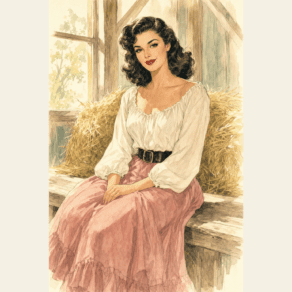
The blouse that defined the film — and, eventually, a neckline — was bought for the equivalent of $4. It was a generic cotton smock with elasticised neckline and ruffled puff sleeves, of the kind sold at every village market between Marseille and Nice. Bardot wore it for the famous mambo scene at the end of the film, the one where she dances barefoot on a table while three men watch in helpless silence. The way she wore it — pulled down to bare both shoulders, tied at the waist with a length of black ribbon — was her own. By 1958 it was in every couture collection in Paris. By 1962 it was in the Sears catalogue. The neckline still bears her name in every fashion textbook printed since 1965.
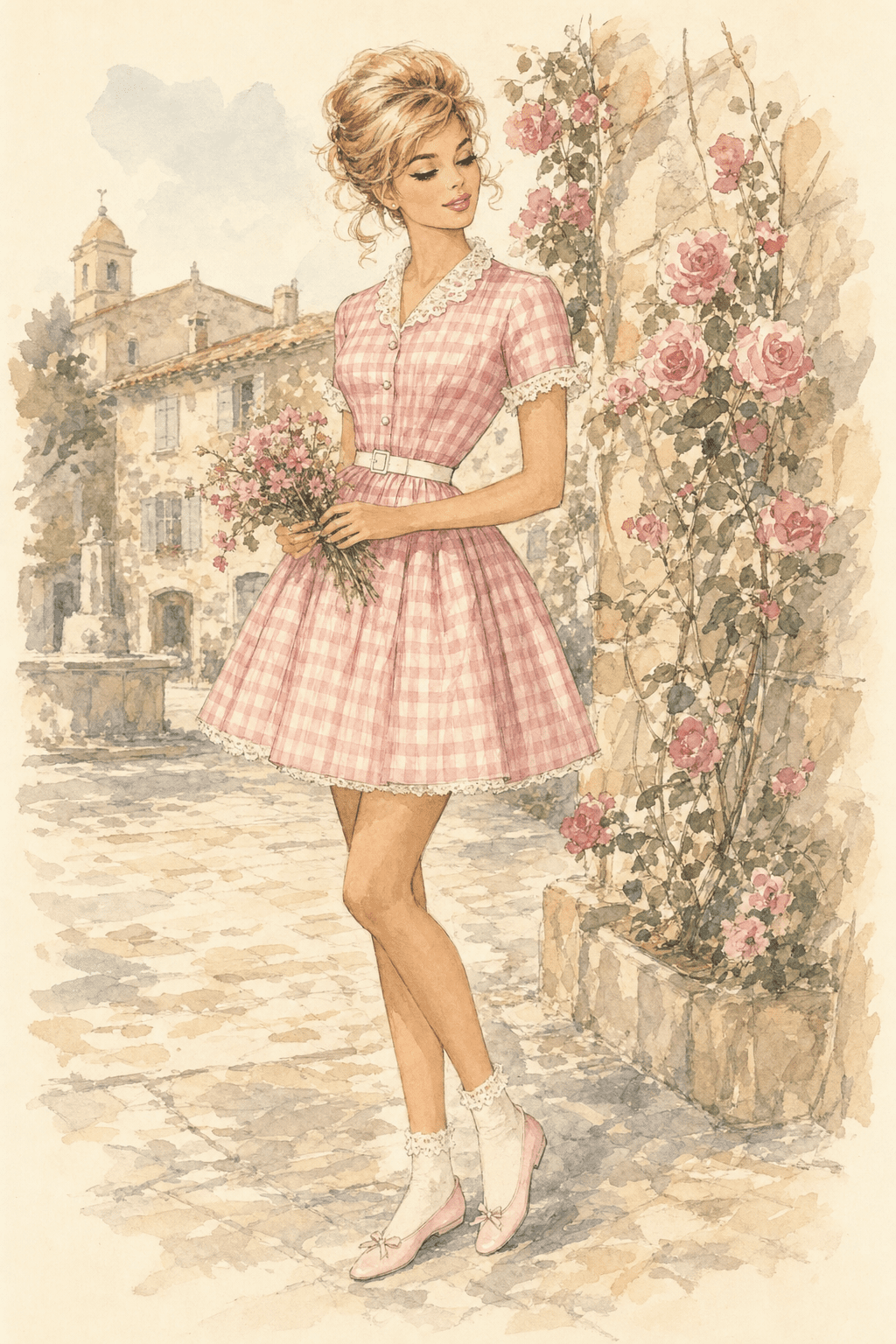
The Pink Gingham Wedding Dress, 1959. Designed in six days by the unknown Jacques Esterel for Bardot’s marriage to Jacques Charrier on 18 June 1959 at Louveciennes. Vichy check, lace trim, slim grosgrain belt, ballet flats. Esterel became famous overnight. Gingham — until then a peasant or apron fabric — became a couture material.
Jacques Esterel was, in early 1959, a 41-year-old former machinist who had opened a couture house on Rue de la Boétie eighteen months earlier. He was on the verge of bankruptcy. Bardot rang him on 12 June and asked if he could make her a wedding dress in six days. She wanted, she said, “something short, in pink Vichy, for under the sun.” Esterel improvised. He cut a slim, knee-length shirtwaist in pink-and-white gingham, trimmed the collar and cuffs with broderie anglaise, added three small mother-of-pearl buttons, and finished with a 1-inch white grosgrain belt. The whole dress cost 800 francs to make. Bardot wore it with white lace ankle socks and pale-pink Repetto Cendrillons.
The wedding was a scrum. Two hundred paparazzi tried to storm the mairie. The photographs of her in the gingham dress — pink, summery, almost laughably innocent for a woman the Catholic Church had condemned three years earlier — were front-page news from Tokyo to Tucson. Esterel’s order book filled within a week. Gingham went from peasant fabric to fashion textile in roughly seventy-two hours, and stayed there.
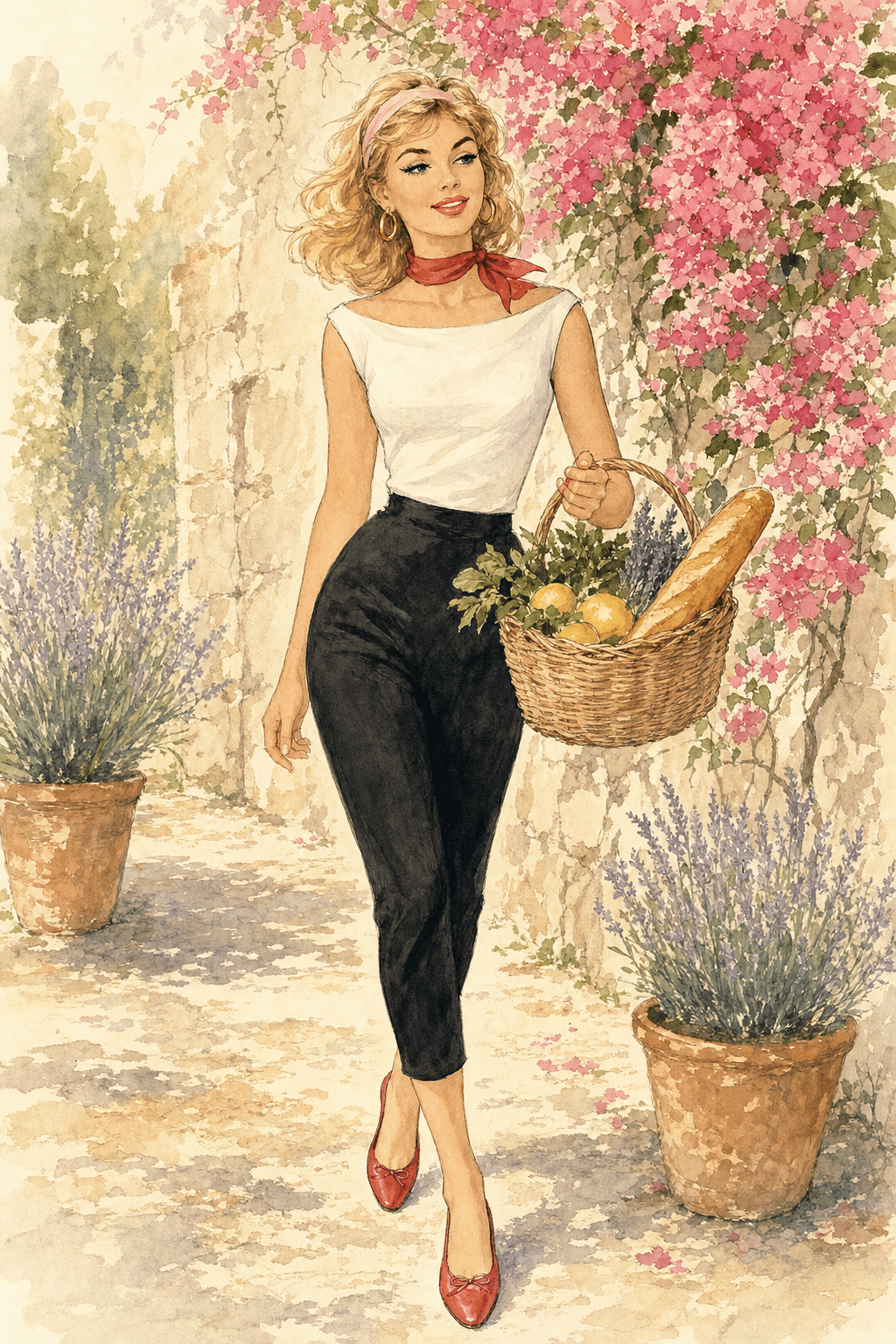
The Uniform, 1957. Black capri pants, white boat-neck top, red silk scarf at the neck, gold hoops, Repetto Cendrillon ballet flats, wicker basket. The everyday Bardot off-set in Saint-Tropez — and the template, line for line, of what “effortless French chic” has meant ever since. Karl Lagerfeld called it “the only uniform that ever worked twice.”
The Cendrillon
Repetto · 1956 · Rose Repetto
Adapted from a stage ballet shoe at Bardot’s request — she found the cobblestones of Saint-Tropez impossible in heels. Soft leather, stitch-and-return construction, drawstring at the heel, no internal lining. Two million pairs and counting. Still handmade in France.
The Choucroute
Self-styled · 1959
The piled, slightly tousled, back-combed updo Bardot improvised herself for the Charrier wedding — French for “sauerkraut,” and a sly self-mockery of how messy it really was. It became the precursor to every beehive of the 1960s, including Audrey Hepburn’s Breakfast at Tiffany’s tower.
✦ ✦ ✦
Part FourHow She Built the Bardot Look
She was, of every screen icon of the 1950s, the only one who looked like the woman she was — not the woman the studio invented.
The Hair
Honey-blonde, tousled, often unwashed, never set in tight curls. She refused the lacquered helmets of her contemporaries. She slept on her hair, ran her hands through it, and let the sea air do most of the work. The choucroute — the soft, piled, slightly chaotic updo — was something she did to herself in fifteen minutes with hairpins she stole from her mother. Every salon in France copied it; no salon in France could quite get it right.
The Face
The black-rimmed cat’s-eye, drawn with kohl rather than liquid liner — softer, more smudged, more bedroom than boardroom. Pale natural lips most days, blood-red only for evening, never the matte deep red of Russell or Monroe. A faint dusting of freckles she refused to cover. Her eyebrows, naturally thick, were left as nature drew them — a small rebellion in an era when every actress plucked hers down to a comma.
The Body
She was 5′7″ and 117 pounds. She lived on cigarettes, oysters, white wine and almonds. She refused to diet for any film. The first nude scene in mainstream cinema — her opening shot in Et Dieu… créa la femme — was filmed without her makeup artist on set, because, as she put it, “if they want a body, they can have my body. They can’t have it pretending.”
The Voice
A husky, slightly breathy alto with a faint provincial intonation — the diction of a bourgeois Parisian who has lived in Saint-Tropez long enough to slow down her vowels. She spoke softly even when furious. She sang her own songs in three octaves of register. She gave precisely four interviews in English during her entire career, all of them brief, all of them ending the same way: with her looking at the camera and saying, “I think we are finished now.”
✦ ✦ ✦
Part FiveThe Brigitte Bardot Timeline
✦ ✦ ✦
Part SixHow Brigitte Bardot Changed the World
She did not change cinema. She changed what a woman was allowed to be inside it — and the trail she left ran far past the cinema doors.
She invented “effortless French chic.”
Before Bardot, “French elegance” meant Dior couture: corseted, painstaking, expensive, inaccessible. Bardot replaced it overnight with capri pants, a boat-neck T-shirt, a silk scarf and ballet flats. Every “French girl” Pinterest board ever made is still inside her closet at La Madrague.
She made the bikini commercially viable.
Louis Réard’s 1946 design had existed for ten years and sold almost nothing — banned in Italy, Spain, Portugal, Belgium, and on most American beaches. Bardot wore one on the beach at Cannes in 1953 and was photographed by Henri Cartier-Bresson. Within five years global sales had multiplied a hundredfold. The bikini became, after Bardot, the dominant women’s swimwear of the West.
She put gingham in haute couture.
Vichy check had been a peasant fabric since the 18th century. After her 1959 wedding it became a luxury textile, used by every major house from Chanel to Prada. It has never left the runways since.
She rescued the ballet flat.
Repetto sold fewer than 50 pairs of Cendrillons in 1955. After Et Dieu… créa la femme, the same shoe sold 2,000 pairs in 1957, 12,000 in 1959, and is the company’s all-time best-seller seventy years later. Tory Burch, Chanel, Lanvin and Dior all subsequently built ballet-flat lines that exist only because Bardot wore one to walk to the bakery.
She made Saint-Tropez Saint-Tropez.
When she arrived in 1956, the village had 1,200 residents and no hotel. Today it has €40 billion of annual luxury tourism. Bernard Arnault, François Pinault and Dolce & Gabbana all own properties within walking distance of La Madrague. The entire Côte d’Azur luxury economy is, in part, a city she built by being photographed in a bikini.
She gave women permission to quit.
When she walked away from cinema at thirty-nine — at the peak of her box-office power, with offers from every studio on earth — she became the most famous woman in history to refuse her own myth. Greta Garbo had retired; Bardot resigned. The difference mattered. Generations of women, from Sade to Robyn to Rihanna, have taken her exit strategy as a template.
She built the most powerful animal-welfare organisation in Europe.
The Fondation Brigitte Bardot has, since 1986, lobbied for the EU’s strictest rules on intensive farming, fur, foie gras, vivisection and ritual slaughter. France’s national law against the slaughter of pregnant mares (2007) bears her informal name. Her foundation now rescues, on average, 5,000 animals per year.
She made femininity younger.
Before Bardot, the French ideal of feminine beauty was a thirty-five-year-old femme du monde. After Bardot, it was a twenty-two-year-old in a peasant blouse with damp hair. The cultural age of “the beautiful French woman” dropped fifteen years in five seasons and has stayed there ever since. Whether this was a gift or a curse depends on who you ask.
✦ ✦ ✦
Coda
The Last Address in Saint-Tropez
La Madrague sits at the western tip of the bay, just past the Plage de la Bouillabaisse. A pale-yellow farmhouse, terracotta roof, eucalyptus trees, a path down to the rocks. She bought it in 1957 for 25,000 francs from a retired fisherman. The estate agent thought she was buying it as a film location and would resell it in a year. She lived there for the next sixty-eight years and, in the end, died there on 28 December 2025.
Inside the house, when journalists were occasionally allowed in for a 1990s photo essay, the rooms were small and bare. White walls. Cotton slipcovers on the sofas. A worn Provençal armoire. A pair of black ballet flats kicked off beside the kitchen door. Photographs of cats, dogs, donkeys, horses and one — exactly one — yellowing studio portrait of herself at twenty-two, leaning out of a window in a peasant blouse, the way she had wanted to live forever, before she found out how much that costs.
“I gave my beauty and my youth to men. I am going to give my wisdom and my experience to the animals.”— Brigitte Bardot, Paris Match, 2018
She did. The rest of us are still wearing her clothes.
✦ ✦ ✦
1950s Icons of Style & Cinema · No. 5 · Brigitte Bardot · Original watercolour illustrations in mid-century French portrait style · 2026



Leave a Comment