
1950s Designers & Couturiers · No. 7
Hubert de Givenchy
Le Grand Hubert — the six-foot-five Parisian aristocrat who invented modern elegance, gave Audrey Hepburn her silhouette, and turned a simple white blouse into the most graceful gesture in twentieth-century couture.
20 February 1927 — 10 March 2018
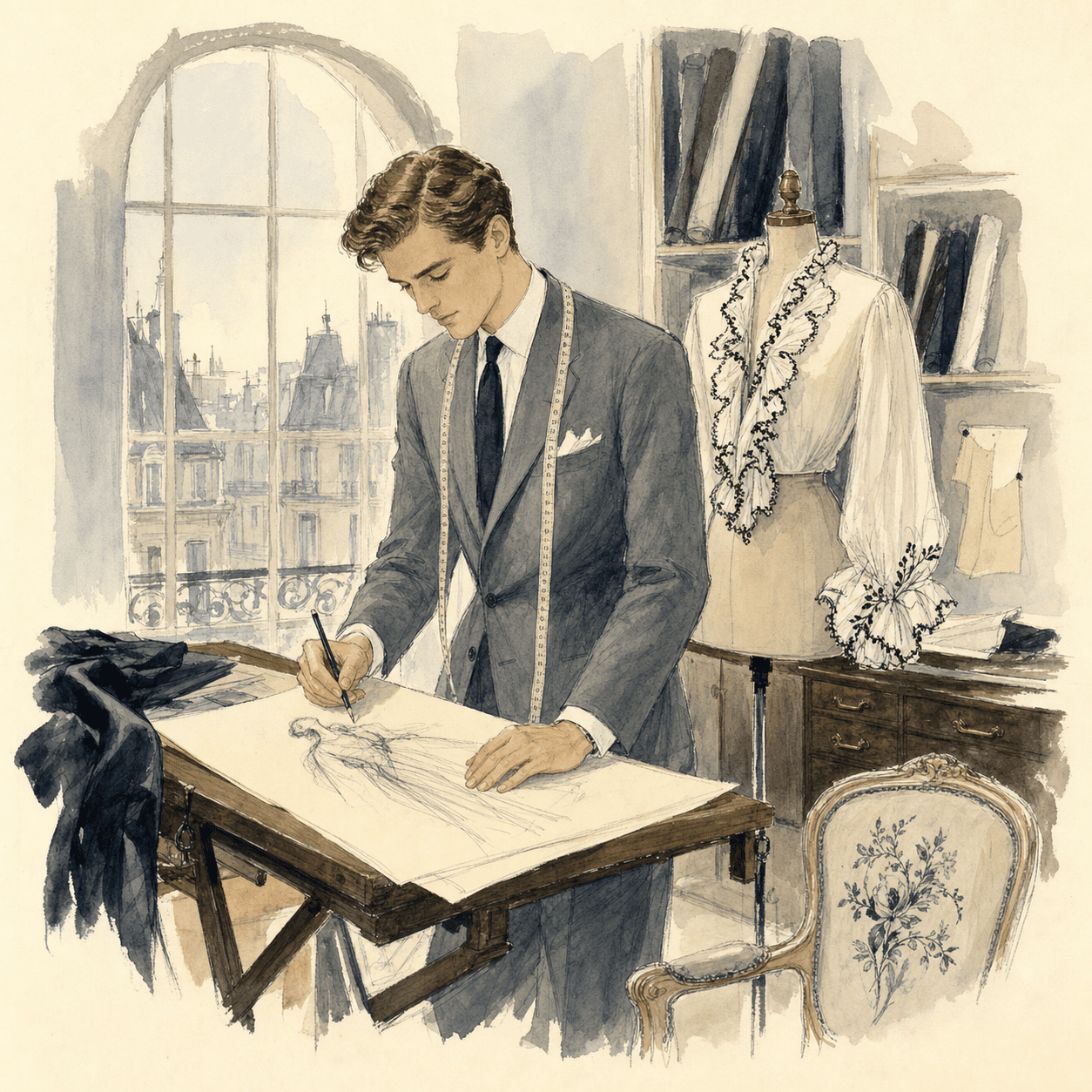
Plate I. The young couturier at his drafting table, Plaine Monceau, winter 1952 — the Bettina blouse already on its stand, the line for a future evening dress emerging in pencil. He was twenty-four.
Part I · The Tall Boy from BeauvaisThe Aristocrat Who Wanted to Sew
ubert James Marcel Taffin de Givenchy was born on 20 February 1927 in Beauvais, a quiet cathedral town an hour north of Paris, into a family of the old French nobility — his father was the Marquis de Givenchy. He grew to six feet five inches, a height that would later make him impossible to miss in any couture salon in Europe. The family pictured a lawyer; the boy wanted to draw dresses. He had decided, by his own account at the age of ten, that he was going to be a couturier — a wholly disreputable ambition for a young marquis in 1937, and one his mother and grandmother nonetheless quietly indulged, taking him to see the 1937 Paris Exposition where the fashion pavilion would change his life.
In 1944, at seventeen, he packed for Paris and enrolled at the École des Beaux-Arts. By the end of the war he had begun his apprenticeship — and what an apprenticeship it was. He sketched at Jacques Fath, then Robert Piguet, then Lucien Lelong (whose studio also employed two young men named Christian Dior and Pierre Balmain), and finally, from 1949, at the House of Schiaparelli, where the Italian-born surrealist Elsa Schiaparelli put him in charge of her boutique. By the age of twenty-four he had absorbed four of the most distinctive houses in Paris. He had also resolved, quietly, that he would never design like any of them.
On 2 February 1952, Hubert de Givenchy opened his own house at 8 rue Alfred de Vigny in the Plaine Monceau, a few weeks before his twenty-fifth birthday. He had almost no money. The textile industry was still rebuilding from the war and luxury fabrics were unaffordable, so he ordered bolts of plain white cotton shirting — the kind couture houses used only for muslin fittings — and built an entire debut collection from it. He called the show Les Séparables: a collection not of formal ensembles but of mix-and-match separates. A young marquis presenting cotton shirting blouses where his peers were showing brocade gowns was, in 1952, something close to scandalous. The fashion press understood it differently. Within a single afternoon the house had earned seven million francs in orders. The most ordered piece — a crisp white shirting blouse with deep flamenco sleeves and rows of black eyelet broderie ruffles at the cuff — was modelled by Bettina Graziani. The press christened it the Bettina blouse. It is still the most famous garment Givenchy ever made.
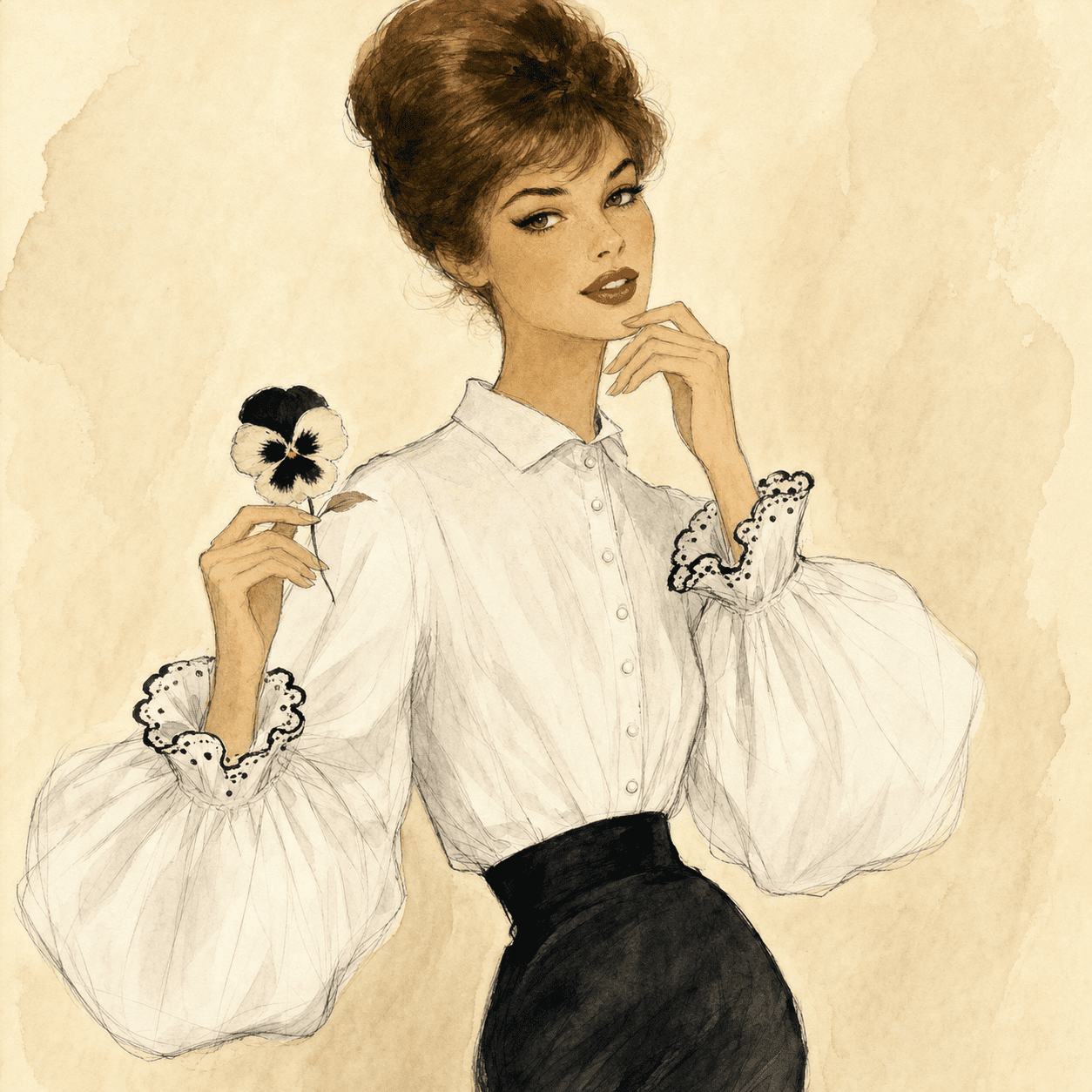
Plate II. The Bettina blouse, 2 February 1952. Plain white shirting, twin flamenco sleeves, three rows of black broderie eyelet at each cuff. Built from fabric meant for muslin toiles — and orders for seven million francs by sundown.
✦ ✦ ✦
Part II · Twelve Things You May Not Know About Le Grand HubertTwelve Fun Facts
Drawn from interviews, archive photographs, and the long memories of the women who wore him.
He thought Audrey Hepburn was Katharine Hepburn.
When his assistant told him in the summer of 1953 that “Miss Hepburn” was coming to discuss costumes for Sabrina, Givenchy assumed the great Katharine. A small, gamine girl in slim trousers, a knotted shirt, ballet flats, and a gondolier’s hat walked through his door instead. He was crestfallen — he was in the middle of his autumn collection — and told her she could borrow any sample she liked. She picked the dresses that would invent her on screen. They were friends, and clients, for the next forty years.
He stood 1.96 metres tall — six feet five inches.
“Le Grand Hubert,” Paris called him. Cristóbal Balenciaga, his hero and later his closest friend, called him simply mon petit.
His childhood favourite painter was Vermeer.
He spoke for the rest of his life about the quiet northern light in Vermeer’s interiors and tried to put that same dust-soft light into his fitting rooms, his vitrines, and his country house.
He launched the first ready-to-wear collection by a couture house in 1954
— long before Yves Saint Laurent’s Rive Gauche of 1966 — when he produced a small line of separates for the New York department store Lord & Taylor.
Audrey Hepburn was the face of the first celebrity perfume campaign in history.
In 1957, Givenchy created the fragrance L’Interdit exclusively for her. He intended it as a private gift; she insisted on advertising it. She is generally credited as the first film star ever to advertise a perfume — and the campaign rewrote how luxury marketing worked.
In 1957 he made one of the most radical silhouettes of the decade
— the so-called sack or chemise dress, a cocoon without a waist that the popular press hated and that, within five years, every designer was quietly copying. “I dreamed of a liberated woman,” he said, “who would no longer be swathed in fabric, armour-plated.”
Cristóbal Balenciaga moved across the street.
When Givenchy opened on the avenue George V, Balenciaga’s atelier was opposite. The Spaniard mentored him for fifteen years, and when Balenciaga closed his house in 1968 he sent his clients — Mona Bismarck, Bunny Mellon, the Duchess of Windsor — straight to Givenchy with a handwritten note.
Mona Bismarck wept for three days in her Capri palazzo
when Balenciaga retired, then put on a Givenchy and recovered. The story became couture legend; Givenchy retold it for the rest of his life.
His house models in the late 1970s were almost exclusively Black women.
Five Black American models walked the runway as the core of the Givenchy mannequin staff — an unheard-of statement in the white-walled world of Paris haute couture, made quietly, without manifesto, simply because (he said) they wore the clothes most beautifully.
Jacqueline Kennedy wore Givenchy at her husband’s funeral.
In November 1963, when the world watched the widowed First Lady walk behind President Kennedy’s caisson, the black veiled coat was his. So, in 1972, was the coat the Duchess of Windsor wore at the Duke’s funeral. Givenchy had become the couturier of state grief.
His weekday alarm clock was 7 a.m. in the studio.
He sketched, chose fabrics, and was in the cutting room before any of his ateliers arrived. He worked, by his own count, fourteen-hour days for forty-three years.
He retired to a moated stone manor.
When he sold the house to LVMH in 1988 and finally retired in 1995, he withdrew to the Manoir du Jonchet, a sixteenth-century moated château on the road to Tours filled with Chinese antiques, English silver, and quiet French light. He gardened there, in a panama hat, until ten days before his death in 2018.
✦ ✦ ✦
Part III · Three Designs That Built the HouseThe Sabrina, the Sack, the Bettina
Three garments, three turning points — and the geometry of postwar elegance.
1. The Sabrina Dress (1954)
For Audrey Hepburn’s title role in Billy Wilder’s Sabrina in 1954, Givenchy designed a knee-length black silk faille evening dress with a precisely horizontal bateau neckline — running straight across from shoulder tip to shoulder tip — tiny black silk bows knotted at each shoulder, a deeply nipped waist, and a full ballerina-cut skirt. There were no sleeves. There was no décolletage. It hid everything and showed everything; it took the New Look’s hourglass and made it a girl’s dress instead of a woman’s. The horizontal neckline became known internationally as the Sabrina neckline — a phrase still used in pattern books seventy years later.
The dress was costumed for an Academy Award-winning film, but the Oscar for Costume Design went to Edith Head, who designed Hepburn’s American wardrobe in the same picture. Hepburn was so distressed by the omission that she telephoned Givenchy in Paris to apologise, and from that day forward made the promise that would change his fortunes: every time I appear in a film, Givenchy dresses me. She kept it.
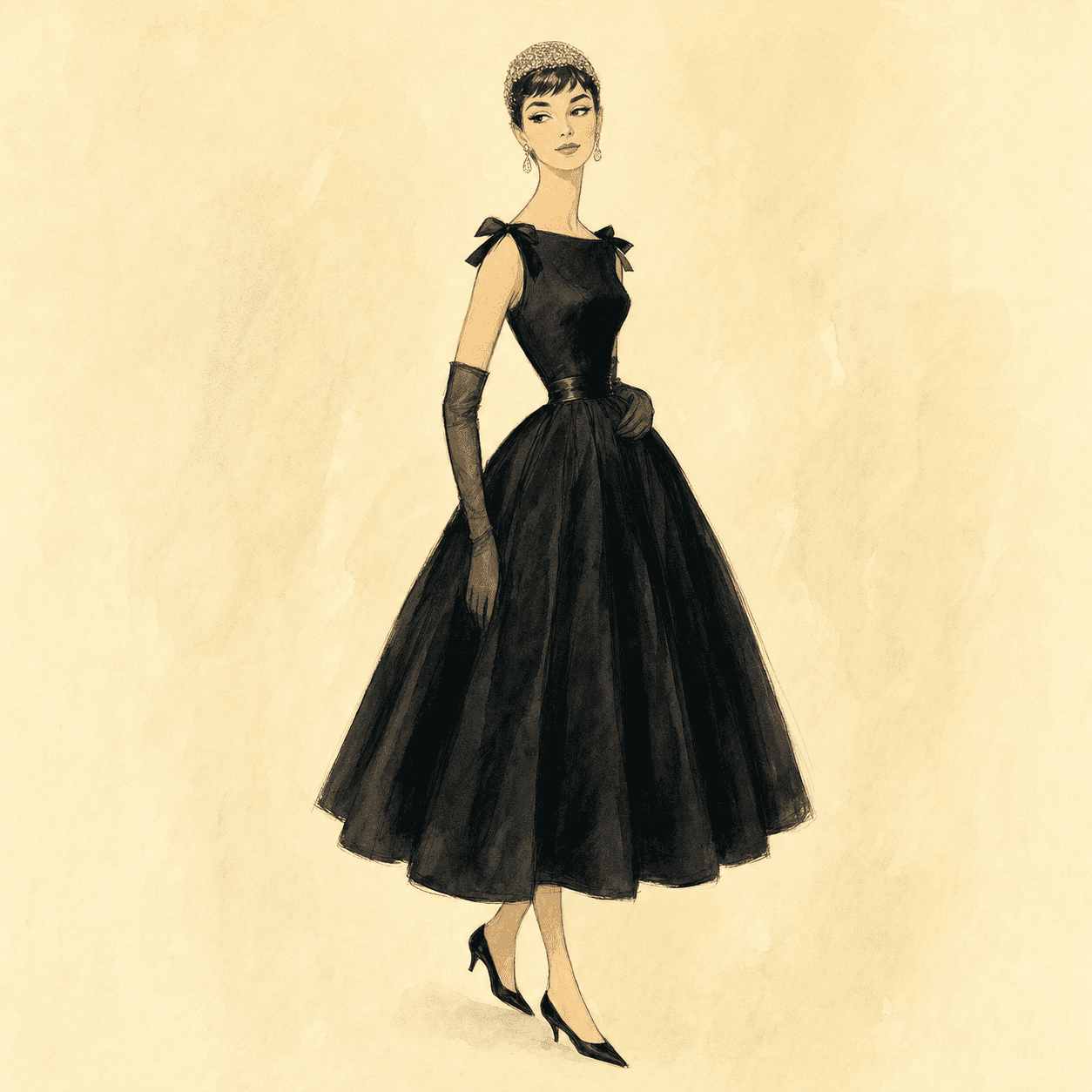
Plate III. The Sabrina dress, 1954. Bateau neckline, twin shoulder bows, ballerina skirt — the silhouette every cocktail dress in the late fifties was secretly trying to be.
2. The Sack / Cocoon Dress (1957)
By 1957, Dior’s New Look was ten years old and the fashion world was bored of corsets. Balenciaga and Givenchy, working independently across the avenue George V, both showed a radical chemise that autumn — a dress with no waist, no nipping, no foundation garments underneath. The torso was a sculpted cocoon; the hem narrowed inward just above the knee like an inverted tulip. American journalists hated it. Time called it “the year of the sack.” Husbands, the editorials said, were horrified.
And the women bought it. Within three seasons every couture house in Paris had a variant — the trapeze, the chemise, the shift — and by 1962 it had spawned the entire silhouette of the early sixties, including the Mary Quant mini and the Pierre Cardin trapeze. Givenchy had quietly built the bridge from the cinched 1950s to the loose-bodied 1960s, one cocoon at a time.
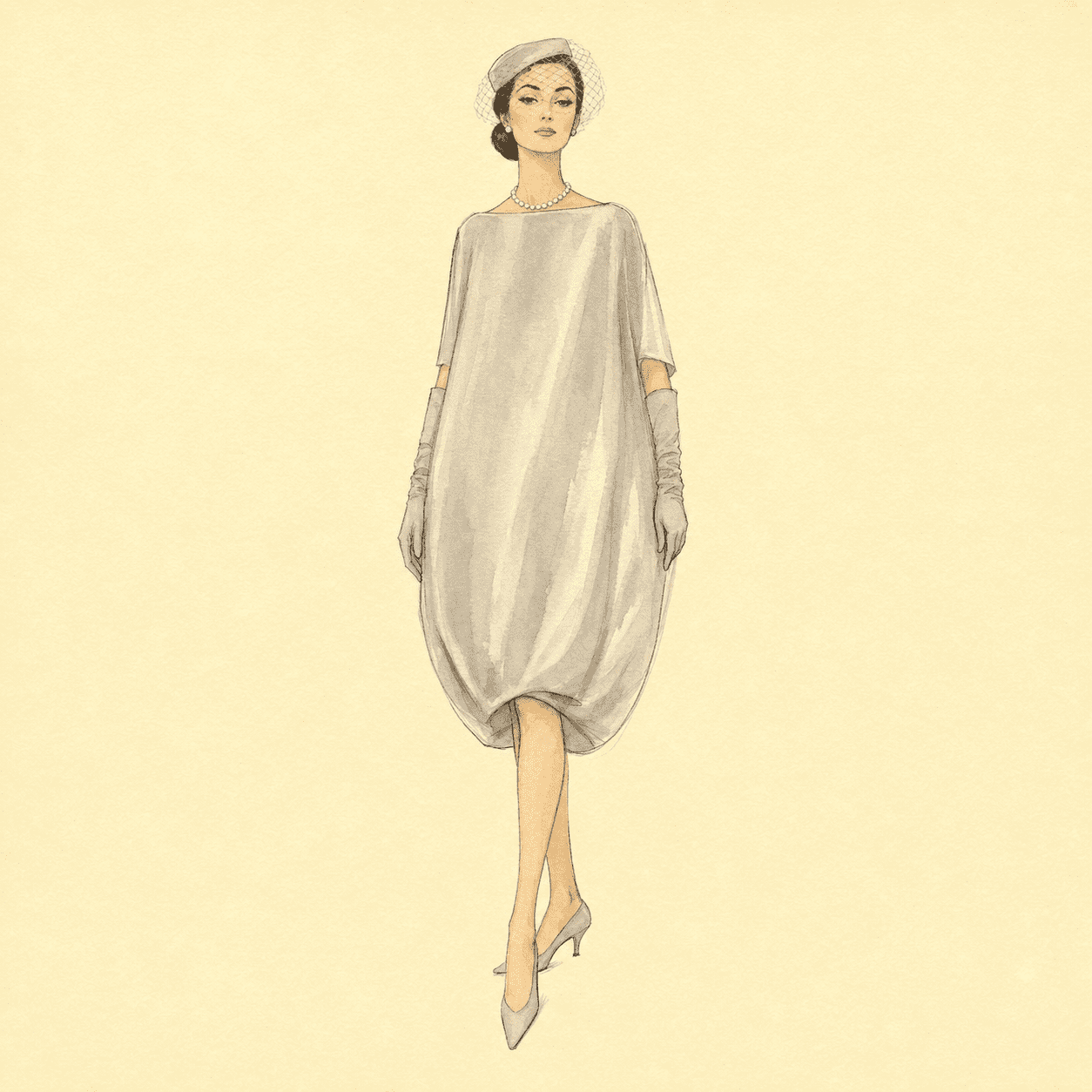
Plate IV. The sack dress, 1957. A cocoon of pale dove-grey silk shantung — no waist, no padding, no corseting — and a quiet revolution dressed up as a frock.
3. The Bettina Blouse (1952)
The first piece, and in many ways still the most consequential. By taking the cheapest fabric in the building — plain white cotton shirting — and elevating it through cut alone, Givenchy did something no couturier had ever attempted: he proved that elegance could be poor, that a blouse could be couture, and that separates belonged in the highest haute couture salons of Paris. The deep flamenco sleeves edged in three scalloped bands of black broderie eyelet were the only ornament, and they were everything. Half the working wardrobe of every chic Parisian woman from 1953 to 1962 traces its lineage to that one shirt.
L’Interdit
Perfume · 1957
Created for Audrey Hepburn and named for her teasing reply when he wanted to market it: je vous l’interdis — “I forbid you.” She relented. The campaign — the first time a film star endorsed a fragrance — changed luxury advertising forever.
The Black Dress at Tiffany’s
Cocktail Gown · 1961
The floor-length black satin column with the cut-out back, the pearls, the long gloves, and the tiara. Sold at auction in 2006 for over £450,000 — and codified the modern Little Black Dress for sixty years and counting.
Elegance is not the prerogative of those who have just escaped from adolescence — it is the privilege of those who have already taken possession of their future.— Hubert de Givenchy
✦ ✦ ✦
Part IV · How He Built the Givenchy LookThe Anatomy of Quiet Couture
Four design principles, drawn from sixty years of cutting.
Subtraction over decoration
Givenchy worked the way Balenciaga taught him — by what he removed. The Bettina blouse has only its sleeves. The Sabrina dress has only its neckline. The sack dress has only its shape. Where Christian Dior built ornament onto a structure and Cristóbal Balenciaga sculpted volume around a body, Givenchy stripped his garments down to a single perfect gesture and let the silhouette do the rest. He called this la ligne — the line.
The bateau neckline
His one true signature. A precise horizontal cut across the collarbone, sitting on the shoulder tip rather than the throat — a neckline that flattered every clavicle, lengthened every neck, and turned ordinary women into Hepburns. He used it on cocktail dresses, evening gowns, day dresses, sleepwear, even his ready-to-wear blouses. The Sabrina neckline is essentially his autograph.
Couture from the cheapest cloth
From the cotton shirting of the 1952 debut through to the unlined gazar evening capes of the 1970s, he made a discipline of dignifying ordinary fabrics. The cut is the luxury, he insisted. It was a quietly democratic idea inside the most undemocratic art in the world.
The client as muse, not as customer
Audrey Hepburn, Jackie Kennedy, Grace Kelly, Bunny Mellon, the Duchess of Windsor, Empress Farah Pahlavi, Gloria Guinness, Lauren Bacall, Elizabeth Taylor, Capucine, Marella Agnelli, Babe Paley — Givenchy did not simply dress these women. He answered their telephones at midnight, designed their funeral coats, attended their christenings, sketched the dress for their daughter’s wedding in pencil on the cardboard of a pastry box. He believed that couture was not a business but une amitié — a friendship made of cloth. Most of his great clients remained friends until they (or he) died.
✦ ✦ ✦
Part V · A Life in Eighteen DatesTimeline 1927–2018
✦ ✦ ✦
Part VI · How He Changed EverythingEight Specific Impacts
He invented the modern Little Black Dress.
Chanel created it in 1926; Givenchy perfected it. The floor-length black satin column from Breakfast at Tiffany’s is now the universal grammar of a woman’s evening wardrobe — sixty-five years and counting, and still the silhouette every designer eventually returns to.
He invented couture separates.
Before 1952, couture meant the full ensemble — top and bottom designed and sold as one piece. Givenchy proved that a single brilliant blouse could be a couture object, paving the way for everything from the mix-and-match wardrobe of the 1960s to the modern designer T-shirt.
He proved that elegance is subtraction.
Where Dior added, Givenchy took away. The minimalist couture lineage that runs through Halston, Calvin Klein, Jil Sander, Helmut Lang, Phoebe Philo at Céline, and The Row begins, in spirit, in the rue Alfred de Vigny in 1952.
He created the first celebrity perfume campaign.
L’Interdit with Audrey Hepburn (1957) is the direct ancestor of every star-fronted fragrance advertisement of the last seventy years — Catherine Deneuve for Chanel No. 5, Charlize Theron for Dior J’adore, Natalie Portman for Miss Dior, Rihanna for her own house.
He launched the first couture ready-to-wear.
The 1954 line for Lord & Taylor — a decade before Saint Laurent’s Rive Gauche — created the entire commercial template for the modern luxury house. Every diffusion line, every boutique floor, every “see now buy now” capsule lives downstream of that decision.
He cast Black women as the face of haute couture.
The five Black models who anchored his runway in the late 1970s — at a time when fashion magazines could go a whole year without a Black cover star — quietly redefined who couture was for, and made way for the Iman, Beverly Johnson, and Naomi Campbell generations that followed.
He turned the designer-muse relationship into a friendship.
The forty-year bond with Audrey Hepburn — letters, perfumes, christening gowns, hospital visits, funeral coats — wrote the playbook for every modern designer-muse partnership: Saint Laurent and Catherine Deneuve, Versace and Princess Diana, McQueen and Isabella Blow, Galliano and Stella Tennant.
He gave the twentieth century its language for grief.
The black coat Jacqueline Kennedy wore behind her husband’s caisson in November 1963, the coat the Duchess of Windsor wore at the Duke’s funeral in 1972, the dress in which Audrey Hepburn was buried in 1993 — three of the most-photographed mourning garments of the century were all his. He understood, perhaps better than any couturier ever has, that clothes are sometimes asked to do the hardest emotional work of a life.
✦ ✦ ✦
Coda
A House by a Moat
After he retired in 1995, Hubert de Givenchy spent the last twenty-three years of his life at the Manoir du Jonchet, a sixteenth-century stone manor surrounded by a still green moat on the road between Paris and Tours. He filled it with Coromandel screens, eighteenth-century French silver, Chinese ginger jars, and a single great library of fashion books. He gardened in a wide panama hat. He answered every letter by hand. His partner of sixty years, the couturier Philippe Venet, lived with him there. When Venet died in 2017, Givenchy was left alone with the gardens.
On the night of 10 March 2018 he died quietly in his sleep at the manor. He was ninety-one. The house of Givenchy — by then in the hands of a long succession of younger designers — sent a wreath of white lilies, the only flower he had ever allowed in his salon during a fitting.
Du calme, de la lumière, du tissu, et du temps.— Hubert de Givenchy · The secret of a beautiful dress
Calm. Light. Fabric. And time. He took all four with him.
✦ ✦ ✦
1950s Designers & Couturiers · No. 7 · Hubert de Givenchy · Original watercolour illustrations in mid-century Paris atelier style · 2026


Leave a Comment